
What Does the FOMC Actually Do? A Simple Explanation for Forex Traders
The Federal Open Market Committee (FOMC) is the group within the U.S. Federal Reserve that decides whether to raise, lower, or hold interest rates.
The FOMC is the Federal Reserve committee that sets U.S. monetary policy by deciding whether to raise, lower, or maintain interest rates. Because the U.S. dollar is the world's most traded currency, every FOMC meeting can affect forex prices, market volatility, and trader expectations. Understanding how the committee makes decisions and how markets react can help you interpret price moves instead of simply reacting to them.
Key Takeaways
- The FOMC is not one event. It releases a rate decision and statement at 2:00 PM ET, then the Chair holds a press conference at 2:30 PM ET, and four times a year it also publishes the dot plot. Each piece can move price on its own.
- The rate decision itself is rarely the surprise since markets price it in beforehand through Fed funds futures. The actual mover is usually the language in the statement and the tone of the press conference.
- Spreads widen and execution gets unpredictable around the announcement and press conference windows, separate from whatever direction price actually moves. A static stop loss can get triggered by spread widening alone.
- The dot plot shows where the 19 Fed officials individually think rates should go. It is not a vote or a promise, and the median dot shifting even slightly can move gold and the dollar within seconds of release.
- Gold and the dollar tend to move opposite each other around FOMC events, since gold pays no yield and becomes less attractive when interest-bearing dollar assets get more rewarding.
What Is the FOMC?
The Federal Open Market Committee is the part of the Federal Reserve that sets U.S. monetary policy. Specifically, it decides what to do with the federal funds rate, the interest rate banks charge each other for overnight loans. That single rate ripples out into mortgage rates, savings yields, corporate borrowing costs, and currency valuations across the entire global economy.
The committee has 12 voting members. That includes all seven members of the Federal Reserve's Board of Governors plus five of the twelve regional Federal Reserve Bank presidents, who rotate annually except for the New York Fed president, who always votes. All 19 Fed officials attend every meeting and contribute their economic projections, but only 12 actually cast a vote on policy.
The Fed Chair leads the committee and runs the press conference after each meeting. As of mid-2026, that's Kevin Warsh, who took over from Jerome Powell in May after his confirmation. His first meeting as chair was the June 16-17 session.
The Meeting Schedule
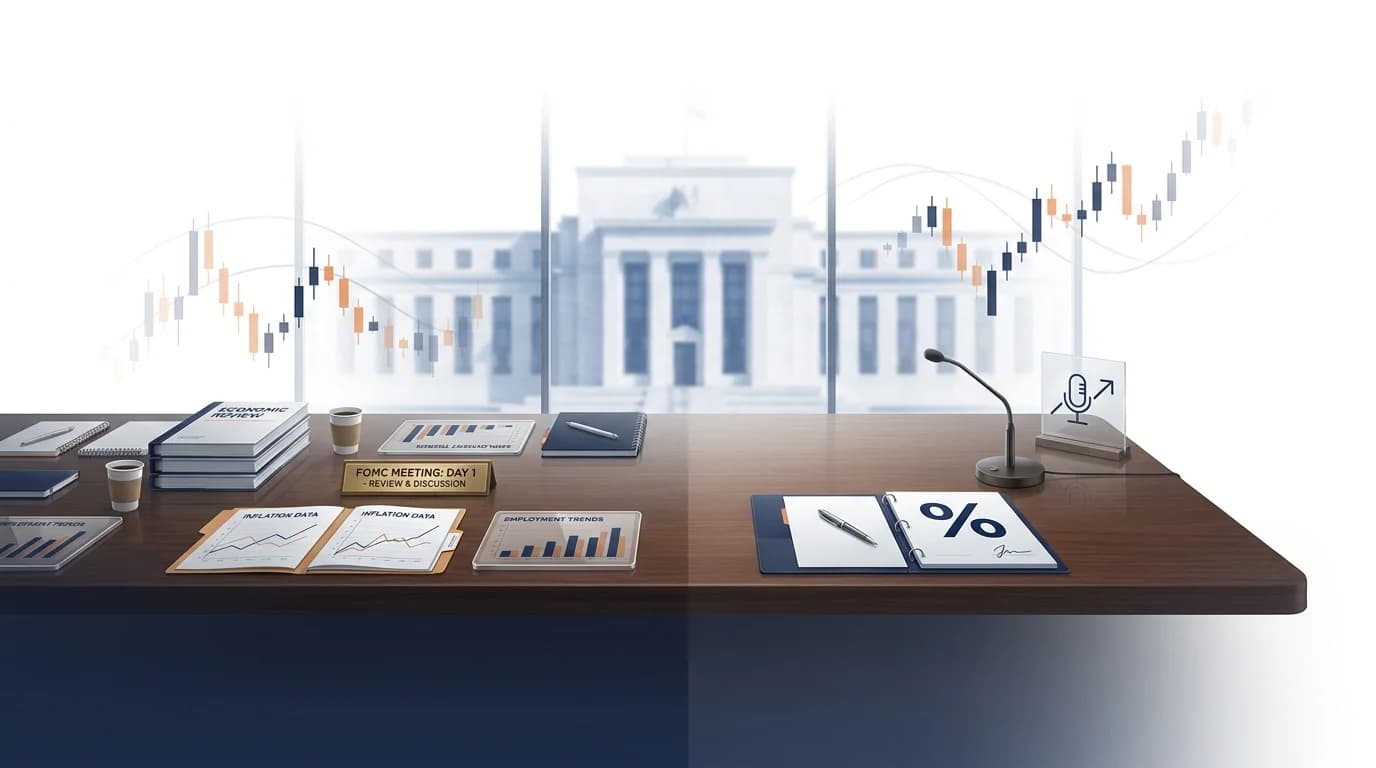
The FOMC meets eight times a year, roughly every six to eight weeks. Each meeting runs two days. Day one is internal: Fed staff present data on inflation, employment, consumer spending, and regional conditions, and committee members compare notes on what they are seeing in their districts. No votes happen on day one, and nothing gets announced. Day two is when the decision gets made, voted on, and released to the public at 2:00 PM Eastern Time, followed by the Chair's press conference thirty minutes later at 2:30 PM ET.
Four of the eight annual meetings, typically March, June, September, and December, include something called the Summary of Economic Projections, which is where the dot plot comes from. The other four meetings still produce a policy statement and a press conference, they just skip the quarterly forecasts.
If you want to watch the actual press conference live rather than rely on a recap, the Fed streams it directly at federalreserve.gov/live-broadcast.htm. No login, no paywall, just the raw feed straight from the source.
The Three Things That Actually Move Price
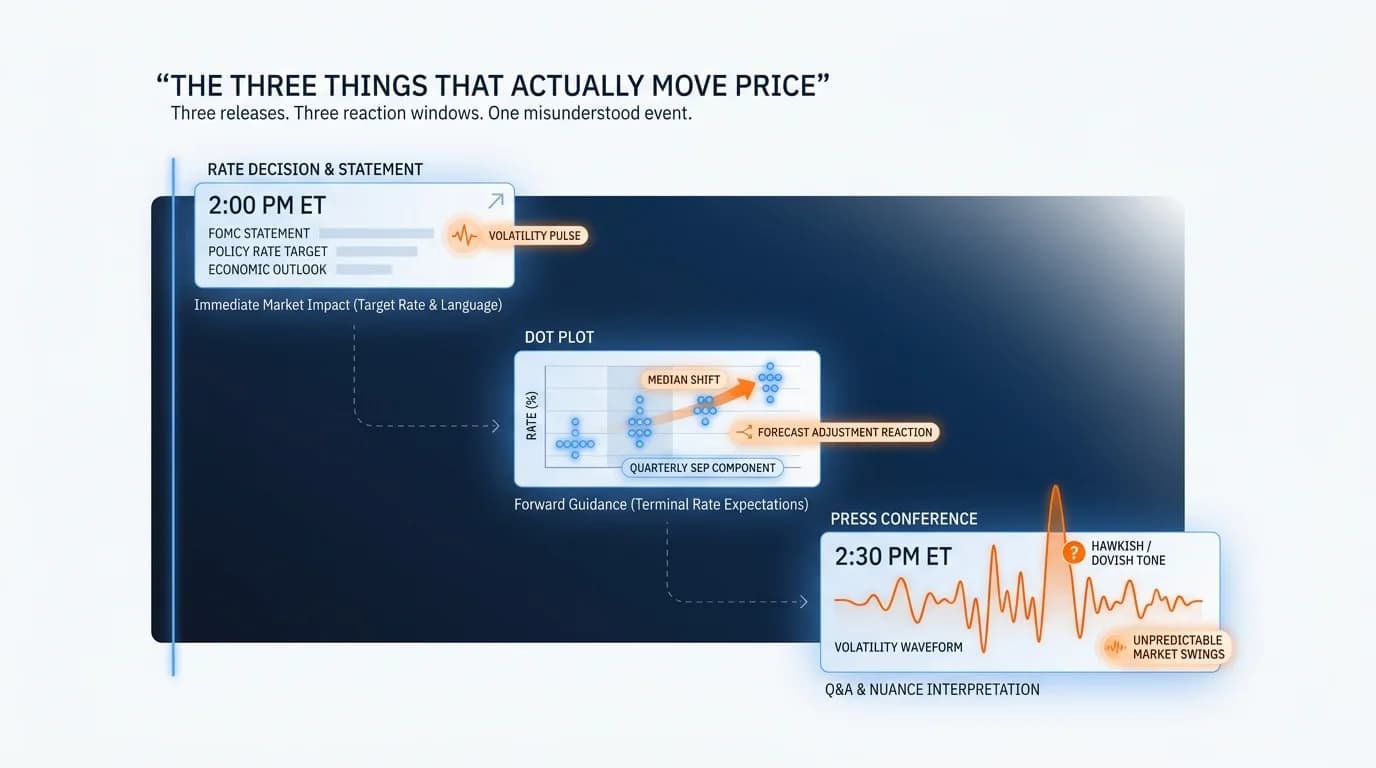
Treating the FOMC as a single headline is where most traders lose the thread. The meeting hands you three separate releases inside about thirty minutes, and each one can move price on its own, sometimes in opposite directions.
1. The Rate Decision and Statement
This drops at 2:00 PM ET. It tells you what the Fed did with the federal funds rate, whether they held, cut, or hiked. As of the June 2026 meeting, the target range sat at 3.50% to 3.75%, where it had remained since a cut in December 2025.
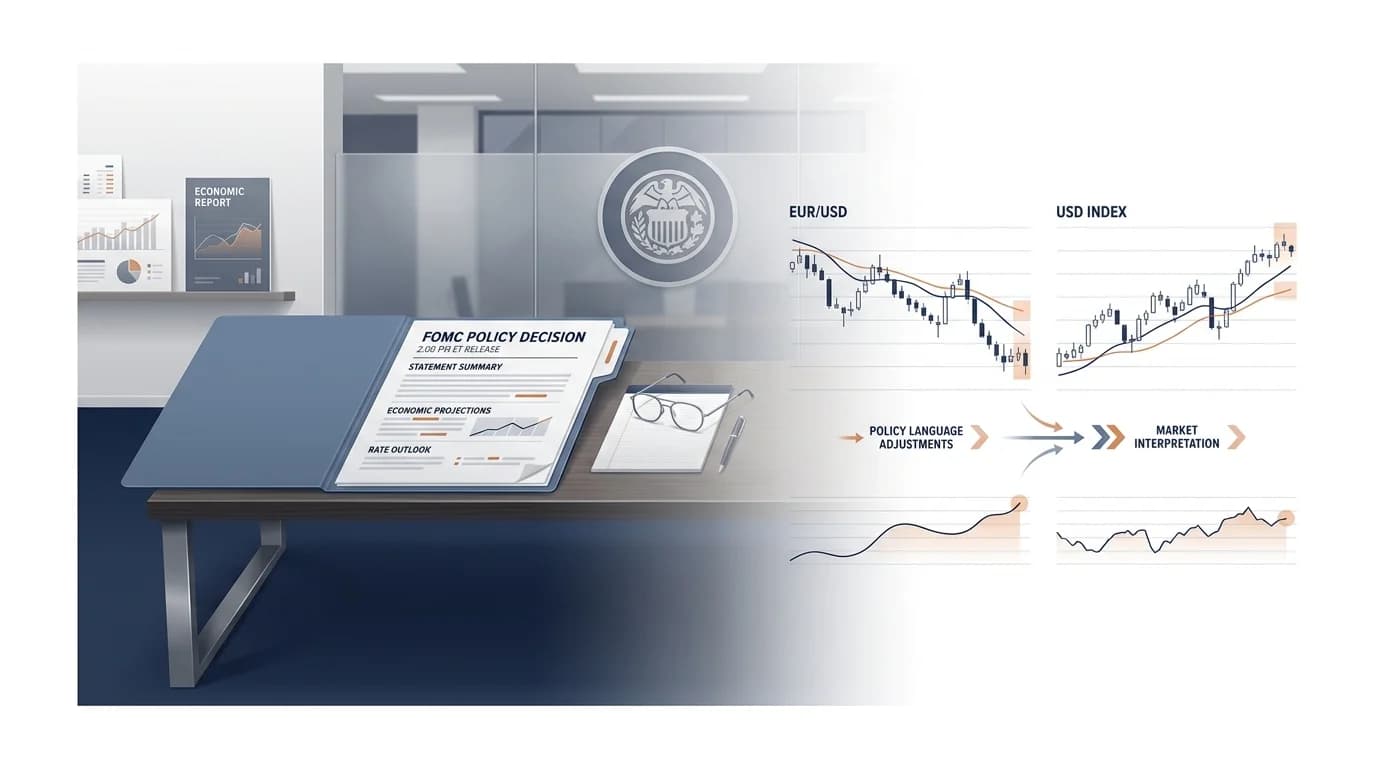
The number itself rarely surprises anyone. Fed funds futures price in the likely outcome weeks ahead, so a widely expected hold usually produces a small, contained reaction. What moves price is the wording. The Fed swaps a handful of words from one statement to the next, and traders pick those changes apart because they hint at where the committee is leaning. Swap "elevated" for "moderating" on inflation, or "patient" for "data-dependent," and gold can move more on that single wording change than it did on the rate decision itself.
2. The Dot Plot
This one only shows up at the four quarterly meetings, alongside the Summary of Economic Projections. Each of the 19 Fed officials anonymously places a dot showing where they think the federal funds rate should sit by year end, over the next two years, and longer term. It's not a vote. It's closer to a temperature check on what the room is thinking heading into the next few quarters.
What traders watch is the median dot and whether it shifted from the previous quarter. Nudge it up even slightly and the market reads "rates stay higher for longer than we thought," which can send gold and the dollar moving hard within seconds, often before the Chair has said a word publicly.
3. The Press Conference
This starts thirty minutes after the statement. The market gets a half hour to digest the written language before the Chair takes live questions from reporters actively trying to get him to say something the statement didn't.
I've personally lost money here twice, in two different ways. The first time, I was holding a SELL position on XAU/USD, 0.05 lots, 1:500 leverage, with a stop loss around $30 away and roughly 70 pips of room, heading into a scheduled press conference at 2:30 PM ET. At 2:29 PM ET the spread started widening. By 2:30 PM ET, when the conference actually started, it had widened enough to trigger my stop loss even though price hadn't naturally moved that far. I lost about $37. Gold then dropped straight past my original take profit target. My read on the market was right. The execution wasn't.
The second time wasn't even during a press conference. I had a $50 stop loss set on a gold trade during a normal New York session, no news hour involved, with a broker I'd used for over a year. The stop triggered, but instead of losing $50 I was debited $110. More than double what I'd risked. That's when I learned slippage on stop losses isn't an edge case brokers can wave away, it's a real cost that eats a strategy's edge at scale. I switched brokers not long after and tested execution quality with a small deposit before moving my full capital over.
Since then, I don't rely on a static stop loss during a live press conference. I manage positions manually during that window, because spread widening on its own, separate from where price actually goes, can stop you out on a trade you got right.
How the FOMC Actually Moves Forex
The forex market reacts to FOMC events through a few specific channels, and understanding which channel is firing helps you read the move instead of just reacting to it.
Interest rate differentials drive most of the longer-term currency reaction. Higher U.S. rates relative to other countries tend to attract capital into the dollar, since investors can earn more holding dollar-denominated assets. That pushes USD pairs in the dollar's favor and tends to weigh on gold, since gold pays no yield and becomes less attractive when safe interest-bearing alternatives get more rewarding.
Forward guidance, the language in the statement and the Chair's tone in the press conference, drives the shorter-term, sharper moves. Markets do not just price in what the Fed did. They price in what the Fed is signaling about what it will do next. A hold that comes with hawkish language about persistent inflation can move price more than an actual rate cut that comes with cautious, uncertain language.
Liquidity conditions shift dramatically around the announcement and press conference windows. Spreads widen, slippage increases, and execution becomes less predictable, regardless of which direction price ultimately goes. This is the part most educational content skips entirely, and it is the part that actually determines whether your analysis translates into a profitable trade or a frustrating one.
What I Actually Do on FOMC Days
This is not a signal or a specific trade recommendation. It is the process I follow, for educational purposes, based on what years of trading these events has taught me.
I check the economic calendar days in advance and know exactly when the statement drops and when the press conference starts. If you're not already tracking high-impact events this way, our guide to reading the Forex Factory calendar walks through how to use it, including what the red, yellow, and grey folders actually mean. I treat the statement and the press conference as separate risk events, not one. Going into the statement release, I either reduce position size or stay flat if I do not have strong conviction, because the initial reaction can reverse hard once the press conference starts.
During the press conference itself, I manage open positions manually rather than trusting a static stop loss to behave normally. If I am holding a position into that window, I watch it actively instead of walking away, because spread widening can trigger an exit that has nothing to do with where the market is actually heading.
I also wait for confirmation rather than chasing the first move. The first spike after a release is often a liquidity grab, not the real directional move. Patience before entering a post-FOMC trade matters more than speed.
The rule that changed my results the most was hard avoidance of high-impact news windows entirely, not just FOMC. Once I stopped taking discretionary entries during scheduled news events and stuck to TP2 exits only, I put together roughly two weeks of uninterrupted profitable trades, including a stretch of 10 consecutive winners at one trade a day on XAU/USD. The strategy hadn't changed. Removing myself from the news-window guesswork did.
A Quick Word on the Dollar Index and Why It Matters Here
If you trade XAU/USD specifically, the FOMC's effect on the U.S. Dollar Index is worth understanding even if you never trade the index directly. Gold is priced in dollars globally, so dollar strength and gold price tend to move opposite each other around these events. A more hawkish Fed than expected usually strengthens the dollar and pressures gold. A more dovish Fed flips that. It is not a perfect inverse relationship every time, but ignoring it means missing half the picture on FOMC days.
How to Watch FOMC Announcements Live
If you want to watch the meeting outcome unfold in real time rather than reading a recap after the fact, the Federal Reserve streams its press conferences directly and publicly. You can watch it here: federalreserve.gov/live-broadcast.htm
The statement itself releases at 2:00 PM ET on the second day of the meeting, with the press conference following at 2:30 PM ET. If you are trading from the MENA region, that translates to evening hours, so plan your screen time accordingly if you intend to watch or trade it live.
Three Events, Not One
The FOMC is not one event. It is three: a rate decision, a statement with carefully chosen language, and a live press conference, each capable of moving price independently and sometimes in opposite directions within the same hour. Most retail traders treat the whole thing as a single headline risk and either avoid it entirely or get caught holding a position through a window they did not fully understand.
You do not need to predict what the Fed will do to trade around these events successfully. You need to understand the mechanics well enough to know which window you are exposed to, and respect that execution quality during these windows matters as much as your analysis does. I learned that lesson with a $37 loss on a trade that was otherwise correct. It is a cheaper lesson to read about than to live through.
Conclusion
None of this requires predicting the Fed. It requires knowing the calendar, knowing the clock, and not confusing a spread spike with an actual market move while you're sitting on an open position. That distinction alone would have saved me $37 and a few gray hairs.
Whatever you trade around these events, gold, EUR/USD, the Dollar Index, the mechanics stay the same. The hard part isn't understanding what the Fed is going to do. It's respecting what happens to your execution while everyone else is trying to figure that out too.
FAQ
What does the FOMC do?
The FOMC, the Federal Open Market Committee, sets U.S. monetary policy. Specifically, it decides what to do with the federal funds rate, the rate banks charge each other for overnight loans, eight times a year. The decision lands at 2:00 PM ET on the second day of each meeting, and it's the single number that ends up moving mortgage rates, savings yields, and currency markets worldwide.
How does the FOMC affect forex?
Mostly through two channels. Interest rate differentials pull capital toward whichever currency pays more, so higher U.S. rates tend to strengthen the dollar. Then there's forward guidance, the actual wording in the statement and what the Chair says in the press conference, which often moves price more than the rate decision itself. Markets aren't just reacting to what the Fed did. They're reacting to what it implies about what comes next.
What's the dot plot, in plain terms?
It's not a vote and it's not a promise. Four times a year, each of the 19 Fed officials anonymously drops a dot on a chart showing where they personally think rates should sit by year end and beyond. Watch the median dot move even slightly and you'll usually see gold and the dollar react within seconds, often before the Chair has said a word.
Why does gold move so hard on FOMC days specifically?
Gold pays no yield, so it's competing directly against interest-bearing dollar assets. Higher-for-longer signals from the Fed tend to strengthen the dollar and pressure gold, and a more dovish read flips that. Add in the liquidity gaps and spread widening that hit during the announcement and press conference windows, and you get some of the sharpest reactions of any instrument I trade. I lost $37 to exactly that combination once, and it wasn't because my analysis was wrong.