
How to Start Forex Trading with Little Money (Without Blowing Your Account)
Most people asking this question are really asking something else: can I lose money I can't afford to lose? The answer is yes, and it happens constantly. Starting with little money is not the problem. Starting without a plan for how to use it is.
You can start forex trading with as little as $30 at some regulated brokers. The money is not the main obstacle.
What ends most small accounts is not the deposit size. It is position sizing that does not match the capital, no clear standard for when demo practice becomes live trading, and a broker that was never tested before real money went in.
Key Takeaways
- You can open a live forex account with as little as $30, but the deposit amount is less important than your position size. For accounts under $500, micro lots (0.01) are the only mathematically safe size. On most USD pairs, one pip at that size costs roughly $0.10.
- Never risk more than 1-2% of your account on a single trade. Three consecutive losses, which is normal at any win rate, will wipe a small account if each trade carries 10-20% exposure.
- Before going live, run a demo account using the exact same capital you plan to deposit, apply all your risk rules, and trade for two months. Go live only if you finish within 10% drawdown or better. "Feeling confident" is not a standard.
- When choosing a broker, ignore the minimum deposit figure. What matters is regulation, execution quality, and withdrawal speed. Make a small deposit, execute a few trades, withdraw.
- Small accounts grow when position size scales as a percentage of equity, not a fixed dollar amount. A 1:2 risk-to-reward ratio at a 50% win rate is profitable over time. The rules have to hold for that math to work.
How much money do you actually need to start forex trading?
You can open a live forex account with as little as $30 at some regulated brokers. Whether you should is a different question.
The minimum deposit at most brokers is low enough that it is not a real filter. The real constraint is lot size and what your account can withstand when a trade goes against you.
A $100 account is not unworkable. But your position size has to match it. If you deposit $100 and immediately trade the same size as someone with $5,000, your account will not survive a normal losing streak, regardless of how good your analysis is.
Start with whatever you can actually afford to lose while you are learning. The number matters less than the discipline applied to it.
What is a micro lot, and why does it matter for small accounts?
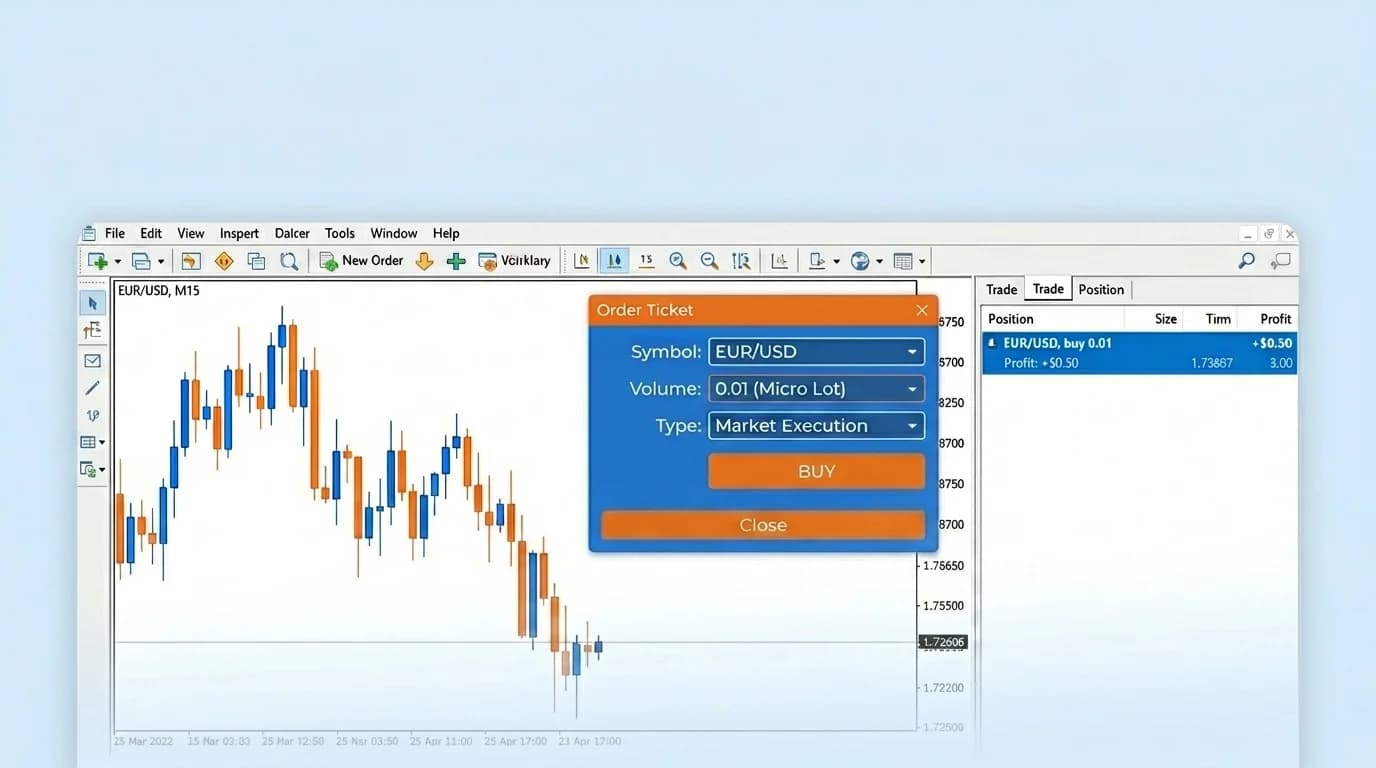
A micro lot is 1,000 units of the base currency, written as 0.01 in your trading platform. On most USD pairs, one pip on a micro lot is worth roughly $0.10.
For comparison, a standard lot (1.00) gives you $10 per pip. A mini lot (0.10) gives you $1 per pip. The difference sounds small until you are in a losing trade and watching each pip tick against you.
For accounts under $500, micro lots are the only mathematically safe position size. Trading anything larger means a normal 30 or 40-pip move against you can take out a significant chunk of capital before your stop loss even triggers. It is about keeping yourself in the game long enough to get good.
How do I calculate the right position size for a small account?
The formula is: Lot Size = (Account Balance x Risk %) / (Stop Loss in pips x pip value per lot).
Without this formula, you are trading blind. A $1,000 account, 1% risk, 50-pip stop loss means you open 0.02 lots. Not 0.1. Not 1.0. Exactly 0.02.
Here is what that looks like across account sizes, risking 1% per trade with a 40-pip stop loss:
| Account size | 1% risk | Max loss per trade | Lot size (approx.) |
|---|---|---|---|
| $100 | $1.00 | $1.00 | 0.01 (micro) |
| $300 | $3.00 | $3.00 | 0.01 (micro) |
| $500 | $5.00 | $5.00 | 0.01-0.02 (micro) |
| $1,000 | $10.00 | $10.00 | 0.02-0.03 (micro) |
The point of the table is not the exact numbers. At every account size, staying at 1-2% risk per trade means your lot sizes are small. That is correct and not something to fix.
Most retail traders fail not because they cannot find good setups, but because they risk 10%, 20%, or 30% of their account on a single trade. Three losing trades in a row, which is completely normal at any win rate, wipes them out before their edge has a chance to play out.
You can use eplanet's forex calculators to calculate your position size based on your account balance, stop loss distance, and risk percentage.
Why do most traders blow small accounts?
ESMA, the European Securities and Markets Authority, found that between 74% and 89% of retail CFD accounts lose money, with average losses ranging from €1,600 to €29,000 per client. The pattern is consistent across regulators in the UK, Australia, and elsewhere.
The cause is almost never the strategy. It is what happens when a trade goes against you and the decision-making stops being rational.
I watched this play out while working on the brokerage side. A trader came in with a $2,000 account, was trading the Dow Jones aggressively, and within three hours the account was at zero. He deposited another $2,000 immediately. He recovered about $300 before stopping. Net: down roughly $1,700. He went inactive for nearly a month, returned briefly, lost another $400, and quit.
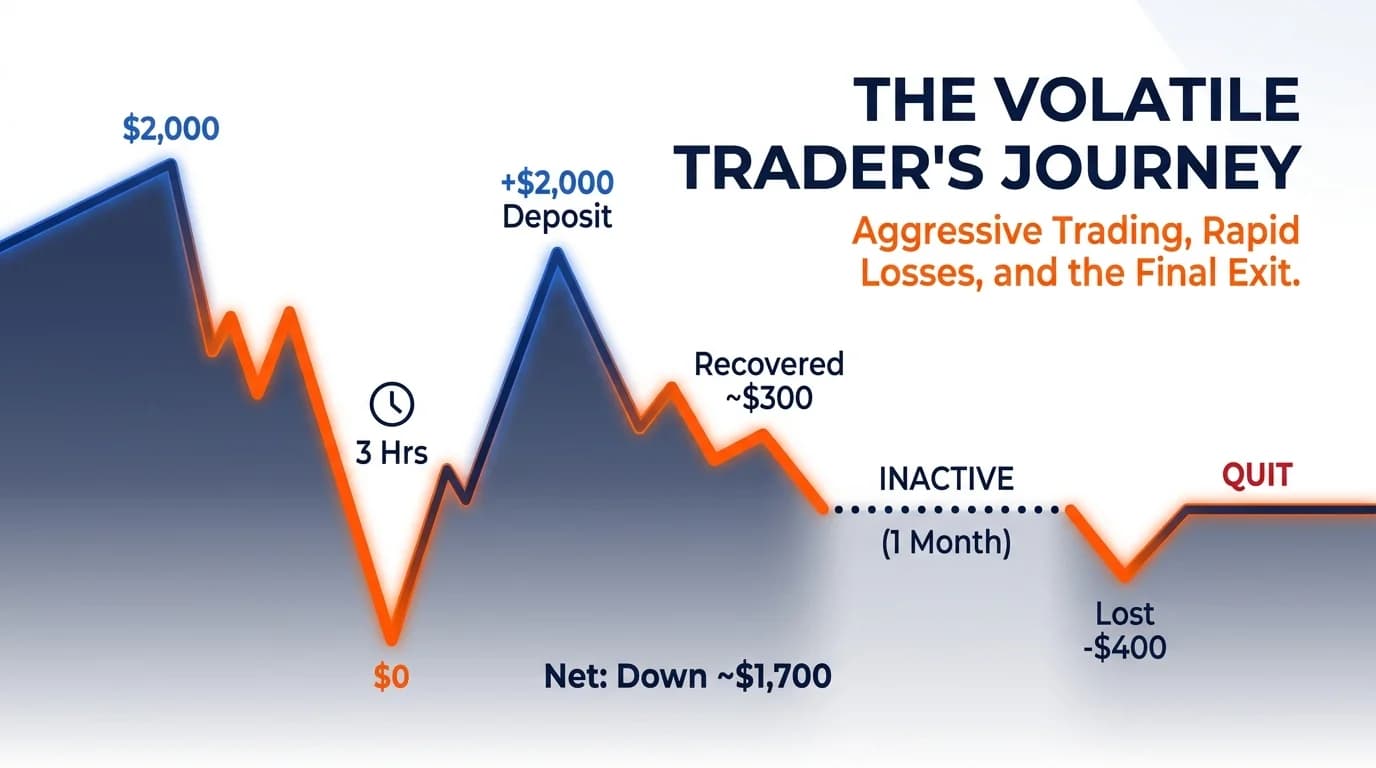
The money was his savings. That detail explains the decision-making. When the capital represents something you cannot replace, the pressure changes how you trade. You stop following your rules. You start trading your emotions.
Never trade with money you cannot afford to lose is not a disclaimer. It is a description of what actually happens when you do.
Should I start on a demo account or go live immediately?
Demo first, but with a specific protocol and not open-ended practice until "you feel ready."
Use forex demo account to build your trading plan and test your strategy before putting real money in. That is the right sequence. The missing part is knowing when demo becomes live.
Start your demo with the exact same amount you plan to deposit live. If you intend to fund a live account with $300, your demo starts at $300. You do not top it up when you lose. You treat every trade as if it is real money, apply your risk rules, and trade for a minimum of two months.
The benchmark: if after two months you are within 10% drawdown, at breakeven, or in profit, you are ready to go live. If not, reset and repeat.
"I feel confident" is not a standard. Two months of not blowing a $300 demo account while following real risk rules is.
What demo does not teach you is how you behave when the money is real. Your win rate on demo will almost certainly be higher than on a live account. That gap is not strategy failure. It is the psychological difference between simulated stakes and real ones. Build your system knowing the gap exists, and size your risk accordingly when you go live.
How do I choose a broker when I have little money?
The minimum deposit is the wrong filter. What you are actually evaluating is execution quality, regulation, and what happens when something goes wrong.
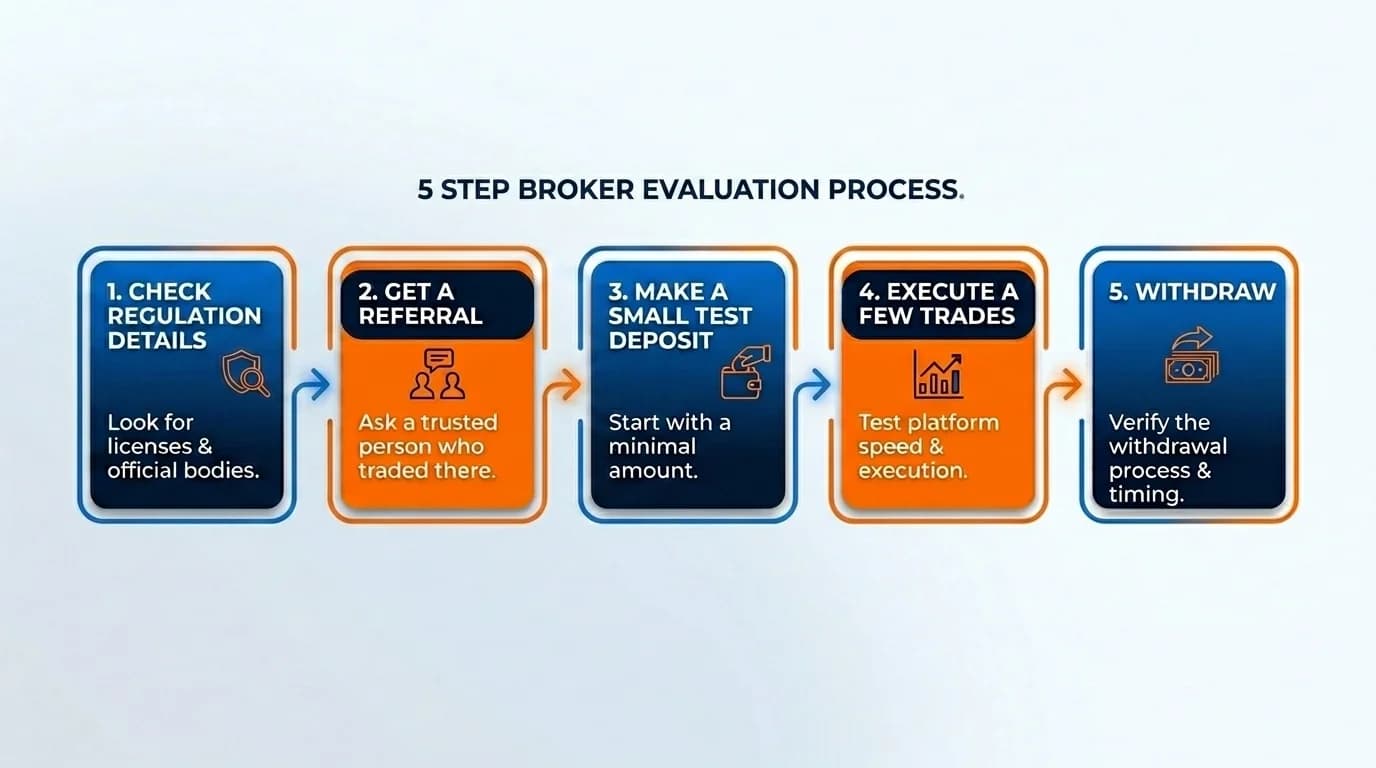
The broker evaluation process I use has five steps:
- Check the website. Regulation details should be clear and verifiable. Fee disclosure should be specific, not buried. If you cannot find the commission structure or the stop-out level in under two minutes, that tells you something.
- Get a referral from someone who has actually deposited, traded, and withdrawn. Not someone who has heard good things. Someone who has moved money in and out with their own capital.
- Make a small test deposit.
- Execute a few trades.
- Withdraw. If the process is clean, communication is clear, and the funds arrive without unexplained delays or holds, the broker passes.
That last step tells you more than any review site. Broker reviews are commercially influenced. Withdrawal speed is not something a broker can manipulate when you are the one testing it.
I learned this without looking for the lesson. I used one broker for over a year, never putting it through a real test. I entered a gold trade during a normal session, not a news hour, with a stop loss set at $50. It triggered at $110. When I contacted support, they told me not to trade during news hours. It was not a news hour. I switched brokers.
Slippage is not always intentional. But how a broker responds when something goes wrong tells you everything about whether they deserve your capital long-term. A $50 stop loss triggering at $110 is not a rounding error. At scale, it destroys a strategy's edge entirely.
Can you realistically grow a small forex account?
Yes, but the math only works if you treat risk as a percentage of equity, not a fixed dollar amount.
If you risk 2% per trade on a $500 account, you are risking $10. If the account grows to $1,000, the same 2% rule means you risk $20. The position size scales with the account automatically. That is where real growth comes from, not from taking bigger bets.
I managed a client account that started at $500. Trading XAU/USD exclusively, with a strict 5% maximum risk per trade and a hard cap of three trades per day, the account reached $3,000 in four months, a 6x return. The rules that produced that result were also what kept the account alive when two consecutive stop losses hit midway through. I stepped back, tested the strategy on demo to confirm it was still valid, and returned with the same position sizing.
The moment I broke the rules, trying to recover quickly by doubling size after those losses, I gave back 30% of the accumulated profit in a short window. The strategy was fine. The execution was not.
Small accounts grow when the rules hold. They give back when the trader decides the rules do not apply today.
A 1:2 risk-to-reward ratio, consistently applied, means a 50% win rate is profitable. You do not need to win most of your trades. You need to follow your rules most of the time.
The Bottom Line
The question is not really about money. Plenty of traders have blown $10,000 accounts for the same reasons others blow $300 ones: too much size per trade, no tested broker, and rules that hold until the first losing streak.
Starting small is fine. Starting small while treating it as practice money, with no position sizing discipline and no demo benchmark, is where it goes wrong. The traders who grow small accounts apply the same rules at $300 as they would at $30,000. That consistency is the only thing that makes the math work.
Frequently Asked Questions
Can I start forex trading with $30?
Some regulated brokers accept deposits as low as $30, which is enough to place real trades using micro lots. At that balance, your position size options are very narrow, and a short losing run will test the account quickly. Start at $30 only if that is actually what you can afford to lose while you are learning.
What lot size should I use on a $100 forex account?
Micro lots only. At 0.01 lot on a USD pair, one pip is worth $0.10, so a 40-pip stop loss costs you $4. Risking 1-2% of a $100 account per trade means your maximum loss per trade is $1 to $2, which at some stop loss distances requires sizing below 0.01. Use a position size calculator and do not skip this step.
Is forex trading profitable for beginners?
ESMA data shows 74-89% of retail accounts lose money. That figure reflects what happens without proper risk management. Beginners who treat position sizing seriously, use demo accounts before going live, and limit themselves to one or two setups they actually understand have a measurably different outcome than those who do not.
How long should I trade on demo before going live?
Two months minimum, using the same starting capital you plan to deposit live and applying real risk rules the entire time. If after two months you are within 10% drawdown, at breakeven, or in profit, you are ready. If not, reset and repeat. There is no benefit to rushing this.