
What Is a Forex Demo Account and Are You Using It Right?
A forex demo account is a practice trading account funded with virtual money that lets you place real trades on live market data without risking actual capital.
A forex demo account is a practice trading environment where you trade with virtual money on real market conditions. Same charts, same spreads, same execution speed as a live account. The only difference is the money isn't real.
That's the textbook answer. But here's something most beginners don't hear: the demo account isn't the problem. How people use it is.
Key Takeaways
- A forex demo account uses real market data but virtual money, so you can practice without financial risk.
- The biggest mistake traders make is using demo differently than they'd use a live account. Over-leveraging, resetting balances, ignoring risk management. That gap is what destroys people when they go live.
- A good demo account mirrors live conditions, including spreads, leverage settings, and execution speed.
- MT5 demo accounts are the standard. Most regulated brokers offer one for free with no time limit.
- Use a demo account for at least 1 to 2 months before going live, and only if your results are consistent.
What Is a Demo Account in Forex?
A forex demo account gives you access to a live trading platform with virtual funds. You see real price movements, real spreads, real market sessions. You place orders, set stop losses, manage positions. Everything works exactly like a live account, except when a trade closes against you, no actual money leaves your pocket.
This sounds like a pure upside setup. And for learning, it absolutely is. The problem is that most traders remove all the constraints that make live trading difficult. They deposit fake $50,000 when they only plan to start with $500 in real life. They enter positions at 30% capital exposure because "it's not real money." They reset the account the moment it drops.
What they're practicing, at that point, isn't trading. It's a video game.
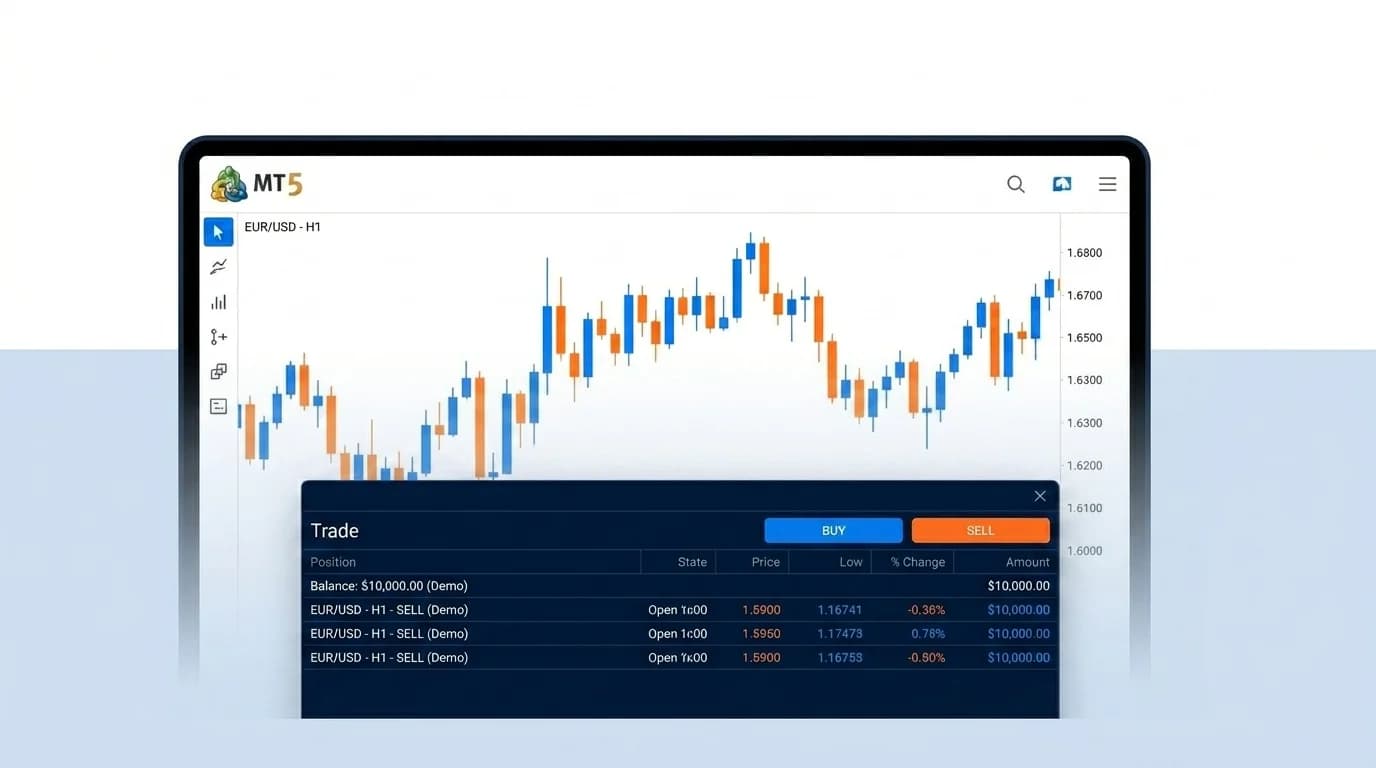
The Difference Between a Forex Demo and a Real Account
This is where most people learn the hard way.
| Feature | Demo Account | Real Account |
|---|---|---|
| Capital at risk | Virtual money | Real money |
| Emotional pressure | Very low | High |
| Execution quality | Usually simulated | Real broker fills |
| Slippage | Often minimal | Varies by broker |
| Psychological experience | False confidence | Real discipline required |
| Reset option | Yes | No |
That comparison makes it look like the only difference is money. That's the trap.
The real difference is what happens in your head when real money is on the line. A trader who casually enters a trade on demo with no stop loss because "it'll probably come back" will do exactly the same thing on a live account during their first losing streak. They've trained themselves to treat losses as reversible.
One of the traders I work with grew a $500 managed account to $3,000 over four months. Midway through, he had two consecutive stop losses, got frustrated, doubled his position size to recover, and took a third stop loss. He lost roughly 30% of his accumulated profits in a short window. Then he did something smart. He switched to demo, ran the exact same setup, walked away from the screen, and came back to find the trade deep in profit. The strategy was fine. His reaction to the losing streak had been the problem.
A demo account isn't there to prove you can win. It's there to validate your system before real money is attached to every decision you make.
How to Open a Forex Demo Account
Opening a Demo Account is a task of 2 minutes with any regulated broker.
Step 1: Find the “Open Demo Account” or “Try Demo” option on the broker’s website. This is usually found in the main navigation of the website.

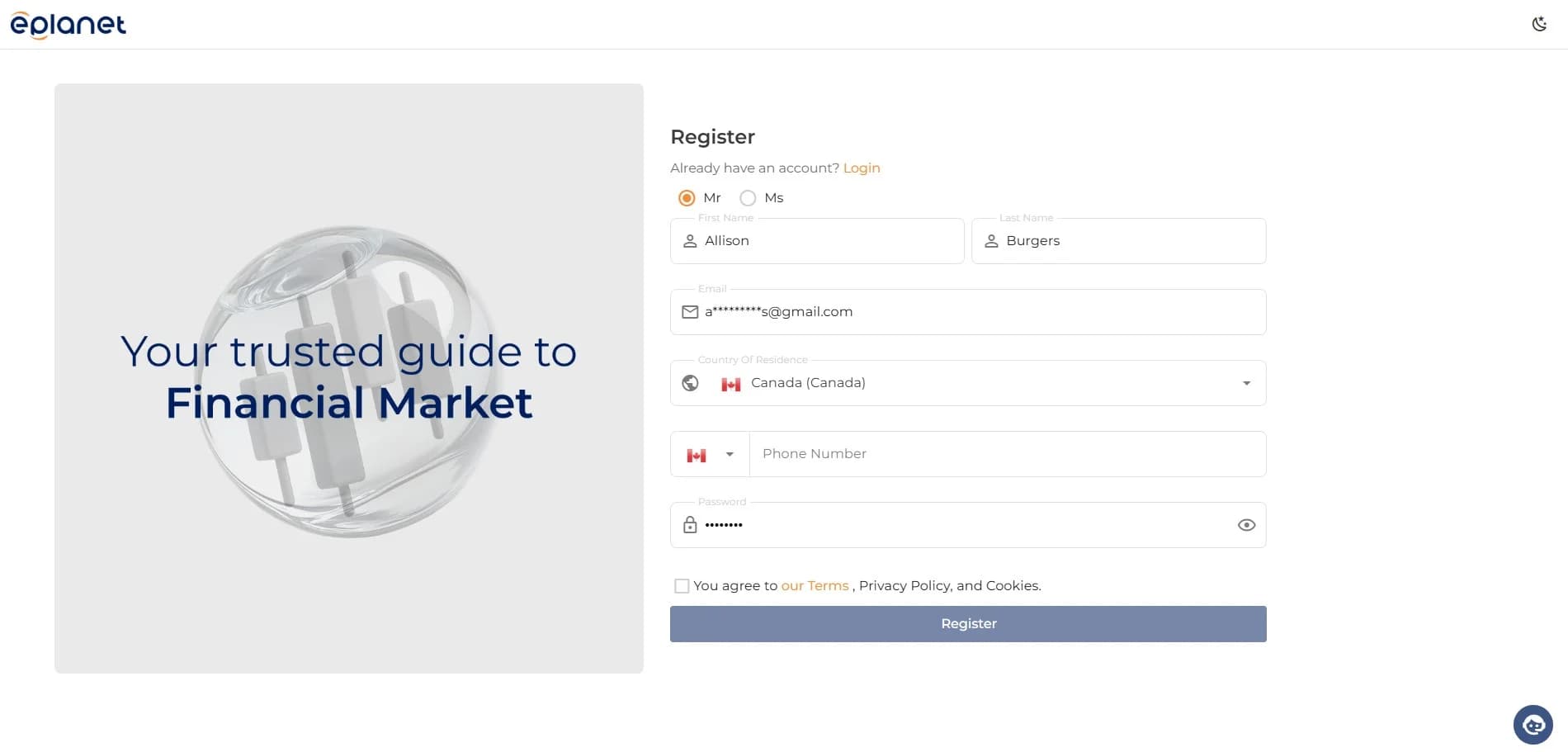
Step 2: Provide basic information. name, email address, sometimes even your phone number. Most Forex brokers don’t require ID verification to open a Forex demo account.
Step 3: Select the appropriate trading platform (MT5 is the most popular) for your demo account, the currency of your account’s deposit, and the virtual amount of your initial funds.
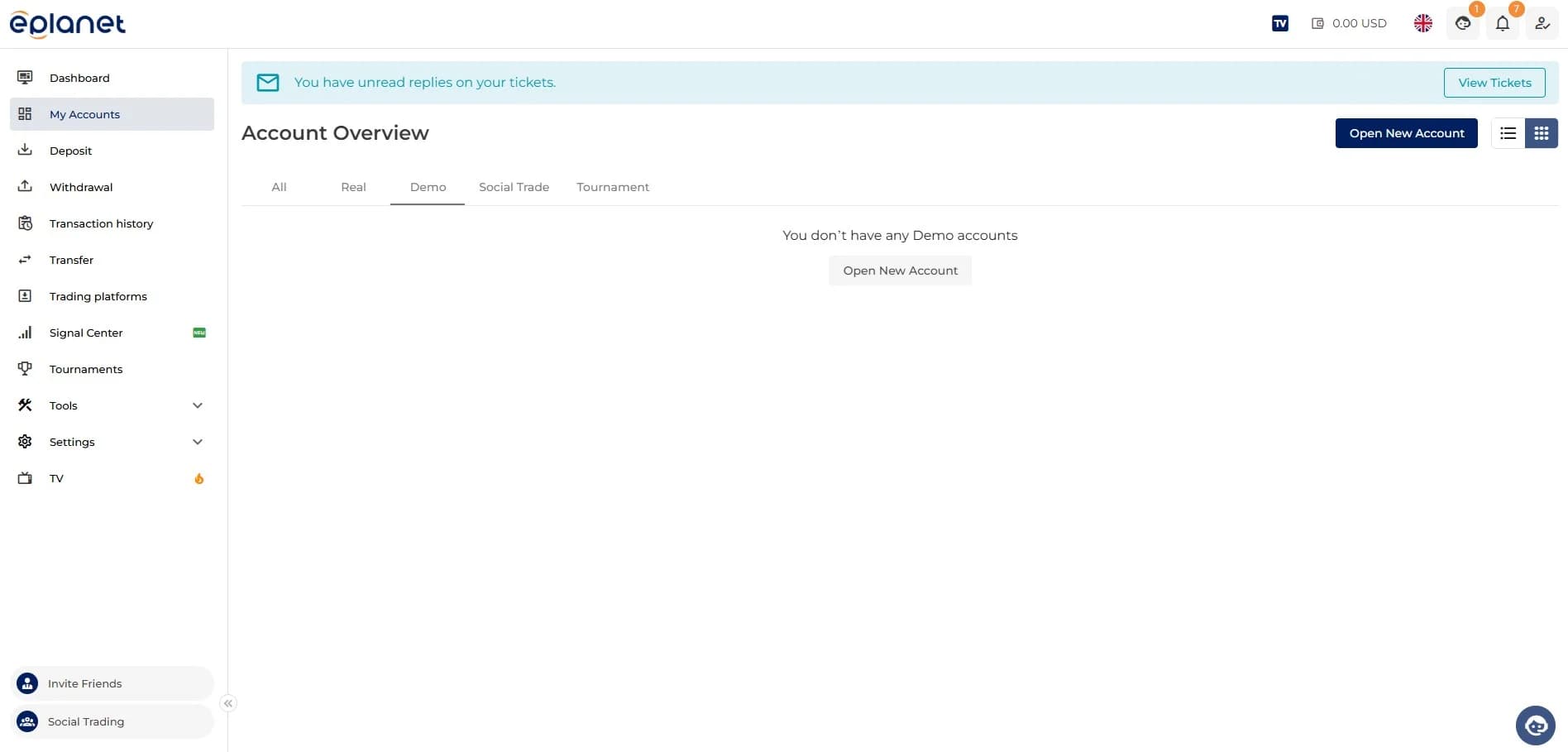
Step 4: Download the trading platform or access the web-based version of the software and log into your account with your login details.
Step 5: Start to trade as you would in real life situations. You would be able to trade on all the instruments (Forex Pairs, Gold (XAU/USD), Indices, Shares and many more).
Trading demo accounts are also offered by eplanet Brokers. The free MT5 demo account allows clients to try trading in the online platform with virtual money and to test all account types in demo mode. The Gold Special account offers 0.0 pip spreads on XAU/USD. The demo account is perfect to test a gold trading strategy and to get used to the platform as if you were trading with real money.
What Features Should a Good Forex Demo Account Have?
Not all demo accounts are created equal. Some brokers restrict the number of instruments on demo accounts, limit the demo account time frame to practice before expiring it and throttle the execution quality on demo accounts to improve it on live accounts.
Here's what to look for:
Actual market spreads, not artificial tight spreads. The demo account should reflect the live account’s spreads, especially for the specific account type that will be opened for live trading.
Same leverage. Practice with the same leverage that you intend to trade with live. So for example if you intend to trade live with 1:500 leverage on the account type “Expert” then practice on the demo account type “Expert” with 1:500 leverage. Don’t get used to trading with 1:100 leverage on the demo account thinking that when you start to trade live with real money that your trades will somehow magically become 5 times more profitable.
No expiry date. Demo accounts should not expire after 30 days. It is not enough time to check and validate your strategy for trading on real money. Unlimited demo access is needed.
Full platform access. Ensure that you have access to all indicators and the full array of order types including Market, Limit and Stop. Also ensure that you have access to all of the instruments you intend to trade on the live account.
Matching execution behavior. As a trader you should know that even during non-volitive market conditions partial fills can occur. On demo accounts this should happen as well during volatile periods. Better demo accounts will then replicate this behavior for gold trading for example.
Also, if you plan to trade Gold, then one of the key lessons you should learn quickly is that stop losses don’t always close at the price at which they were set. For example, during a Federal Reserve press conference, a SELL trade with a stop loss of 70 pips could get stopped out due to the spread alone, before the trade even goes into loss.
I know of one trader who had a $30 stop loss on a trade that closed for $37, a 23% worse outcome than he anticipated. So, be sure to practice opening and closing trades manually around news events on the demo account first. Otherwise, you will likely learn the hard way that static stop losses don’t always work as intended.
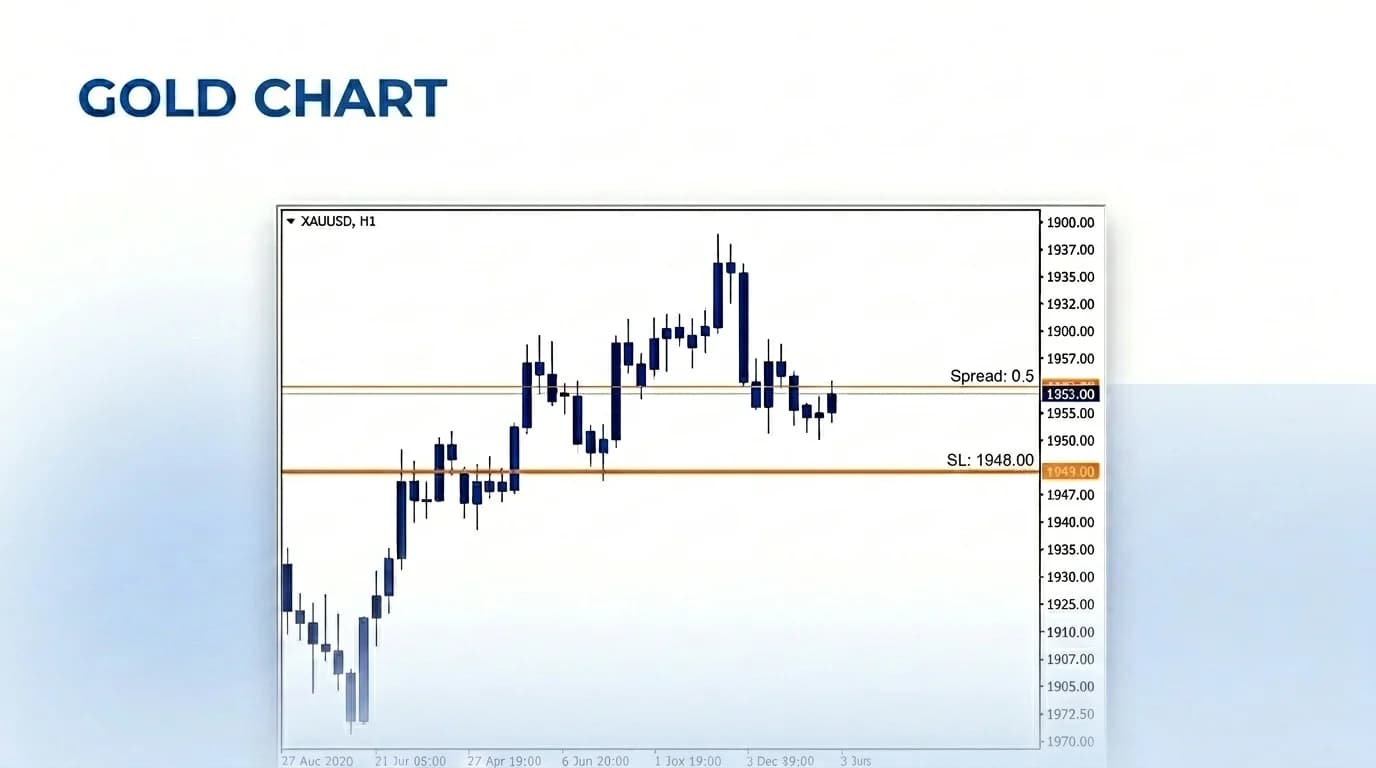
Forex Demo Account for MT5
The MetaTrader 5 platform is the leading solution for a retail forex demo account. MT5 is available for download for a Desktop PC running on Windows or a Mac, as well as online at the MetaTrader 5 site, on iPhone and Android-based smartphones and tablets. Many forex brokers operate with the MT5 trading platform, offering to their customers a forex demo account on MT5 with all the necessary features of the live account, such as charts, indicators and orders.
Here are a few things to keep in mind when it comes to trading on MT5 demo accounts:
The strategy tester is built in to the platform. You can backtest your strategy using historical data on the forex market directly within the MetaTrader 5 platform. Many traders do not realize the benefits of the strategy tester and thus miss the opportunity to test their trading strategies before risking any real money.
Custom indicators and EAs are tested on demo accounts in the same way as on live accounts. So, if you have come up with a number of custom indicators or even created your own scripts and are planning to test them for trading on the foreign exchange market, then you should start testing them on a forex demo account first. This will allow you to check how they work in practice and whether they bring any benefits to your work as a trader.
Note that even though you are opening a demo account for MT5 it will connect to a demo server and not a live server. Hence the execution will differ from the execution on the live markets. Execution speed on demo accounts during peak trading hours (when markets are volatile and trading is very active) may differ from live market execution as well.
What Are the Best Forex Demo Accounts for Beginners?
Beginners require 3 fundamental elements from a demo account: A) a regulated Broker, B) MT5 / cTrader Platform (NOT Broker’s own simplified platform) and C) No time frame on account.
I am going to put you through a more practical filter, instead of going down the numbers / rankings route, that would expire in a month or two.
Step 1: Only demo accounts with regulated brokers. We list here some of the well-known forex trading authorities, such as FSCA (South Africa), FCA (UK), ASIC (Australia) and CySEC (Cyprus). This is very important because a demo account with an unregulated broker will teach you nothing. Live spreads and execution may be completely different than what you practiced with on your demo account.
Step 2: Test with the correct account type. If you are interested in gold trading with low spreads for example, you should test on a demo Gold trading account with low spreads.
Step 3: Start with the same amount of capital in demo as you will in live trade. For instance, if you intend to start live with $500 on a specific account type (i.e. the gold trading account with very low spreads), you would start your demo with the same $500 and then trade on the same MT5 or cTrader trading platform as you will in live trade.
Step 4: Give it at least two months. The minimum benchmark: if after two months you're within 10% drawdown, at breakeven, or in profit, you're ready to consider going live.
The Right Way to Use a Demo Account
This section is the one most traders skip because they're in a hurry to trade live. Don't skip it.
Trade with the same capital as you intend to start trading with. Protecting $500 in a demo account is very different to protecting $50,000 in a live account. Make it real.
Never add to the balance once you start. The “demo account” should be treated as a finite resource, just like real money. Don’t keep topping up the “account” as you go along. If you blow it, start again from scratch. The reset button doesn't exist on a live account, so stop using it on demo.
Apply your risk rules to your demo trading. This means, your maximum position size for any trade, your stop loss size for any trade and your take profit for any trade. The majority of traders who go live and lose all of their money in the first month of trading (on their live accounts) are traders who during their demo trading period never enforced any risk rules because there was no real consequence for them.
Record your trades. Keep a journal of your trades. In this journal, write down the reasons you entered the trade, your target for the trade, and what actually happened with the trade. In about 30 to 50 trades, you will begin to see patterns that you were unable to recognize while you were taking the trades.
Don’t treat news events in demo money any differently than you would in real money. So if in real life you would stay out of the market in the CPI release for instance on demo you should do the same. Same goes for closing trades before a Fed meeting, on demo as well. You are rehearsing your trading habits on demo, not fine-tuning your trading system for implementation on live trading accounts.
The demo account has a singular limitation: your win rate on a demo account will always be greater than your win rate on actual money trading the exact same trading plan and methodology. This discrepancy between demo account performance and live account performance has to do entirely with psychological bias as well as with how one executes trades (i.e. money management, position sizing, trading hours, etc.).
Typically this bias results in a 10-15% differential between a person’s demo account results and their actual results. For instance, if you get an 85% win rate on your demo account, then you have to drop your expectations for actual live trading down to around 70-75%. That’s not poor trading. that’s just a result of having skin in the game.
The bottom line
A demo account is not a shortcut. It's a filter. The traders who blow their first live account usually weren't bad at analysis. They were using a strategy they'd never properly tested under real-sounding conditions, sizing their trades way too large, and had no risk rules because nobody had ever forced them to write any down.
Spend two months on demo. Trade it seriously. If your numbers hold up, go live with a small deposit first and test a broker's withdrawal process before committing serious capital. If a broker can get your withdrawal to you within 30 minutes, that tells you more about whether they're trustworthy than any review site ever will.
Frequently Asked Questions
What is a demo account in forex?
A demo account in forex is a practice environment where a trader trades with virtual money under real market conditions. The trader works with live prices, real market hours, and the real trading platform. There is no financial risk because no real money is involved. The account gives traders a chance to get familiar with the platform, test strategies, and build experience before going live.
How do I open a forex demo account?
To open a demo account all you need to do is go to any broker’s website that offers demo trading accounts, click on the demo account button, fill in some basic information like name and email and then download the MT5 or cTrader and you will be ready to start testing. This will only take around 2-5 minutes to do. Note that most forex brokers will not require any ID verification to open a demo account.
What features should a good forex demo account have?
The demo account should have no restrictions on virtual funds or expiry date. The full MT5 or cTrader platform must be available, not a simplified version. All instruments offered on the live account should be accessible on demo as well, including forex pairs, gold, and indices.
What are the best forex demo accounts for beginners?
We suggest demo accounts provided by regulated forex brokers that allow you to test accounts you plan to open in real money mode as well as accounts with no time limits. The most important thing is the platform, and there are several platforms for trading forex online. For beginners, we recommend MT5 platform, which is widely used as well as well-documented.