
What Is Risk-Reward Ratio? A Complete Guide for Traders in 2026
The risk-reward ratio measures how much you stand to make on a trade compared to how much you stand to lose, expressed as a ratio like 1:2 or 1:3. It comes from your stop loss distance against your take profit distance, and it has to be set before you enter, not adjusted once the trade is open.

The risk-reward ratio tells you how much you stand to gain for every dollar you risk on a trade. If you risk $50 to potentially make $100, your ratio is 1:2. That number, as simple as it sounds, is one of the most important decisions you make before entering any trade.
Most traders spend their time searching for the perfect strategy. They test indicators, watch chart patterns, follow signals. What they rarely stop to ask is whether their trades are actually structured to be profitable even when they lose. The risk-reward ratio is what forces that question.
Key Takeaways
- The risk-reward ratio compares what you stand to lose against what you stand to gain on a trade. A 1:2 ratio means you risk $1 to potentially make $2. It is calculated from your stop loss distance versus your take profit distance, and it must be set before you enter, not adjusted while the trade is running.
- Win rate alone does not determine profitability. A trader winning 40% of trades at 1:3 will outperform a trader winning 70% of trades at 1:1. The ratio is what determines whether your wins can consistently outweigh your losses over time.
- A 1:2 ratio is the practical minimum for most traders. At 1:2, you only need to win 34% of trades to break even. That buffer is what gives a strategy room to survive losing streaks without requiring a near-perfect win rate.
- Position sizing and ratio work together. A correctly structured ratio cannot protect you if you are risking 20 or 30% of your account on a single trade. Maximum risk per trade should be controlled tightly, regardless of how strong a setup appears.
- The ratio only works when it is treated as a rule, not a preference. Moving your stop loss, extending your take profit mid-trade, or abandoning the ratio after a losing streak all break the mathematical edge the ratio is designed to create. Consistency over time is what makes it work.
What Is the Risk-Reward Ratio in Trading?
The risk-reward ratio in trading is a way to determine whether a trade is worth taking. It compares how much money you could lose on a trade (the risk) with how much money you could potentially make (the reward). Traders usually express it as a ratio, such as 1:1, 1:2, or 1:3.
For example, a 1:1 risk-reward ratio means you are willing to risk $100 to make $100. A 1:2 risk-reward ratio means you are willing to risk $100 to make $200. A 1:3 risk-reward ratio means you are willing to risk $100 to make $300.
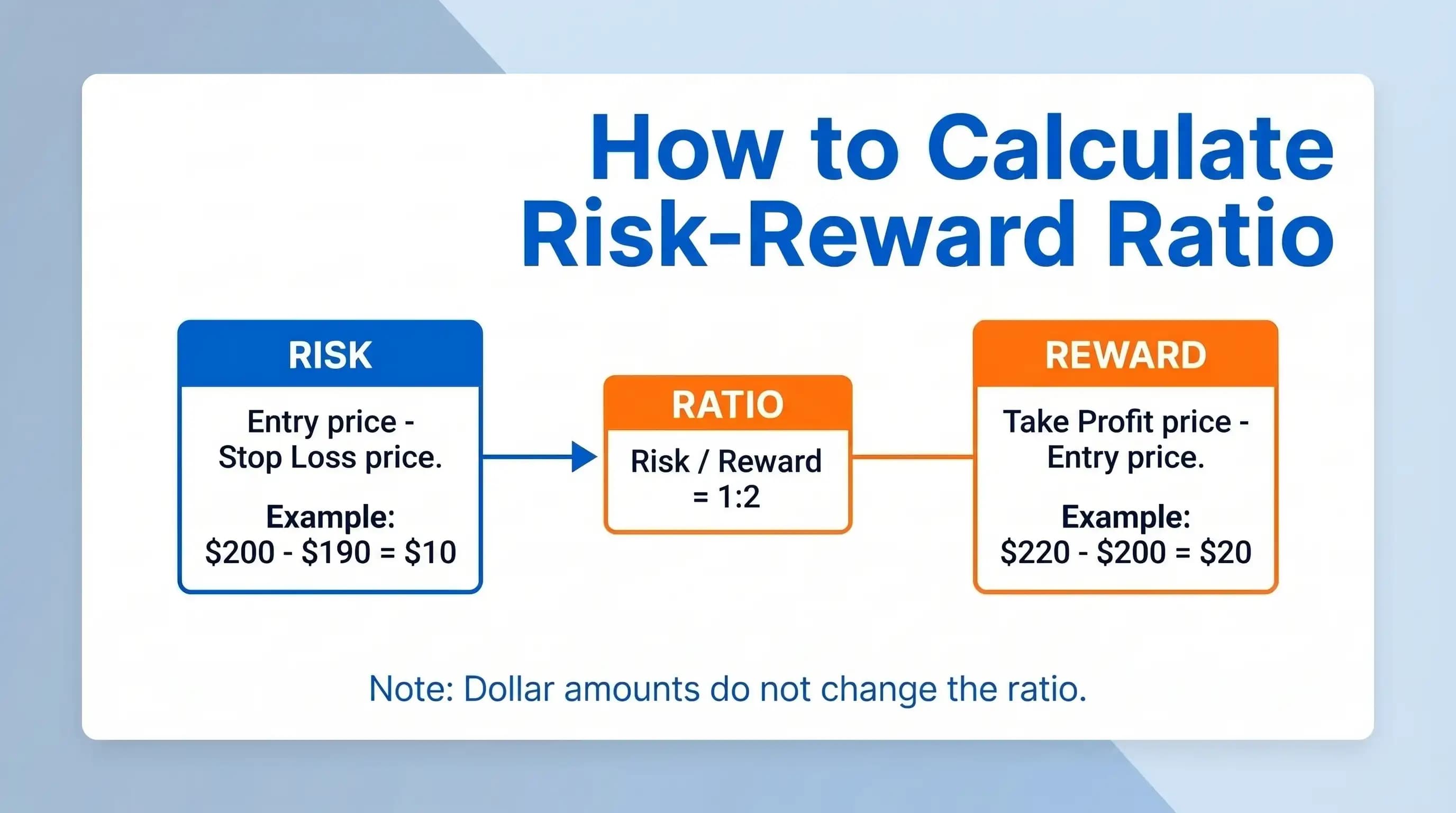
The ratio comes from two prices: your stop loss and your take profit. The distance from your entry to your stop loss is your risk. The distance from your entry to your take profit is your reward. The ratio between those two distances is your risk-reward ratio.
Nothing else determines this number. Not your feelings about the trade. Not how strong the setup looks. Not how long you have been watching the chart. Just those two distances.
How to Calculate Risk-Reward Ratio
The calculation is straightforward.
Risk = Entry price minus Stop Loss price Reward = Take Profit price minus Entry price Ratio = Risk divided by Reward
A simple example. You enter a trade at $200. Your stop loss is at $190. Your take profit is at $220.
Risk = $10. Reward = $20. Ratio = 1:2.
The dollar amounts do not change the ratio. Whether you are trading with $100 or $10,000, if your stop loss is 10 units away and your take profit is 20 units away, the ratio is still 1:2.
Why Risk-Reward Ratio Matters More Than Win Rate
Win rate feels like the most logical measure of success. The more trades you win, the better you are doing. That logic sounds reasonable. It is also incomplete.
Win rate only tells half the story. The other half is how much you make when you win versus how much you lose when you lose.
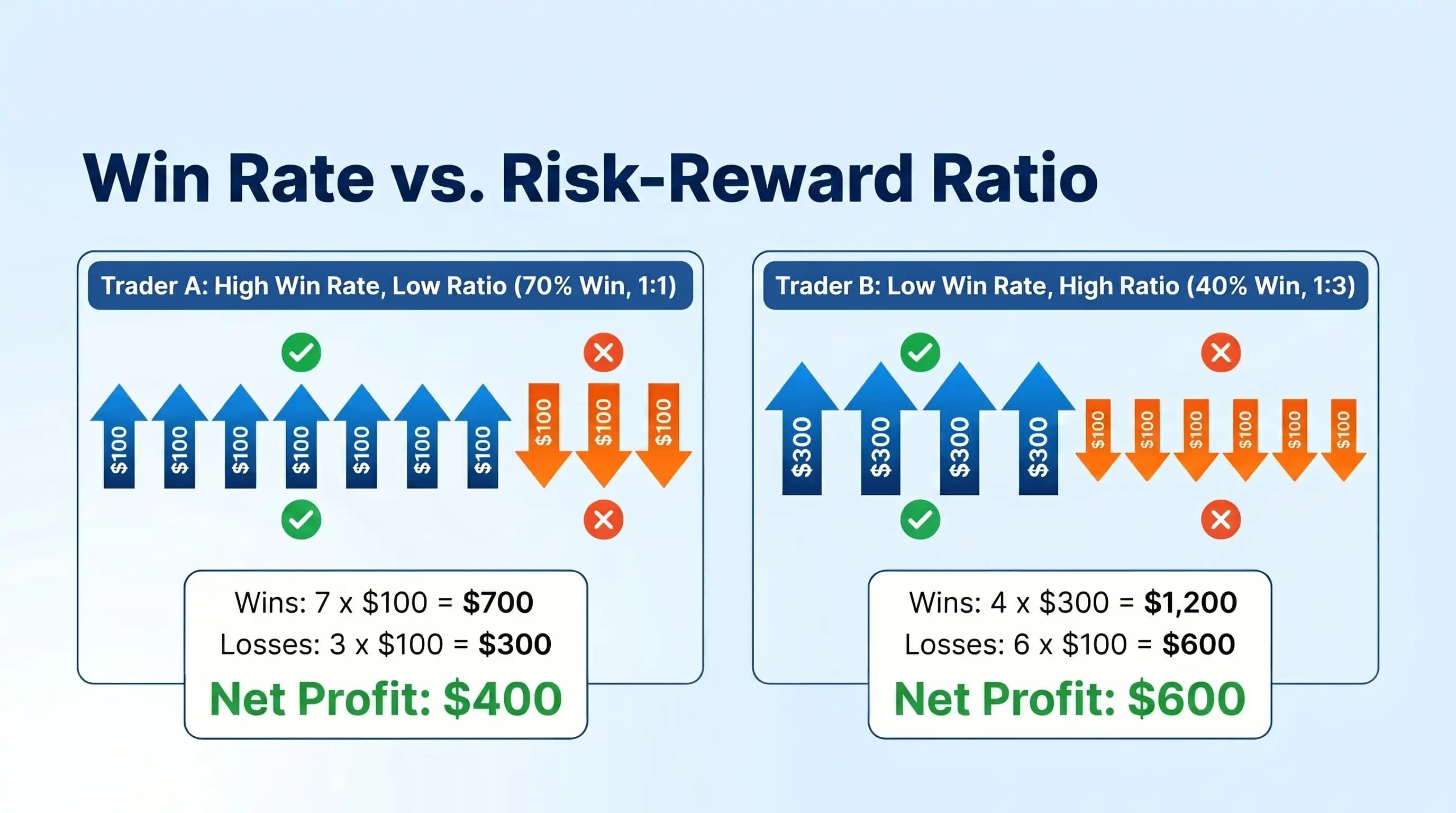
Trader A wins 70% of their trades but uses a 1:1 ratio. Over 10 trades: 7 wins at $100 = $700. 3 losses at $100 = $300. Net profit: $400.
Trader B wins only 40% of their trades but uses a 1:3 ratio. Over 10 trades: 4 wins at $300 = $1,200. 6 losses at $100 = $600. Net profit: $600.
Trader B wins fewer than half their trades and still makes 50% more money.
Early in my trading career I tested a strategy built on a triple SMA, EMA, and WMA combination on the 1-hour chart. The setups looked clean on the screen. The problem was the win rate came in around 30%. Without a ratio structure that could compensate for that, the strategy was not survivable regardless of how good the entries looked. I abandoned it. Not because 30% is automatically a losing win rate, but because at 1:1 it was mathematically impossible to come out ahead.
After more than 5 years trading across crypto and forex markets, the conclusion I keep returning to is this: win rate is secondary. The ratio comes first. If a trade cannot deliver at least 1:2 given my entry and stop loss placement, I do not take it. No exceptions.
What Is a Good Risk-Reward Ratio?
There's no single number that works for every trader or every strategy. But ask around among traders who've been doing this a while, and most will tell you 1:2 is the floor, not something you settle for.
The math is what makes the difference. At 1:2, you only need to win 34% of your trades to break even. Win 40% and you're profitable. Win 50% and the numbers swing heavily in your favor. That gap gives your strategy room to survive a rough stretch of losses without needing a near-perfect win rate.
At 1:1, things get unforgiving fast. You need to win more than half your trades just to cover spreads and commissions, before you've made a dime. Do that over hundreds of trades and there's almost no room left for error.
At 1:3 and above, your win rate can drop quite a bit and you still come out ahead. The catch is that real 1:3 setups don't show up that often. Waiting for them takes more patience than most beginners actually have.
For most traders starting out, 1:2 is the right target. It's realistic on most instruments, it gives your strategy room to breathe, and it forces you to figure out where your take profit sits before you ever pull the trigger on a trade.
What the 1:2 Ratio Looks Like Over Real Trades
Numbers are more useful than theory here.
The primary setup I developed over two years was built on a hard 1:2 minimum. Every trade had to clear that threshold before it was taken. The setup ran at approximately 70% win rate. Over two years, a $5,000 account grew to over $70,000. The ratio structure was not incidental to that outcome. It was the foundation of it.
The same principle applied when managing a client account. Trading exclusively with a strict 5% maximum risk per trade and a hard 1:2 minimum on every entry, a $500 account reached $3,000 in 4 months.
Neither result came from winning every trade. Both came from making sure that when trades did win, they won enough to more than cover the losses.
Even a 50% win rate with a 1:2 ratio produces profit over time. Most traders never stay with the structure long enough to see it.
Risk-Reward Ratio and Position Sizing
The ratio alone does not protect you. The other variable is how much capital you risk per trade.
A 1:2 ratio means nothing if you are risking 30% of your account on a single entry. Even a short losing streak destroys the account before the edge has time to play out.
Most traders do not fail because their analysis is wrong. They fail because their position sizing makes it impossible to survive the normal variance any strategy produces.
Managing that $500 client account made this concrete. Midway through the four months, two consecutive stop losses hit. The temptation to increase position size to recover faster was strong, and I gave in to it. That one decision wiped out roughly 30% of the profits built to that point.
The strategy had not changed. The entries were still valid. But breaking the position sizing rule turned a normal losing stretch into a serious drawdown. When the same strategy was immediately tested on a demo account under identical conditions, it produced profits without any adjustment. The strategy was not the problem. The sizing decision was.
The rule that came from that experience: maximum 5% of capital per trade, regardless of how confident the setup looks.
A good strategy can be destroyed by the person trading it. The ratio and the position sizing have to work together. One without the other is not a plan.
The Role of Risk-Reward Ratio in a Losing Streak
Every strategy goes through losing streaks. A system with a 70% win rate will still hand you 3, 4, sometimes 5 losses in a row. That's not failure. That's variance doing what variance does.
Where traders actually go wrong is abandoning a sound strategy mid-streak, before the edge gets the chance to show up.
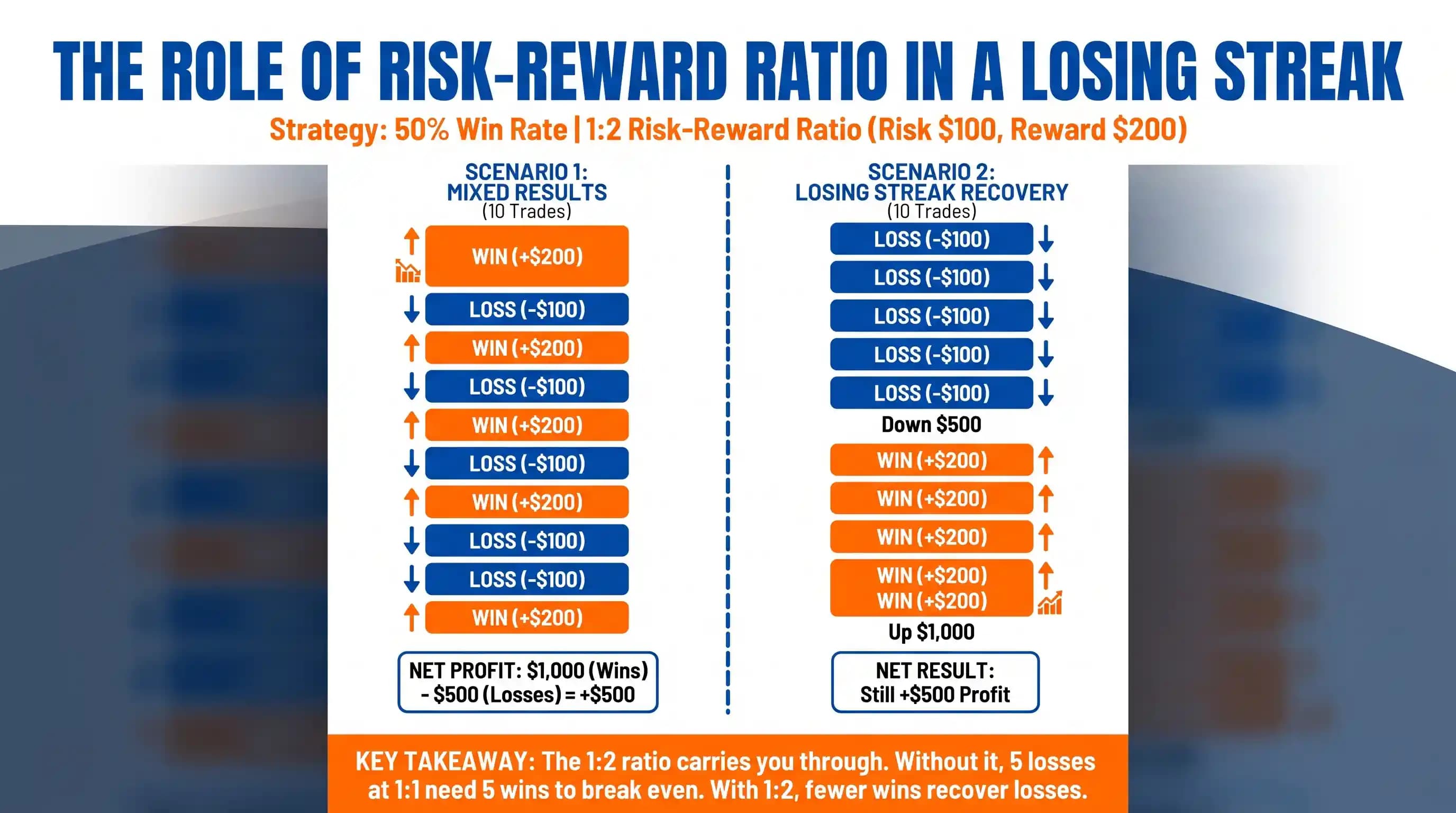
Take a strategy with a 50% win rate and a 1:2 risk-reward ratio. Run it 10 times: 5 wins at $200 each is $1,000. 5 losses at $100 each is $500. Net profit: $500.
Now flip the order. The first 5 trades all lose. You're down $500. The next 5 all win. You're up $1,000. Same 10 trades, same result: $500 in profit.
The ratio is what carries you through the rough stretch. Drop to 1:1 and 5 losses in a row means you need 5 wins just to break even again. At 1:2, you need a lot fewer wins to climb back out.
There's also the demo-to-live gap to think about. My demo win rate on setups I trust runs around 85%. The same setups on a live account drop to 70-75%. That gap is real and predictable. Hesitation plays into it, and so does the psychological weight of trading with real money, something demo accounts never quite replicate no matter how realistic they feel. A trader who sets expectations off demo numbers, then goes live without accounting for that drop, walks into a losing stretch they didn't see coming. A proper ratio is what gives you room to survive it.
That's also why chasing recovery trades after a drawdown does so much damage. The moment you abandon the ratio to make the loss back faster, the whole structure falls apart. Size creeps up, the target moves, and what was a controlled strategy turns into something running on pure emotion.
Common Mistakes Traders Make with Risk-Reward Ratio
Ignoring the ratio entirely
Many beginners enter trades without setting a take profit. They get in, watch it move, and close whenever it feels right. Without a defined ratio, there's no way to know if your strategy is actually profitable over time. You could win 6 out of 10 trades and still lose money, if the losses are consistently bigger than the wins.
Using 1:1 and wondering why results are flat
A 1:1 ratio isn't inherently wrong, but it demands a high win rate to hold up. Once spreads, commissions, and slippage are factored in, you need to win well above 50% of trades just to break even. Most strategies can't sustain that over hundreds of trades.
Moving the take profit during the trade
The trade moves in your favor, confidence builds, and you stretch the take profit to grab more. Sometimes that works. More often the trade reverses before it reaches the new target, and a winning trade turns into a small loss or breakeven. Set the take profit before you enter and leave it alone.
Moving the stop loss to avoid being stopped out
If your stop loss is about to trigger, moving it further away doesn't reduce your risk. It increases it. A 1:2 ratio becomes 1:1 or worse. The setup you based your decision on doesn't exist anymore.
Abandoning a valid strategy during a losing streak
This is the most damaging mistake on the list. A strategy with a 60% win rate and a 1:2 ratio is profitable over time, by the math. Most traders never give it enough time to find that out.
Running a signals group makes this painfully visible. One day, 4 out of 5 signals hit stop loss. The signals weren't really the problem. A lot of followers were risking 40%, 70%, sometimes their entire account, on a single signal. Some lost everything that day. A correctly structured 1:2 ratio couldn't save them, because their position sizing had already wiped out any chance of recovery before the day even started.
The ratio only does its job when the position sizing behind it holds up.
Treating the ratio as a preference rather than a rule
The ratio works when it's non-negotiable. The moment it becomes something you bend for a setup that looks too good to pass up, it stops protecting you. That's the whole game: not the ratio itself, but whether you actually stick to it.
Risk-Reward Ratio vs Risk Management
The ratio is one part of risk management, not the whole of it.
Risk management also covers how much of your total capital you risk per trade, how many trades you take per day, whether you stop trading after a strong session to avoid overtrading, and how you handle positions around high-impact news events.
The ratio tells you the structure of a single trade. Risk management tells you how that trade fits into your overall account.
A good ratio with poor position sizing still leads to blown accounts. Good position sizing with a poor ratio means slow, grinding losses over time. Traders who only fix one side of that equation tend to find out about the other side the hard way.
Read More: Forex Risk Management Strategies
How to Use Risk-Reward Ratio Before Every Trade
The process should happen before you enter, not during the trade.
Start with your entry. Place your stop loss at a level that makes technical sense. It should sit at a point where, if price reaches it, the original reason for entering the trade is no longer valid. Not an arbitrary distance.
Calculate the distance from entry to stop loss. That is your risk.
Identify a logical take profit level based on technical analysis, not a number you back-calculate to hit a target ratio. Price needs a genuine reason to reach that level.
Calculate the distance from entry to take profit. That is your reward.
Divide reward by risk. If the ratio is below 1:2, do not adjust your stop loss or take profit to force the numbers to work. Either wait for a better entry that produces the ratio naturally, or skip the trade entirely.
Before every signal I send to my trading group, there is a hard checkpoint: does this entry and stop loss give at least 1:2 to a logical target? If the answer is no, the trade does not go out. Not to me, not to anyone in the group. The setup has to earn its place.
If the trade does not give you at least 1:2, there is no trade.
Risk-Reward Ratio: Break-Even Win Rate Reference
The table below shows the minimum win rate needed to break even at different risk-reward ratios, before accounting for spreads and commissions.
| Risk-Reward Ratio | Minimum Win Rate to Break Even |
|---|---|
| 1:1 | 50% |
| 1:1.5 | 40% |
| 1:2 | 34% |
| 1:3 | 25% |
| 1:4 | 20% |
1:1 ratio requires a 50% win rate to break even 1:1.5 ratio requires a 40% win rate to break even 1:2 ratio requires a 34% win rate to break even 1:3 ratio requires a 25% win rate to break even 1:4 ratio requires a 20% win rate to break even.
The higher your ratio, the lower the win rate you need to stay profitable. Most traders land somewhere in the middle. A 1:2 target gives you a workable buffer regardless of where your win rate sits.
Frequently Asked Questions About Risk-Reward Ratio
What is a good risk-reward ratio?
Most experienced traders treat 1:2 as the practical minimum. At 1:2, you only need to win 34% of trades to break even, which gives a strategy room to survive losing streaks. A 1:3 ratio lowers that requirement further, but setups that genuinely support 1:3 are harder to find. There is no single ratio that fits every strategy. What matters is that the ratio is set before entry and matches the technical structure of the trade, not a number chosen to make the math look good.
Does a higher risk-reward ratio mean a lower win rate?
Not necessarily, but in practice the two are often linked. A wider take profit target usually needs price to travel further, which gives the market more opportunities to reverse before reaching it. That is why a 1:3 setup typically wins less often than a 1:1 setup on the same instrument. The trade-off is fine as long as the ratio compensates for it, which is the entire point of calculating risk-reward before you enter.
Can a risk-reward ratio guarantee profit?
No. A risk-reward ratio describes the structure of a single trade. It says nothing about whether price will actually reach your stop loss or your take profit. A 1:2 ratio applied to a strategy with no real edge will still lose money over time. The ratio protects your account from a string of small mistakes. It does not replace the need for a strategy with a genuine statistical edge.
Is a 1:1 risk-reward ratio ever acceptable?
It can work, but it demands a high win rate to stay profitable. At 1:1, you need to win more than 50% of trades just to cover spreads and commissions over time. Some short-term scalping strategies are built around 1:1 because they rely on a very high win rate rather than a wide reward. For most swing and day trading strategies, 1:1 leaves little room for error.
What risk-reward ratio do professional traders use?
Most professional and experienced retail traders treat 1:2 as a hard minimum rather than a target. If an entry and stop loss placement cannot produce at least 1:2 to a logical take profit level, the trade is skipped, regardless of how strong the setup looks. The exact ratio varies by strategy and instrument, but the discipline of refusing trades below a set minimum is consistent across most traders who survive long term.
Should you adjust your risk-reward ratio after entering a trade?
No. The ratio is decided before entry, based on where the stop loss and take profit make technical sense. Moving the take profit further because a trade is going well, or moving the stop loss to avoid being closed out, both break the original structure and turn a planned trade into a reaction to price movement. The ratio only protects you when it is treated as fixed once the trade is open.
Final Thoughts
The ratio itself is not complicated. The calculation takes less than a minute. What makes it difficult is applying it consistently, including in the trades where everything looks perfect and the temptation to bend the rules is highest.
Most traders do not fail because they cannot read charts. They fail because they cannot follow their own rules when money is on the line. The ratio is one of those rules. Set it before you enter. Leave it alone while the trade is open. Let the math do its work over time.
Trading is a long-term job. The ratio is not going to make every trade a winner. It is going to make sure that over enough trades, the wins outweigh the losses.
That is what it is there to do.