
MACD Indicator Explained: How to Read Signals, Settings and Strategies for Forex and Gold Trading
Most traders stare at a trading screen all day waiting for price to move in one direction or another. It can feel truly random at times. This was how I spent my days three years ago, loosing money consistently across several accounts. I felt as though I was simply flipping a coin deciding whether a trade would come out winning or loosing. I never realised that all that time trading was actually just gambling. It all changed for me when I discovered how to effectively use the MACD indicator.
When trading, many find themselves lost in a sea of indicators. After hours and even years of utilizing a multitude of technical tools, I have come to the realization that one good indicator can be far more powerful than ten average ones. One of the most powerful indicators that I have found for trading is the MACD indicator.
While every technical indicator has its own fan base, the MACD (Moving Average Convergence Divergence) stands apart from the rest because it translates complex market emotion into simple, easy to read buy and sell signals. But did you know that every price movement on a chart is ultimately driven by human emotions - some pairs of emotions (like fear and greed) and some combinations of emotions (like hope and uncertainty) play a larger role than others. The MACD brings these underlying forces to the surface through mathematical insight and helps the reader interpret them.
One of the things I really like about the MACD indicator is that it’s honest. It doesn’t pretend to predict where price will be in the future. Instead, it merely reveals where momentum is currently headed, and this can be shown through the histogram. As buyers become increasingly excited and drive price up, MACD reflects that enthusiasm in its chart signal. Or, when the sellers become increasingly frustrated and take control of the market, you’ll see MACD follow suit in the histogram. It really acts as a translator for market psychology and can even help you anticipate where the crowd is going before they know it themselves.
Key Takeaways
- The MACD indicator is better than most indicators at identifying the trend momentum, showing if a trend is gaining momentum or loosing momentum before the trend is even confirmed by price.
- When the MACD line crosses above the signal line it is a buy signal. When the MACD line crosses below the signal line it is a sell signal.
- Before the MACD even crosses, we get early warning from the Histogram.
- Divergence is Gold. When Price makes a new High whilst MACD doesn't, usually this is a Reversal Signal.
- you need to optimize for the timeframe you are looking at - 12, 26, 9 works well for daily charts, but for smaller time frames you need different numbers.
What is MACD? Breaking Down the Basics
I get a lot of comments when I post charts with a MACD indicator, “oh that’s so boring.” In fact a very well known technical analyst stated once that MACD is his number one indicator for trend following and, in my opinion, it outperforms all others at that task. Developed by Gerald Appel back in the 1970’s the MACD stands for Moving Average Convergence Divergence and helps us to identify not only the current trend but the amount of momentum that is behind it all.
The MACD is your trading GPS. You wouldn't drive across country without knowing where you are going, and you shouldn't trade a security without knowing the future path of the security, and even more importantly, how fast it is traveling to reach that future destination.
The SwingTrader indicator for Thinkorswim consists of three sections (top, middle and bottom) that assess all the crucial aspects for timing entry and exit trades with accuracy.
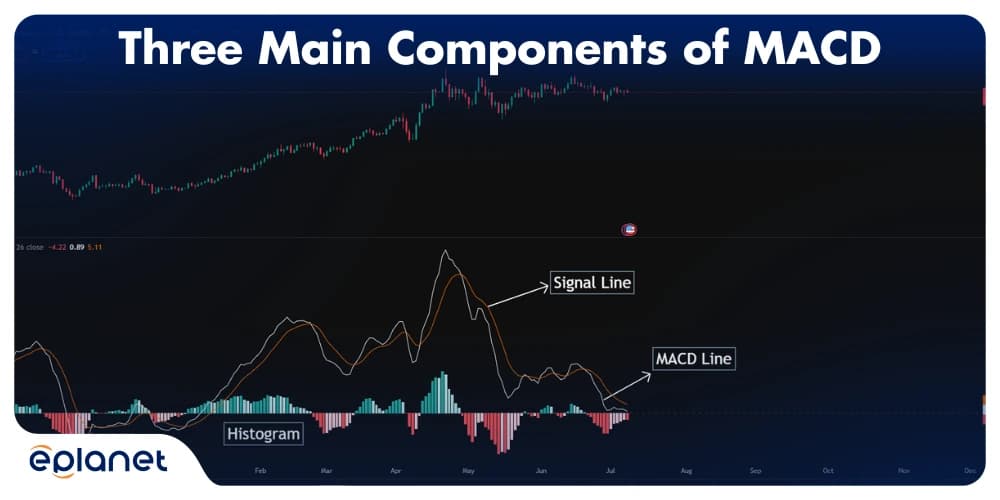
The MACD Line is the primary trend indicator for this study and is calculated as 12 period EMA - 26 period EMA. When the MACD Line is positive it signals bullish momentum, and when it's negative it signals bearish momentum.
The Signal Line is a 9-period EMA of the MACD line. This creates a smoothed MACD that will give you more solid entry and exit points for trades. It's a 9-period EMA of the MACD line, effectively removing a lot of the noise and allowing you to see what really matters.
The Histogram is the difference between the MACD line and the signal line, representing where the momentum changes occur before they are clearly visible on the MACD lines.
MACD Settings: Fine-Tuning Your Instrument
Let's talk about something that frustrates me to no end: traders who blindly use default settings without understanding what they're doing. The default settings (12, 26, 9) aren't random numbers—they're based on traditional trading periods. But that doesn't mean they're perfect for every situation.
For day trading, you might want to use faster settings like (8, 17, 6) to catch shorter-term moves. For swing trading, the standard settings usually work well. For position trading, you might go slower with something like (19, 39, 14).
But here's the thing: changing settings isn't about finding the "perfect" combination. It's about matching the indicator to your trading style and market conditions. Faster settings give you more signals but also more noise. Slower settings give you fewer signals but more reliability.
| Trading Style | Fast EMA | Slow EMA | Signal Line | Best For |
|---|---|---|---|---|
| Scalping | 5 | 13 | 4 | Very short-term moves |
| Day Trading | 8 | 17 | 6 | Intraday momentum |
| Swing Trading | 12 | 26 | 9 | Multi-day trends |
| Position Trading | 19 | 39 | 14 | Long-term trends |
MACD Settings for Day Trading: Speed Matters
Day trading requires faster settings to catch intraday moves. The standard (12, 26, 9) settings are too slow for most day trading strategies.
Popular day trading settings include:
Fast Setup (5, 13, 4): Catches quick moves but generates more false signals. Good for scalping in liquid markets.
Moderate Setup (8, 17, 6): Balances speed with reliability. My personal favorite for day trading.
Conservative Setup (10, 20, 7): Fewer signals but higher accuracy. Good for part-time day traders.
The key is matching your settings to your trading style and the market you're trading. High-frequency traders might use even faster settings, while swing traders disguised as day traders might use slower ones.
Read More: Best MACD Settings for Day Trading: Your Ultimate Guide for Intraday Traders
The Real Question: What Are You Trading?
Volatile stocks need faster settings to catch quick moves, while stable blue-chips work better with standard parameters. I've seen traders blow up accounts because they used day-trading settings on weekly charts, or vice versa. Don't be that trader.
How to Read MACD Like a Professional
Reading MACD isn't rocket science, but it does require understanding what each signal actually means. Let me break it down:
Signal Line Crossovers
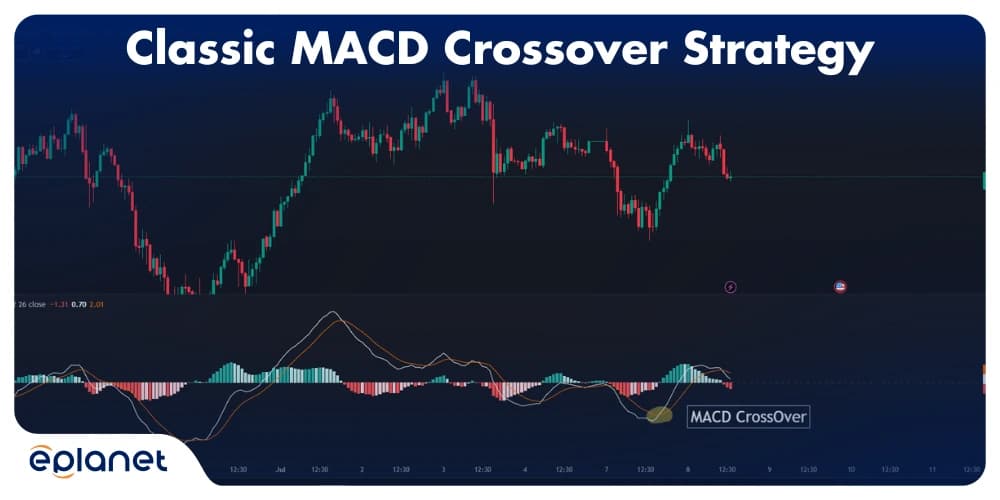
When MACD crosses above the signal line, it's generally bullish. When it crosses below, it's bearish. But here's the catch—not all crossovers are created equal. The strongest signals occur when:
- The crossover happens near or below the zero line (for bullish signals)
- The crossover is accompanied by increasing histogram bars
- Price is approaching a support or resistance level
Zero Line Crossovers
This is where many traders get confused. When MACD crosses above zero, it doesn't always mean "buy immediately." Instead, it confirms that the 12-period EMA is above the 26-period EMA, indicating that recent price action is stronger than longer-term trends.
Histogram Analysis: The Crystal Ball
The histogram is your early warning system. When histogram bars start shrinking, momentum is weakening—even if the main MACD line is still trending strongly. This gives you a heads-up that a reversal might be coming.
MACD Trading Strategies That Actually Work
After years of testing different approaches, here are the strategies that have consistently performed:
The Classic Crossover Strategy
The MACD crossover is the bread and butter of momentum trading—simple to understand but surprisingly effective when executed properly. This strategy has been my go-to approach for swing trading strong stocks, and I've refined it over hundreds of trades to maximize its effectiveness.
The Setup Process: The magic happens when MACD crosses above the signal line, but not every crossover deserves your attention. I look for crossovers that occur near or below the zero line, as these tend to catch the beginning of new momentum cycles rather than late-stage moves. The best setups often happen after a period of consolidation, when the market has been "coiling" like a spring ready to release energy.
Entry Timing: Here's where patience pays off. Instead of jumping in immediately when you see the crossover, wait for the next candle to open before entering. This small delay filters out many false signals and gives you a better entry price. I've learned this lesson the hard way—rushing into trades at the exact moment of crossover often means buying at temporary peaks.
Stop Loss Strategy: Your stop loss should sit below the most recent swing low, but with a crucial twist: make sure it's at least 1% below that level to avoid getting stopped out by minor price noise. In volatile stocks, I sometimes use 1.5-2% below the swing low. The key is giving your trade enough breathing room while still maintaining strict risk control.
Profit Targets: The 2:1 risk-to-reward ratio isn't arbitrary—it's based on the mathematical expectation that if you're right 65% of the time with this win rate, you'll be profitable long-term. However, I often scale out of positions, taking 50% profits at 1.5:1 and letting the remaining position run to 3:1 or until MACD shows weakening momentum.
Why This Works: This strategy succeeds because it captures the psychology of momentum building. When MACD crosses above its signal line, it means recent price action is gaining strength relative to the recent past. It's like watching a runner gradually pick up speed—the crossover is your signal that acceleration is happening.
Real-World Performance: In my experience, this strategy delivers about 65% wins in trending markets, but the success rate drops to around 45% in choppy conditions. The key is knowing when to use it—during earnings season, sector rotations, or when stocks are breaking out of consolidation patterns. It works particularly well with growth stocks and momentum plays, but tends to struggle with defensive sectors and dividend stocks that move more slowly.
The Zero Line Bounce
The Zero Line Strategy takes a different approach. Instead of focusing on crossovers, you wait for MACD to cross the zero line. This filters out many false signals but can make you late to the party. It's the difference between being fashionably late and missing the entire event.
- Setup: MACD approaches zero line from above (in an uptrend).
- Entry: Buy when MACD bounces off zero without crossing below.
- Stop Loss: If MACD closes below zero line.
- Target: Previous MACD high.
This strategy works because it catches the continuation of existing trends rather than trying to predict reversals.
Divergence Trading: The Holy Grail
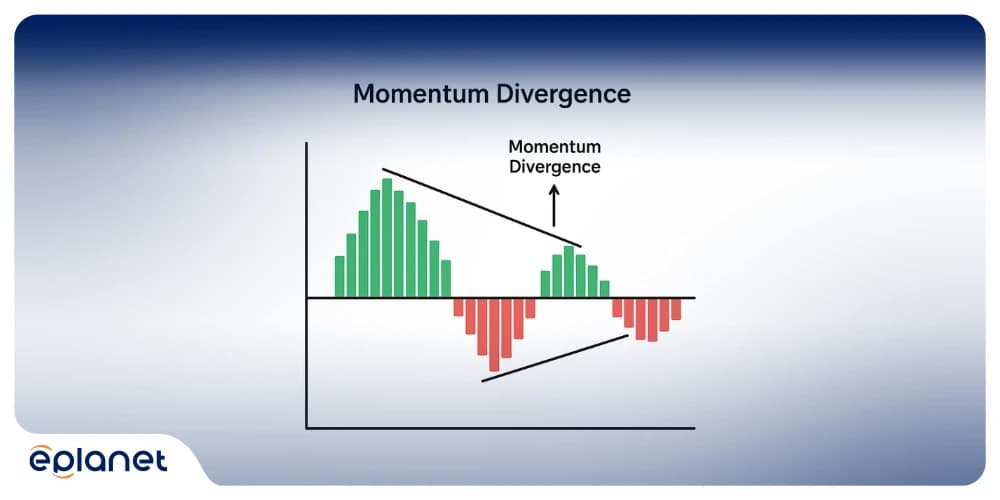
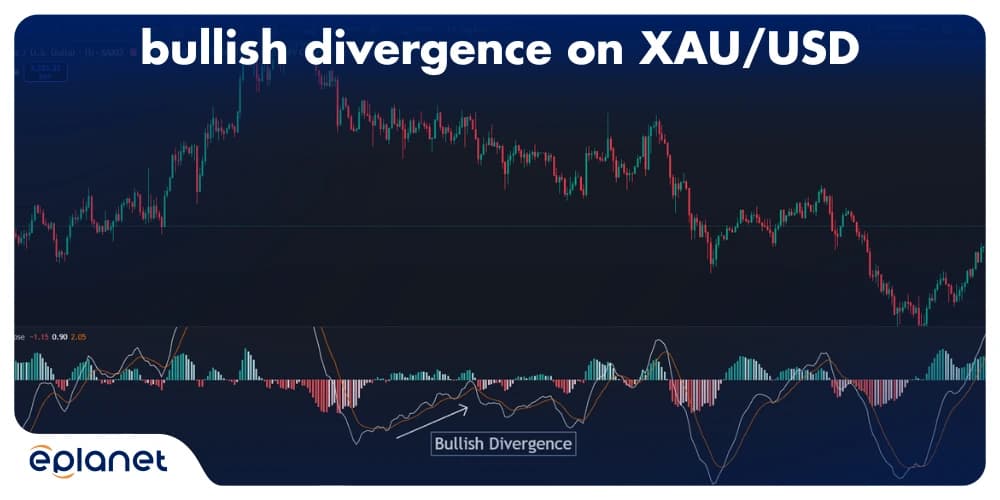
This is where MACD truly shines. When price makes new highs but MACD doesn't, or vice versa, a reversal is often brewing. I've caught some of my biggest wins using this approach.
Bullish Divergence: Price makes lower lows, MACD makes higher lows.
Bearish Divergence: Price makes higher highs, MACD makes lower highs.
Common MACD Mistakes (And How to Avoid Them)
Mistake #1: Ignoring the Bigger Picture
MACD is a trend-following indicator, which means it sucks in sideways markets. I can't count how many times I've seen traders get chopped up using MACD in consolidation phases. Always check the broader trend first.
Mistake #2: Chasing Every Signal
Not every MACD crossover is worth trading. The best signals come when multiple factors align:
- Clear trend direction
- Significant support/resistance levels
- Volume confirmation
- Proper risk management setup
Mistake #3: Using Wrong Timeframes
Your MACD timeframe should match your trading style. Day traders using weekly MACD signals are setting themselves up for failure, just like swing traders using 1-minute MACD are asking for trouble.
MACD vs. Other Indicators: The Honest Comparison
Let's address the elephant in the room: Is MACD actually better than other indicators?
RSI vs MACD: Choosing Your Weapon
RSI and MACD are both momentum indicators, but they approach the market from different angles. Understanding their differences can help you choose the right tool for the job.
RSI is an oscillator that measures the speed and change of price movements. It's bounded between 0 and 100, making it easy to identify overbought and oversold conditions.
MACD is an unbounded oscillator that measures the relationship between two moving averages. It's better at identifying trend changes and momentum shifts.
| Feature | RSI | MACD |
|---|---|---|
| Type | Bounded oscillator | Unbounded oscillator |
| Best for | Overbought/oversold | Trend changes |
| Signals | Divergence, extremes | Crossovers, divergence |
| Timeframe | Short to medium | Medium to long |
| Noise level | Higher | Lower |
Use RSI when you want to identify overbought/oversold conditions or trade mean reversion strategies.
Use MACD when you want to identify trend changes or trade momentum strategies.
Use both when you want comprehensive momentum analysis. They complement each other beautifully.
Read More: What is RSI Indicator?
MACD vs. Stochastic
Stochastic is more sensitive and gives earlier signals, but it's also prone to false signals. MACD is more reliable but sometimes enters late. Your choice depends on your risk tolerance.
MACD vs. Moving Averages
MACD is essentially a sophisticated moving average system. It provides the same information as dual moving averages but with better visual clarity and additional momentum insights.
To learn more about moving averages, check out our guide on Mastering the Best EMA for 5 Minute Charts.
Advanced MACD Techniques
The Three-Screen System
Developed by Dr. Alexander Elder, this approach uses three timeframes:
- Long-term: Identify overall trend direction
- Medium-term: Find entry signals with MACD
- Short-term: Fine-tune entries with other indicators
MACD Histogram Slope Analysis
Instead of just looking at histogram values, analyze the slope. When histogram bars start flattening after a strong move, momentum is weakening—even if the values are still positive.
Multiple Timeframe MACD
Use MACD on different timeframes simultaneously. For swing trading, I like to see alignment between daily and 4-hour MACD signals before entering trades.
Risk Management with MACD
The best MACD strategy in the world won't save you if your risk management sucks. Here's what works:
Position Sizing
Never risk more than 2% of your account on any single MACD signal. I know it's tempting when you see a "perfect" setup, but perfect setups fail too.
Stop Losses
Use technical stop losses based on chart patterns, not arbitrary percentages. If MACD gives a buy signal near support, place your stop below that support level.
Profit Taking
Scale out of winning positions as MACD momentum weakens. Don't wait for the perfect exit—take profits when you have them.
Read More: Forex risk management strategies
MACD for Different Market Conditions
Bull Markets: Where MACD Truly Shines
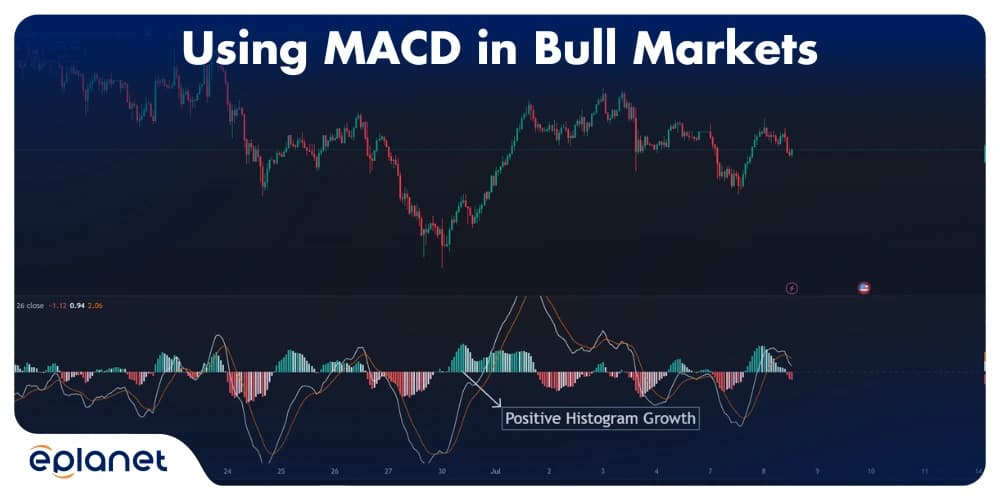
Bull markets are where MACD becomes your best friend. There's something almost magical about how cleanly MACD signals work when the overall market sentiment is positive. During these periods, false breakouts are less common, and momentum tends to follow through more consistently.
The sweet spot for bull market MACD trading is buying pullbacks to the zero line. Think of the zero line as a magnet during uptrends—price keeps getting pulled back to it, creating fantastic buying opportunities. When MACD approaches zero from above and bounces without crossing below, it's often indicating that the pullback is over and the next leg up is beginning. I've seen this pattern work beautifully in stocks like Amazon and Tesla during their major bull runs.
Signal line crossovers above zero carry extra weight in bull markets. When MACD crosses above its signal line while both lines are above zero, you're seeing confirmation that momentum is accelerating in an already positive environment. It's like watching a car shift into higher gear on the highway—the speed was already good, but now it's getting even better.
Pay special attention to positive histogram growth during bull markets. When those histogram bars start expanding upward, it tells you that the gap between the MACD line and signal line is widening, which means momentum is not just positive but accelerating. This is your cue that a move might have more legs than initially expected.
Bear Markets: MACD as Your Shield and Sword
Bear markets transform MACD from a momentum indicator into a survival tool. The psychology changes completely—instead of looking for ways to catch rising momentum, you're hunting for short opportunities while protecting yourself from false hope.
MACD excels at identifying short opportunities in bear markets because it helps you distinguish between genuine bounces and dead cat bounces. When MACD attempts to cross above its signal line but fails to sustain the move, it's often signaling that any price rally is temporary. These failed breakouts in MACD often precede some of the most profitable short trades.
The indicator also helps you avoid false breakouts, which are incredibly common in bear markets. When a stock breaks above resistance but MACD doesn't confirm with a strong signal, it's often a trap. I learned this lesson the hard way during the 2020 COVID crash when I kept buying every bounce, only to watch MACD warn me that the momentum wasn't there.
Perhaps most importantly, MACD helps you time market re-entries when bear markets finally end. The transition from bear to bull often shows up in MACD before it's obvious in price action. When you start seeing MACD making higher lows while price continues making lower lows, that's your first hint that the selling pressure might be exhausting itself.
Sideways Markets: MACD's Achilles' Heel
Here's where I need to be brutally honest with you: MACD struggles in sideways markets like a fish out of water. The indicator was designed to catch trends, and when there's no trend to catch, it becomes a whipsaw machine that can chop your account to pieces.
During consolidation phases, MACD generates frequent crossovers that lead nowhere. You'll get buy signals that immediately reverse, sell signals that turn into rallies, and histogram readings that change direction more often than a confused tourist. It's during these periods that many traders lose faith in MACD—but the problem isn't the indicator, it's the market condition.
Instead of forcing MACD to work in sideways markets, consider switching to oscillators like RSI or Stochastic, which are better suited for range-bound conditions. These indicators excel at identifying overbought and oversold levels within a trading range, something MACD simply wasn't designed to do.
If you must use MACD in sideways markets, dramatically reduce your position sizes and expect lower win rates. Focus on range-bound strategies that take advantage of support and resistance levels rather than trying to catch momentum that doesn't exist.
Using MACD for Gold Trading (XAU/USD): What Most Traders Get Wrong
Let's talk about gold specifically, because XAU/USD is not just another instrument you can drop MACD onto and expect the same results.
I've spent years trading gold — and monitoring it through a custom automated alert system I built in Python that runs 24 hours a day on a VPS. What that process taught me is that gold has a personality that most MACD guides never account for. It reacts violently to Fed speeches, CPI releases, and geopolitical noise. It moves on sessions that most forex pairs ignore. And it has a very specific relationship with key weekly levels that makes MACD signals far more readable than on most other instruments — once you know what to look for.
Here's the honest version of how to use MACD on XAU/USD.
Why Gold Behaves Differently
Most indicators are calibrated against equity or currency behavior. Gold trades 24 hours a day, carries safe-haven demand that can override technical setups entirely, and experiences session-specific volatility patterns that most traders underestimate. The London and New York sessions are where the real moves happen. The Asian session tends to be quieter — but it's also where institutional positioning begins to show up in structure, which MACD reads well on the 5-minute and 15-minute timeframes if you know what exhaustion looks like.
The single thing that separates experienced gold traders from everyone else is understanding where key levels sit — specifically, last week's higher highs and the price zones where institutional rejection has happened before. MACD doesn't replace that map. It confirms it. When price approaches a known rejection zone and the MACD histogram starts contracting while momentum is still technically bullish, that's your early warning. You're watching the engine run out of fuel before the car visibly slows down.
The Right MACD Settings for XAU/USD
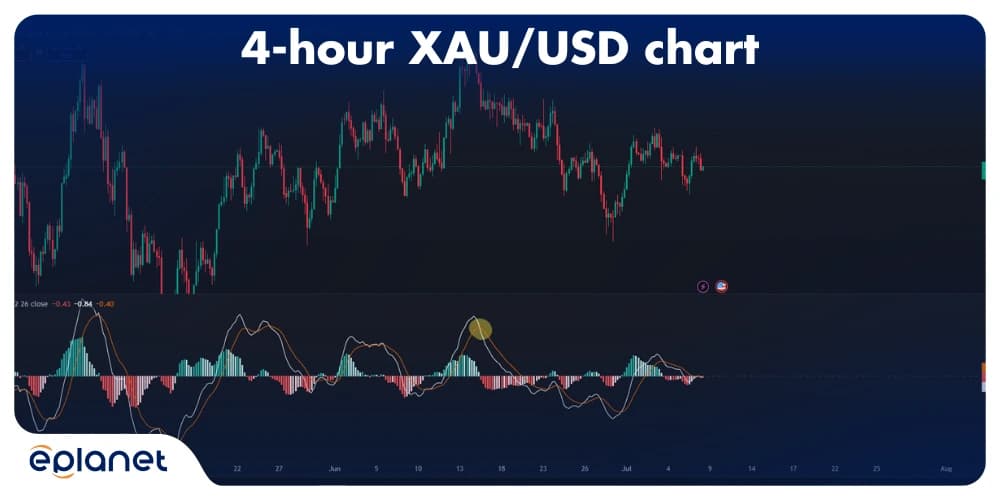
The standard 12, 26, 9 settings work on the daily gold chart. But if you're working the 4-hour chart — which is where most reliable swing signals on XAU/USD live — a faster configuration performs better. MACD (8, 21, 5) gives you sharper signal crossovers that aren't delayed by the slower EMA calculation. Gold moves fast enough that the standard settings can have you entering a trade that has already given most of its move.
For scalping on the 5-minute chart, go faster still. Settings like (5, 13, 4) will catch the short-term exhaustion signals at key intraday levels. But be clear with yourself: faster settings mean more signals, and more signals means more noise. On gold, that noise can be brutal during news hours.
| Timeframe | Recommended Settings | Best Use Case |
|---|---|---|
| 5-minute | (5, 13, 4) | Scalping key level rejections |
| 15-minute | (8, 17, 6) | Intraday momentum entries |
| 4-hour | (8, 21, 5) | Swing trade entries and confirmation |
| Daily | (12, 26, 9) | Trend direction and bias |
The Setup That Actually Works on Gold
Here is a specific approach worth testing. It is built around one core idea: gold makes very clean rejection signals at its weekly higher highs during a bullish run, and MACD tells you when that rejection is real versus a brief pause.
The process works like this. Wait for XAU/USD to be in a clear bullish trend making new highs. Identify and mark the previous week's higher high as a horizontal level. Watch for price to approach that level with momentum — strong bullish candles, MACD histogram expanding positively. Then look for the first sign of exhaustion: a bullish candle with a visible upper shadow, showing price tried to break the level and got rejected. When the next candle closes bearish, the MACD histogram has typically already started contracting. That contraction is your signal that the momentum behind the move has genuinely weakened, not just paused.
Enter short at the close of the bearish confirmation candle. Stop loss sits 10 pips above the high of the shadow candle. Target is 2:1 risk-to-reward minimum.
The reason this works is not magic. It is institutional logic. Those weekly highs are price zones where large orders sit. When price gets there during a bullish run, that liquidity gets taken, and then the institutions who placed those orders begin to unwind. MACD shows you the momentum signature of that unwinding — the histogram tells you the story before the price action makes it obvious to everyone else.
What to Avoid on Gold
Do not use MACD signals on XAU/USD during high-impact news events without a very tight stop or staying out entirely. CPI, NFP, Fed rate decisions — gold can move $30 to $50 in minutes. MACD is a momentum tool, not a news filter. No indicator is.
Also avoid the common mistake of treating every MACD crossover on gold as a trade. Gold consolidates in tight ranges for hours before making its real move, especially during the Asian session. In those conditions, MACD will generate crossovers that lead nowhere. The fix is not a different indicator — it is patience. Wait for the London or New York session to bring real directional momentum, and then let MACD do its job.
The Automation Angle
One thing that changed how I trade gold entirely was removing the need to watch the chart. I built a custom monitoring script that tracks XAU/USD around the clock, identifies the specific pivot conditions and MACD signatures I look for, and sends alerts directly to a private Telegram group. The system watches for the setup. I execute when it calls.
Most retail traders try to improve results by analysing more. The real leverage is in systematising what you already know works so it runs without you. You don't need a development team to do this — basic Python or Pine Script knowledge is enough to build alert systems that monitor MACD conditions on your chosen timeframes and notify you when they are met. That shift, from manually watching a screen to having a system that watches for you, is one of the most underrated edges available to retail traders today.
The Future of MACD Trading
The trading landscape has changed dramatically since Gerald Appel created MACD in the 1970s. High-frequency trading algorithms, cryptocurrency markets, and increased retail participation have all impacted how traditional indicators perform. Yet MACD has shown remarkable resilience, adapting to new market conditions while maintaining its core effectiveness.
High-frequency trading has made some traditional MACD signals less reliable, particularly on shorter timeframes. Those lightning-fast algorithms can trigger and reverse signals within milliseconds, creating noise that didn't exist in previous decades. However, this mainly affects very short-term trading—the core principles of MACD remain sound for swing and position traders.
Cryptocurrency markets have breathed new life into MACD trading. The 24/7 nature of crypto markets, combined with their high volatility, creates ideal conditions for MACD signals. Bitcoin, Ethereum, and other major cryptocurrencies often show textbook MACD patterns that would make any technical analyst smile. The key is using slightly faster settings to account for the increased volatility.
Forex markets have also embraced MACD, particularly with shorter-period settings. The constant flow of economic data and central bank actions create momentum shifts that MACD captures beautifully. Currency pairs like EUR/USD and GBP/USD often respond well to settings like 8, 17, 9 instead of the traditional 12, 26, 9.
Stock indices continue to show traditional MACD effectiveness, proving that some things never go out of style. The S&P 500, NASDAQ, and Dow Jones all provide excellent MACD signals using standard settings, particularly on daily and weekly timeframes.
Building Your MACD Trading System
Creating a successful MACD system isn't about copying someone else's approach—it's about understanding your own needs and market preferences, then building a system that fits your personality and goals.
Step 1: Choose Your Market and Timeframe with Purpose
The foundation of any successful MACD system starts with honest self-assessment. Are you the type of person who can watch screens all day, or do you prefer checking positions once or twice daily? Your answer determines everything else.
Day trading requires constant attention and emotional stamina. If you choose this path, focus on liquid markets with tight spreads and predictable patterns. Tech stocks, forex majors, and popular ETFs work well. Your MACD settings should be faster (like 5, 13, 7) to catch quick momentum shifts.
Swing trading offers more flexibility but requires patience. You're looking for moves that last days or weeks, which means using standard MACD settings on 4-hour to daily charts. This approach works particularly well with earnings plays, sector rotations, and trend-following strategies.
Position trading is for those who think in months and years. Here, you're using MACD on weekly charts with possibly slower settings like 19, 39, 9. The signals are less frequent but often more reliable, perfect for retirement accounts or long-term wealth building.
Step 2: Optimize Your Settings Through Systematic Testing
Here's where most traders go wrong—they either use default settings without testing or they over-optimize until the system only works on historical data. The key is finding the middle ground through systematic testing.
Start with standard 12, 26, 9 settings and test them on your chosen market and timeframe. Look for at least 100 trades to get meaningful statistics. Don't just focus on win rate—pay attention to average wins, average losses, maximum drawdown, and consistency across different market conditions.
If standard settings don't work well, try faster settings like 8, 17, 9 or 5, 13, 7. These work better in volatile markets or shorter timeframes. For slower, more stable markets, consider 19, 39, 9 or even 26, 52, 18.
Remember that what works for Apple might not work for Bitcoin. Tech stocks might respond better to faster settings due to their volatility, while utility stocks might work better with slower settings due to their stability. This is why systematic testing is crucial—you need to understand how your chosen market behaves.
Step 3: Define Your Rules with Mathematical Precision
Successful MACD trading requires rules that are so clear a computer could follow them. Vague rules lead to inconsistent execution, which destroys even the best strategies.
For entry signals, define exactly what constitutes a valid MACD signal. Is it simply when MACD crosses above the signal line, or do you require additional confirmation? Maybe you need the histogram to be positive, or perhaps the crossover must occur above a certain level. Whatever you choose, write it down in specific terms.
Exit signals need the same precision. Are you exiting when MACD crosses back below the signal line? Are you using profit targets or trailing stops? Do you exit if the histogram starts shrinking, even if MACD hasn't crossed yet? These decisions should be made before you enter the trade, not while you're watching your position move against you.
Position sizing rules protect your capital and ensure long-term survival. Never risk more than 1-2% of your account on any single MACD signal, regardless of how confident you feel. Use position sizing formulas that automatically adjust your risk based on the distance to your stop loss.
Risk management rules should cover everything from maximum daily loss limits to what happens when you have multiple losing trades in a row. Some traders reduce position sizes after consecutive losses, while others take a break entirely. Whatever you choose, decide in advance when your head is clear and your emotions are stable.
Step 4: Backtest Everything
Test your system on historical data before risking real money. Look for at least 100 trades to get meaningful statistics.
Step 5: Paper Trade
Practice with virtual money until you can consistently follow your rules. This step is crucial—most traders skip it and pay the price.
Frequently Asked Questions About the MACD Indicator
What does MACD stand for and what does it measure?
MACD stands for Moving Average Convergence Divergence. This indicator is used to measure the relationship between a faster and a slower exponential moving average of a stock’s price. In most MACD formulas, a 12-period EMA is subtracted from a 26-period EMA to get the MACD line. A 9-period EMA of that MACD line is often used as a signal line. The histogram represents the difference between the two lines, indicating whether momentum is increasing or decreasing and predicting whether a stock is likely to be going up or going down, and whether a current trend will continue or reverse.
What are the best MACD settings for day trading?
Standard for day trading would be too slow at 12, 26, 9. I find that 8, 17, 6 works best. If you are scalping on very short timeframes like the 5-minute chart, 5, 13, 4 is a good starting point. The main thing is to make sure that the time frame of the Stochastics matches the time frame of the chart that you are trading. Faster time frames like 8 or 5 produce more signals, but they can also produce more noise, and you may want to use additional filters to confirm the signals.
What is the best MACD setting for gold (XAU/USD)?
I’ve found that for Gold (XAU/USD) on the 4-hour chart, I get better results with the MACD settings of 8, 21, 5. That’s because Gold moves fast enough that the default 26-period slow EMA creates a lag that is too great. On the daily chart for Gold, I use the standard MACD settings of 12, 26, 9 to help identify the overall trend bias and to confirm signals from other indicators. For 5-minute XAU/USD scalping, I get better results with the MACD settings of 5, 13, 4.
What is MACD divergence and how do you trade it?
Bullish (or upside) divergence occurs when price and MACD move in opposite directions. This means that even though price is making a new low, MACD is making a higher low. Conversely, bearish (or downside) divergence occurs when price is making a new high but MACD is making a lower high. The idea being that selling momentum is easing (bullish) or buying momentum is easing (bearish). Here’s how I trade MACD divergence: wait for the divergence to form, ideally at a strong support or resistance level, and then use the MACD crossover as your entry confirmation. Divergence by itself is not enough to be a trade trigger. The crossover is what provides confirmation.
Is MACD a leading or lagging indicator?
It is often a misunderstood fact that the MACD is a lagging indicator and does not predict price movement. In reality, the MACD is comprised of two exponential moving averages calculated from past price data. The main advantage of the MACD is its ease of interpretation. The histogram, in particular, acts as a leading signal. For example, the histogram bars can start to decrease in size well before the MACD line starts to reverse. Seasoned traders do not just wait for the crossover, they monitor the slope of the histogram. The crossover simply confirms what has already began to happen. The histogram gives you a head start on the trade.
Does MACD work in sideways markets?
No, a MACD indicator is not intended for that use. The MACD is a momentum following indicator designed to monitor the trend in a market. In sideways or range-bound markets, the MACD will regularly go long and short in quick succession with little between trades apart of a loss. In such a trading environment, one would be better off to utilize an oscillator, such as the RSI or Stochastic, that is designed to recognize the high and low points of a range-bound market. Even with the best of settings, MACD is meant to be used in trending markets. Always look at the higher time frame before entering any trade based off a MACD signal.
What is the difference between MACD and RSI?
MACD: This indicator looks at the difference between two moving averages and identifies changes in a trend and gauges the momentum of a security. RSI: This indicator looks at the speed of a security’s price movement and measures whether a security is overbought or oversold. MACD is an open-ended indicator which has no upper or lower limit, whereas RSI is a closed-ended indicator that tops out at 100 and bottoms out at 0. In practice, MACD identifies the direction and the magnitude of a trend, and RSI determines if it is time to enter that trend before price has moved too far in that direction.
How accurate is the MACD indicator?
So in trending markets the MACD swings have a hit rate of roughly 60 to 70% provided there is some form of confirmation (price action, market structure, risks etc) and risk managed accordingly. In sideways or range bound markets the hit rate reduces to roughly the 40% mark hence why it is paramount to understand the market conditions and how best to trade it. Using MACD in isolation for trading decisions would have a hit rate of less than 50%.
The Bottom Line: Is MACD Worth Learning?
After years of using MACD in various market conditions, here's my honest assessment: it's not perfect, but it's reliable. It won't make you rich overnight, but it will give you a significant edge if you use it properly.
The real power of MACD isn't in its complexity—it's in its simplicity. In a world of increasingly complex trading systems, MACD provides a clear, understandable way to identify trends and time entries.
Your Next Steps
Ready to start using MACD effectively? Here's what I recommend:
- Start with paper trading using standard 12, 26, 9 settings
- Focus on one strategy at a time—don't try to master everything at once
- Keep detailed records of your trades and results
- Be patient—MACD mastery takes time and practice
Remember, the goal isn't to win every trade. It's to win more than you lose and to lose small when you're wrong. MACD can help you do both, but only if you approach it with the right mindset and proper risk management.
The markets will always be there, but your capital won't be if you don't protect it. Use MACD as a tool in your arsenal, not as a magic bullet. Combine it with solid risk management, realistic expectations, and continuous learning, and you'll be well on your way to consistent profitability.