
How to Use ChoCH (Change of Character) for Forex Trend Reversals
Master Change of Character (ChoCH) trading patterns to identify market reversals and boost your trading success. Complete guide with strategies.

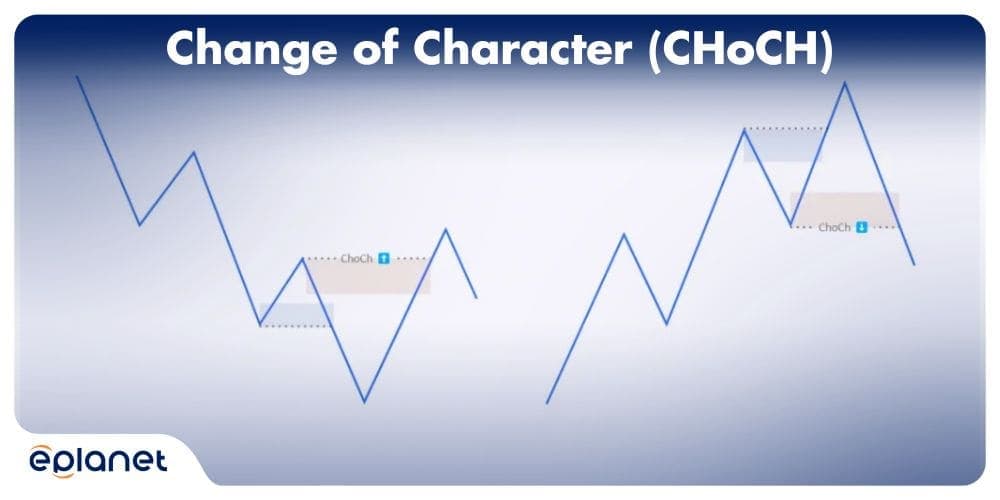
Reading a traders’ room is for the most part rather uneventful, price action unfolding much like you would have predicted pre trade plan. Then, seemingly out of nowhere, things can completely reverse image overnight leaving you grinning like a chump or scratching your head wondering what hit you. All traders experience these shifts in price behavior which is why you’ll hear us refer to them as instances of the Change of Character (ChoCH).
Most traders are in a constant pursuit for that latest “edge in the market”, as they scour the globe for the perfect indicator or latest black magic trading strategy. The reality is, for those who have followed the markets for any length of time, a beast like ChoCH is plain to see. It isn’t particularly complex or “clever” for those who choose to observe. And for those who do pay attention, there is a reason ChoCH offers such value: the market is actually giving us a sense of when a complete and radical reorientation of the trend is at hand.
Key Takeaways
- ChoCH identifies market reversals by spotting when price breaks previous market structure in the opposite direction of the prevailing trend, offering traders early signals of potential trend changes with a 60-70% success rate when properly executed.
- Wait for confirmation signals before entering ChoCH trades, including volume surges, successful retests of broken levels, and follow-through movement—patience prevents costly fake-out trades that can destroy trading accounts.
- Multi-timeframe analysis enhances ChoCH accuracy by aligning higher timeframe trend changes with lower timeframe entry points, creating high-probability setups that professional traders use to maximize their edge.
- Smart money concepts drive ChoCH patterns as institutional players create liquidity sweeps and order block formations before major structural shifts, making these patterns reliable indicators of where big money is positioning.
- Risk management determines ChoCH trading success through proper position sizing (1-3% per trade), strategic stop loss placement below/above broken levels, and maintaining 2:1 or better risk-reward ratios for long-term profitability.
What Exactly Is This ChoCH Thing Everyone's Talking About?
Let's cut through the trading jargon and get real for a second. Change of Character is basically the market's way of announcing, "Hey, I'm done with this trend, time for something new." It's that pivotal moment when market structure shifts from one direction to another—like watching a sports team suddenly change their entire game plan mid-match.
This concept is a cornerstone of what professional traders call Smart Money Concepts—the advanced methodology where institutional players and big money moves create these structural shifts that retail traders can learn to identify and follow.
In technical terms, ChoCH occurs when the market breaks previous market structure in the opposite direction of the prevailing trend. But honestly, that definition sounds about as exciting as watching paint dry. Let me paint you a picture that actually makes sense.
Imagine you're at a party where everyone's been dancing to hip-hop all night. Suddenly, the DJ switches to classical music. That jarring moment of transition? That's essentially what happens in the markets when ChoCH occurs. The entire vibe shifts, and smart traders position themselves accordingly.
The Anatomy of a ChoCH Pattern
Here's where things get interesting. A Change of Character doesn't just happen randomly—it follows a specific pattern that you can learn to spot:
Trending Phase: The market establishes a clear direction, creating higher highs and higher lows (uptrend) or lower highs and lower lows (downtrend). Everyone's comfortable, riding the wave.
The Break: Price decisively breaks the most recent significant high or low in the opposite direction of the trend. This is where most amateur traders panic.
The Confirmation: The market doesn't just fake you out—it continues in the new direction, often with increased momentum. This is your "aha" moment.
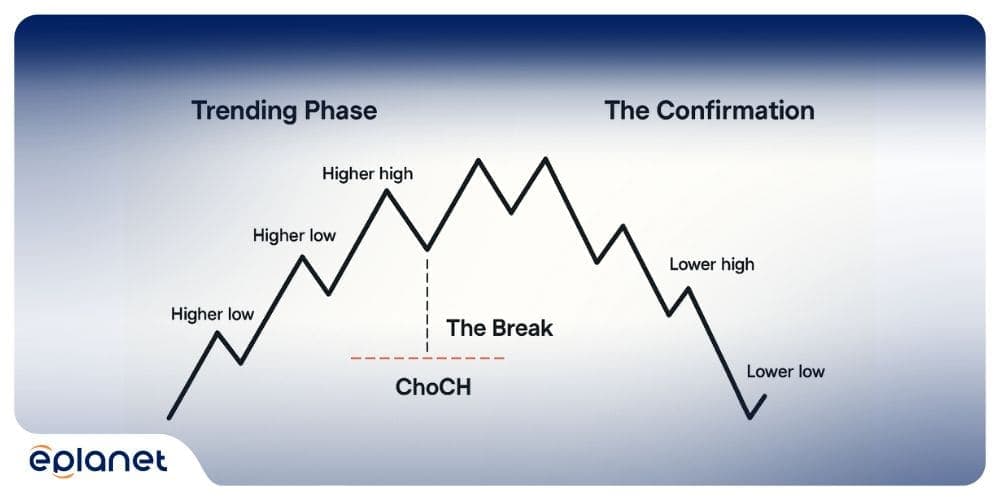
Three Phases of CHoCH Formation
Why ChoCH Happens: The Psychology Behind Market Reversals
You know what's fascinating about Change of Character patterns? They're not just random market movements—they're the result of collective human psychology playing out in real-time. When I first started trading, I thought markets were purely mathematical. Boy, was I wrong.
ChoCH occurs because of what I like to call the "herd mentality breaking point." Picture a crowded movie theater where everyone's been sitting quietly. Suddenly, someone yells "fire!" and the entire crowd's behavior changes instantly. That's essentially what happens in markets during a ChoCH moment.
Smart Money vs. Retail Money: Professional traders and institutions often start positioning for reversals before retail traders catch on. They begin accumulating or distributing positions, creating the initial cracks in market structure.
Liquidity Sweeps: Before a major ChoCH, you'll often see what traders call "liquidity sweeps"—quick moves that grab stop losses before the real move begins. It's like clearing the deck before the main event.
Sentiment Shifts: News events, economic data, or simply overbought/oversold conditions can trigger the initial sentiment change that leads to ChoCH.
The Different Flavors of ChoCH: Not All Changes Are Created Equal
Here's something most trading educators won't tell you: not all Change of Character patterns are the same. I've identified several distinct types, each with its own personality and trading implications.
Bullish ChoCH: When Bears Throw in the Towel
A bullish ChoCH happens when a downtrending market suddenly breaks its most recent lower high with conviction. It's like watching a boxer who's been on the defensive suddenly land a knockout punch. The characteristics include:
- Price breaks above the most recent lower high
- Often accompanied by increased volume
- Previous support levels become new resistance
- Creates opportunity for long positions
Bearish ChoCH: Bulls Getting Reality Check
Conversely, a bearish ChoCH occurs when an uptrending market breaks below its most recent higher low. Think of it as the moment when everyone realizes the party's over and it's time to go home:
- Price breaks below the most recent higher low
- Usually coincides with negative sentiment shifts
- Previous resistance becomes new support
- Sets up potential short opportunities
Fake-Out ChoCH: The Market's Cruel Joke
Now here's where things get tricky. Sometimes the market will give you what looks like a textbook ChoCH, only to reverse back to the original trend. These "fake-outs" are why trading isn't just about pattern recognition—it's about understanding context, volume, and confirmation.
FeatureGenuine ChoCHFake ChoCHVolumeStrong increaseWeak or decreasingFollow-throughSustained movementQuick reversalTime frameMultiple time frame confirmationSingle time frameMarket contextAligns with broader sentimentConflicts with overall trend
How to Trade ChoCH Like a Pro: My Battle-Tested Strategy
Alright, here's where the rubber meets the road. You can study ChoCH patterns all day, but if you don't know how to trade them profitably, you're just collecting theoretical knowledge. Let me share the strategy that's worked for me through bull markets, bear markets, and everything in between.
Step 1: Identify the Setup
First, you need to spot a clear trending market. I'm talking about obvious higher highs and higher lows (uptrend) or lower highs and lower lows (downtrend). If you're squinting at your chart trying to determine the trend, move on to the next opportunity.
Step 2: Wait for the Break
Patience is key here. You're waiting for price to decisively break the most recent significant high or low opposite to the trend. I emphasize "decisively" because weak breaks often lead to fake-outs that'll eat your lunch money.
Step 3: Look for Confirmation
This is where most amateur traders mess up. They see the break and immediately jump in, only to get whipsawed when the market reverses. I wait for one of these confirmation signals:
- Volume surge accompanying the break
- Retest of the broken level that holds as new support/resistance
- Follow-through movement in the direction of the break
Step 4: Enter with Proper Risk Management
Once confirmed, I enter the trade with a stop loss just below/above the broken level (depending on direction) and target the next significant support/resistance level. Risk management isn't sexy, but it's what separates profitable traders from the broke ones.
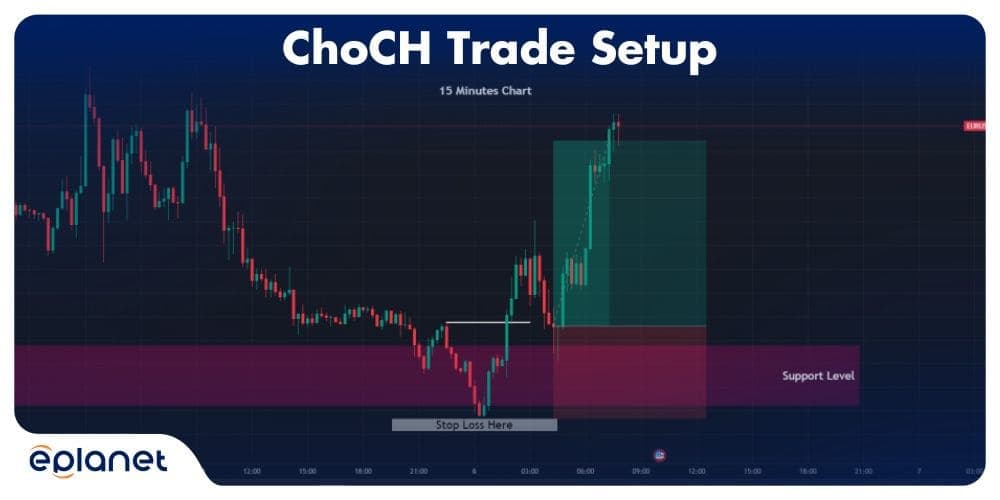
ChoCH Trade Setup (Entry, Stop Loss, Target)
The Success Rate Reality Check: What You Can Actually Expect
Let's talk numbers, because I'm tired of trading gurus promising 90% win rates with their "secret" strategies. In my experience, quality ChoCH setups have a success rate of approximately 60-70% when properly identified and executed. That might not sound impressive, but here's the kicker—the winners typically outsize the losers by a factor of 2:1 or better.
This is why ChoCH trading works: you don't need to be right all the time, you just need your winners to be bigger than your losers. It's basic math, but it's math that most traders ignore in their quest for the holy grail setup.
Factors That Affect Success Rates
Market Conditions: ChoCH patterns work better in trending markets than in choppy, sideways action. When the market doesn't know what it wants to do, neither will your ChoCH signals.
Time Frame: Higher time frames generally produce more reliable ChoCH signals. While you might spot patterns on 5-minute charts, the 4-hour and daily charts are where the magic really happens.
Economic Environment: During high-impact news events or economic releases, ChoCH patterns can become unreliable as price action becomes driven by headlines rather than technical levels.
Smart Money and ChoCH: Following the Big Players
Here's something that took me years to fully appreciate: ChoCH patterns often coincide with what's called "smart money" activity. These are the institutional players, hedge funds, and professional traders who move markets with their massive positions.
Order Blocks: Before a major ChoCH, you'll often see order blocks—areas where large institutional orders were placed. These become significant support or resistance levels.
Liquidity Grabs: Smart money often triggers stop losses (creating liquidity) just before initiating the ChoCH move. It's like clearing out the weak hands before making their real move.
Fair Value Gaps: These are areas where price moves so quickly that it creates an imbalance, often filled later. They frequently appear during ChoCH formations.
Read More: Fair Value Gap (FVG) Explained: The Complete Trading Guide for 2025
Understanding these concepts transforms ChoCH trading from simple pattern recognition to reading the market's deeper story. You're not just trading lines on a chart—you're following the footprints of the big money.
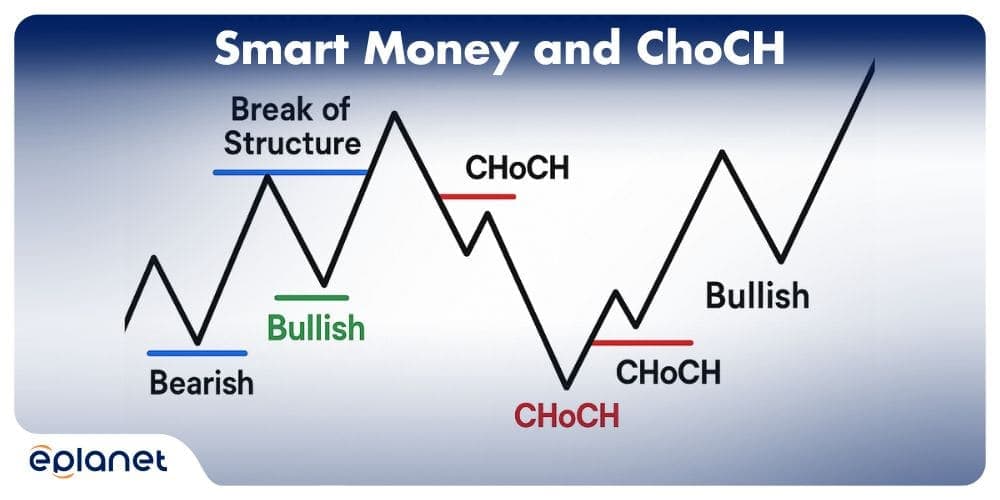
Smart Money concepts in relation to ChoCH patterns
ChoCH vs. Other Trading Concepts: Clearing Up the Confusion
The trading world loves its acronyms and fancy terms, and sometimes they overlap in ways that confuse traders. Let me clear up some common mix-ups:
ChoCH vs. Market Structure Shift (MSS)
Many traders use these terms interchangeably, but there's a subtle difference. Market Structure Shift is the broader concept, while ChoCH is a specific type of MSS that involves a complete character change in price action behavior.
ChoCH vs. Break of Structure (BOS)
Break of Structure is more about breaking key levels, while ChoCH implies a fundamental change in market behavior and sentiment. Think of BOS as the action, and ChoCH as the implication of that action.
Read More: What is a Break of Structure?
ChoCH vs. Traditional Support/Resistance Breaks
Traditional support and resistance breaks focus on specific price levels. ChoCH considers the broader context of market structure and the implications for future price movement.
ChoCH vs BOS vs MSS: Understanding the Key Differences
One of the biggest sources of confusion for developing traders is understanding the difference between Change of Character (ChoCH), Break of Structure (BOS), and Market Structure Shift (MSS). These concepts are closely related, but they are not identical.
Each one provides a different insight into price behavior, trend direction, and potential trading opportunities. Knowing when to use each concept can dramatically improve decision-making and market timing.
| Concept | Meaning | What It Usually Signals | Best Use Case |
|---|---|---|---|
| ChoCH | Change of Character | Possible trend reversal or sentiment shift | Spotting early market turns |
| BOS | Break of Structure | Trend continuation or confirmation | Trading with the current trend |
| MSS | Market Structure Shift | Strong momentum shift with structural break | Confirming aggressive reversals |
In simple terms, Break of Structure is usually continuation-focused, while Change of Character is often reversal-focused. Market Structure Shift is commonly used when price breaks structure with clear momentum, showing that control may be changing hands quickly.
Think of it like this:
- BOS says the current trend is still healthy.
- ChoCH says the current trend may be ending.
- MSS says momentum has already started changing.
Professional traders often combine all three concepts rather than relying on only one signal.
For example, a bearish ChoCH may appear first, followed by an MSS as selling pressure increases, and then a BOS lower confirms that a new downtrend is underway. This sequence can provide stronger confirmation than using a single pattern in isolation.
The real edge comes from context. During trending markets, BOS setups may offer cleaner continuation entries. During exhausted trends or after liquidity sweeps, ChoCH and MSS signals can become far more valuable.
Instead of asking which one is best, smart traders ask which one best fits the current market environment.
The Psychology Game: Why Most Traders Miss ChoCH Opportunities
Here's something I've observed after years in this business: most traders are terrible at recognizing ChoCH patterns, not because they're technically incompetent, but because they're psychologically unprepared for what these patterns represent.
Fear of Missing Out (FOMO): When traders see a strong trend, they want to jump on board, even when ChoCH signals suggest the party might be ending.
Confirmation Bias: Traders often see what they want to see, ignoring ChoCH signals that contradict their existing positions or biases.
Analysis Paralysis: Some traders recognize ChoCH patterns but overthink the setup, missing the optimal entry point while waiting for "perfect" confirmation.
The solution? Develop what I call "pattern discipline"—the ability to follow your trading rules even when your emotions are screaming otherwise.
Advanced ChoCH Strategies: Taking It to the Next Level
Once you've mastered basic ChoCH recognition and trading, it's time to level up your game. Here are some advanced concepts that separate intermediate traders from the pros:
Multi-Timeframe ChoCH Analysis
The Fractal Nature: ChoCH patterns appear on all timeframes, from 1-minute charts to monthly charts. The key is understanding how they interact across different timeframes.
Top-Down Analysis: Start with higher timeframes to identify the major ChoCH, then drop down to lower timeframes for precise entry timing.
Confluence Trading: The most powerful ChoCH setups occur when multiple timeframes align, creating what traders call "confluence."
Combining ChoCH with Volume Analysis
Volume tells the story behind price movement. During genuine ChoCH formations, you'll typically see:
- Expansion of volume during the initial break
- Contraction during any retest phase
- Re-expansion as the new trend establishes itself
Using ChoCH for Position Sizing
Here's an advanced concept: not all ChoCH setups are created equal. I adjust my position size based on the strength of the ChoCH signal:
High Conviction ChoCH: Multiple timeframe alignment, strong volume, clear break.
Medium Conviction ChoCH: Good setup but missing one or two confirmation factors.
Low Conviction ChoCH: Weak signal, used primarily for small speculative positions.
ChoCH StrengthPosition SizeRisk Per TradeHigh Conviction2-3% of account1% riskMedium Conviction1-2% of account0.5% riskLow Conviction0.5-1% of account0.25% risk
Common ChoCH Trading Mistakes (And How to Avoid Them)
Let me save you from the painful lessons I learned the hard way. These are the most common mistakes I see traders make with ChoCH patterns:
Mistake #1: Trading Every ChoCH Signal
The Problem: Not all ChoCH patterns are worth trading. Some occur in low-volume environments or during sideways markets where they lack follow-through.
The Solution: Be selective. Quality over quantity wins every time.
Mistake #2: Ignoring Market Context
The Problem: Trading ChoCH patterns in isolation without considering broader market sentiment, economic events, or sector rotation.
The Solution: Always consider the bigger picture. Is your ChoCH signal aligned with or fighting against major market forces?
Mistake #3: Poor Risk Management
The Problem: Getting so excited about a ChoCH setup that you risk too much on a single trade.
The Solution: Stick to your risk management rules regardless of how "perfect" the setup looks.
Mistake #4: Premature Entry
The Problem: Jumping in at the first sign of a potential ChoCH without waiting for proper confirmation.
The Solution: Patience pays. Wait for your confirmation criteria to be met before pulling the trigger.
The Future of ChoCH Trading: Where We're Heading
As markets evolve and algorithmic trading becomes more prevalent, ChoCH patterns are also evolving. Here's what I'm seeing and where I think we're headed:
Faster Pattern Formation: With increased market speed and automation, ChoCH patterns are forming and resolving more quickly than in the past.
Increased Noise: More algorithmic trading means more false signals and fake-outs, making pattern confirmation even more critical.
Cross-Market Analysis: Modern ChoCH analysis increasingly involves correlation with other markets—stocks, bonds, commodities, and currencies all influence each other.
AI and Machine Learning: Some traders are using AI to identify ChoCH patterns, but human judgment remains crucial for context and confirmation.
Does Change of Character (ChoCH) Still Work in 2026?
So do you still get Change of Character (ChoCH) trades in today’s algorithmic trading driven, high frequency, highly liquid forex, stock and crypto markets with speeds of trade that are many times faster than just a few years ago and with volatility that could possibly be at a all time high for many markets.
The simple answer is yes, the book still works in 2026, but how you apply its lessons has changed.
Change of Character still stands out as one of the best ways to see a shift in market sentiment. However, the rest of trading fundamentals still exist and can be seen through price movement, liquidity structures, and the footprints of big market participants such as institutions.
What has changed is the speed and complexity of the price movement.
The lower timeframes such as the 1-minute and 5-minute charts have never contained as much noise as they do today! The quick stop hunts, false breakouts, and high frequency trading activity in the market are providing plenty of fake signals. For this reason, experienced traders are placing more importance on the higher timeframe ChoCH signals, especially on the 1-hour, 4-hour and daily timeframes.
For the 2026 version of ChoCH, the trade idea should NOT be triggered by using ChoCH as a standalone signal. Rather, the additional confirmation signals should be used in conjunction with it such as:
- Liquidity sweeps before the structure break
- Strong volume expansion during the move
- Retests of broken highs or lows
- Alignment with the higher timeframe trend
- Order blocks or fair value gaps near the entry zone
All things being equal, when these conditions are present, ChoCH can continue to serve as a leading indicator for early reversals and trend continuations.
The way in which markets now trade is vastly different to how they were say 10 years ago. Many of the leading forex markets now get affected by central bank policies, Stock Indexes get affected by key inflation releases, and Crypto markets have in recent times got affected by overall risk sentiment. Therefore, taking a reasoned approach and reviewing context is key. A Counter-trend correction move heralded by a swing trade in the context of strong macro sentiment is typically a more powerful trade than a isolated swing trade.
Yes, the ChoCH indicator still works in 2026. However, traders who will profit with it in the future will be those who adjust the indicator to their current reality, who look for quality setups and constantly demand confirmation.
Despite cycles of market boom and bust, the concept has endured – because although price action changes, man’s nature and liquidity behaviour remain constant.
Practical ChoCH Trading Examples: Real-World Applications
Let me walk you through some real-world scenarios where ChoCH trading principles would apply:
Scenario 1: Tech Stock Breakdown
Imagine you're watching a popular tech stock that's been in a strong uptrend for months. Suddenly, it breaks below a significant higher low with heavy volume. This bearish ChoCH could signal the end of the bull run and the beginning of a corrective phase or even a bear market for that stock.
Scenario 2: Currency Pair Reversal
In forex trading, ChoCH patterns are particularly valuable. Picture EUR/USD in a sustained downtrend, then suddenly breaking above a key lower high with conviction. This bullish ChoCH might indicate a shift in monetary policy expectations or economic sentiment.
Scenario 3: Commodity Market Shift
Gold has been trending lower for weeks, then breaks above a significant lower high during a period of increased geopolitical tension. This ChoCH could signal the start of a new gold bull run as investors seek safe-haven assets.
Tools and Resources for ChoCH Trading
Charting Platforms: TradingView, MetaTrader, and ThinkOrSwim all provide excellent charting capabilities for ChoCH analysis.
Volume Indicators: Use volume indicators like On-Balance Volume (OBV) or Volume Price Trend (VPT) to confirm ChoCH signals.
Multiple Timeframe Analysis: Most modern platforms allow you to view multiple timeframes simultaneously—crucial for ChoCH analysis.
Drawing Tools: Horizontal lines, trend lines, and Fibonacci retracements help identify key levels for ChoCH analysis.
For more detailed information about ChoCH trading strategies and implementation, check out this comprehensive guide on what is a change of character choch and how can you trade it.
ChoCH PDF Resources: Your Trading Library Essential
Here's something I wish someone had told me when I started learning ChoCH—having a comprehensive ChoCH PDF guide on hand makes all the difference during live trading sessions. Think of it as your trading bible, something you can reference quickly without fumbling through multiple browser tabs when the market's moving fast.
Building Your ChoCH Trading Plan
Success with ChoCH trading requires a systematic approach. Here's how to build your own ChoCH trading plan:
Define Your Markets
Choose Your Focus: Are you trading stocks, forex, commodities, or cryptocurrencies? Each market has its own ChoCH characteristics.
Select Timeframes: Determine which timeframes you'll use for analysis and execution. I recommend using at least two timeframes—one for analysis and one for entry timing.
Establish Entry Criteria
Pattern Recognition: Define exactly what constitutes a valid ChoCH setup in your trading plan.
Confirmation Requirements: List the confirmation signals you need before entering a trade.
Volume Requirements: Specify minimum volume criteria for valid ChoCH signals.
Set Risk Parameters
Position Sizing: Determine how much of your account you'll risk per ChoCH trade.
Stop Loss Placement: Define where you'll place stops relative to the ChoCH pattern.
Profit Targets: Establish how you'll take profits on successful ChoCH trades.
Create Review Processes
Trade Journaling: Record every ChoCH trade with screenshots and notes about what worked or didn't work.
Weekly Reviews: Analyze your ChoCH trades weekly to identify patterns in your performance.
Monthly Adjustments: Make adjustments to your ChoCH strategy based on performance data and market changes.
Frequently Asked Questions
What does ChoCH mean in trading?
ChoCH stands for Change of Character. In trading, it describes a shift in market structure where price breaks a previous swing high or swing low against the current trend. Many traders use ChoCH as an early sign that momentum may be changing and a new trend could be forming.
Is ChoCH bullish or bearish?
ChoCH can be either bullish or bearish depending on where it appears.
A bullish ChoCH happens when price breaks above a recent lower high during a downtrend, suggesting buyers may be taking control.
A bearish ChoCH happens when price breaks below a recent higher low during an uptrend, suggesting sellers may be gaining strength.
The pattern itself is neutral—the direction depends on market context.
Is ChoCH better than BOS?
ChoCH and BOS serve different purposes.
Break of Structure (BOS) often signals trend continuation, while Change of Character usually points to a possible reversal or sentiment shift. Many experienced traders use both together rather than choosing one over the other.
For example:
- BOS helps confirm the current trend
- ChoCH helps identify when the trend may be ending
Which timeframe is best for ChoCH?
ChoCH patterns appear on all timeframes, but higher timeframes are generally more reliable.
Many traders prefer:
- 1-hour chart for intraday trading
- 4-hour chart for swing setups
- Daily chart for longer-term positions
Lower timeframes can produce more signals, but they also contain more fake-outs and market noise.
Can beginners use ChoCH?
Yes, beginners can learn to use ChoCH, especially if they already understand basic support and resistance concepts. The key is to focus on clear market structure rather than forcing setups on every chart.
New traders often benefit from combining ChoCH with:
- Trend direction
- Volume confirmation
- Proper stop loss placement
- Risk management rules
Does ChoCH work in forex and crypto?
Yes, ChoCH is commonly used in forex, crypto, stocks, commodities, and indices. Since the concept is based on price structure and market psychology, it can be applied to nearly any liquid market.
However, each market has different volatility characteristics, so traders should always adapt risk management accordingly.
How accurate is ChoCH in trading?
No trading pattern is accurate all the time, and ChoCH is no exception. Its effectiveness depends on market conditions, timeframe selection, and confirmation signals.
ChoCH setups tend to perform better when supported by:
- Strong momentum
- Increased volume
- Higher timeframe alignment
- Liquidity sweep reactions
- Clear retests of broken levels
Is ChoCH good for scalping?
ChoCH can be used for scalping, but lower timeframe setups require faster decision-making and stricter confirmation. Because short-term charts contain more false signals, many traders prefer using ChoCH scalping setups only when they align with the higher timeframe trend.
What is the difference between ChoCH and MSS?
Market Structure Shift (MSS) is a broader term used to describe changes in price behavior. ChoCH is often considered a specific form of market structure shift that signals a possible reversal.
Some traders use the terms interchangeably, but ChoCH usually refers more directly to the break of a recent key swing point against the prevailing trend.
The Bottom Line: Making ChoCH Work for You
After years of trading and teaching others about Change of Character patterns, here's what I know for sure: ChoCH isn't a magic bullet, but it's one of the most reliable ways to identify potential market reversals and trend changes.
The traders who succeed with ChoCH are those who understand that it's not just about pattern recognition—it's about reading market psychology, managing risk effectively, and maintaining discipline in the face of uncertainty.
Start small: Don't bet the farm on your first ChoCH trade. Build confidence through experience and small wins.
Stay patient: The best ChoCH setups require patience. Don't force trades when the setup isn't there.
Keep learning: Markets evolve, and your understanding of ChoCH should evolve too. Stay curious and keep refining your approach.
Trust the process: Like any trading strategy, ChoCH will have losing trades. Trust your process and stick to your rules.
Your Next Steps: From Theory to Practice
Reading about ChoCH is one thing; actually implementing it in your trading is another entirely. Here's your action plan:
- Study the charts: Spend time identifying historical ChoCH patterns on your favorite instruments
- Practice identification: Use a demo account to practice spotting ChoCH setups in real-time
- Start small: When you're ready to trade real money, start with small position sizes
- Keep detailed records: Document every ChoCH trade to track your progress and identify areas for improvement
- Stay disciplined: Stick to your trading plan even when emotions run high
Remember, the goal isn't to get rich quick with ChoCH trading—it's to build a sustainable, profitable approach to reading market reversals and trend changes. The traders who approach ChoCH with patience, discipline, and realistic expectations are the ones who ultimately succeed.
Whether you're a seasoned trader looking to add another tool to your arsenal or a newcomer trying to understand how markets really work, mastering Change of Character patterns can be the difference between reacting to market moves and anticipating them.
The choice is yours: you can keep chasing the latest trading fad, or you can master this time-tested concept that's been helping traders navigate market changes for decades. Which path will you choose?