
Bollinger Bands Explained: Step-by-Step Guide for Traders
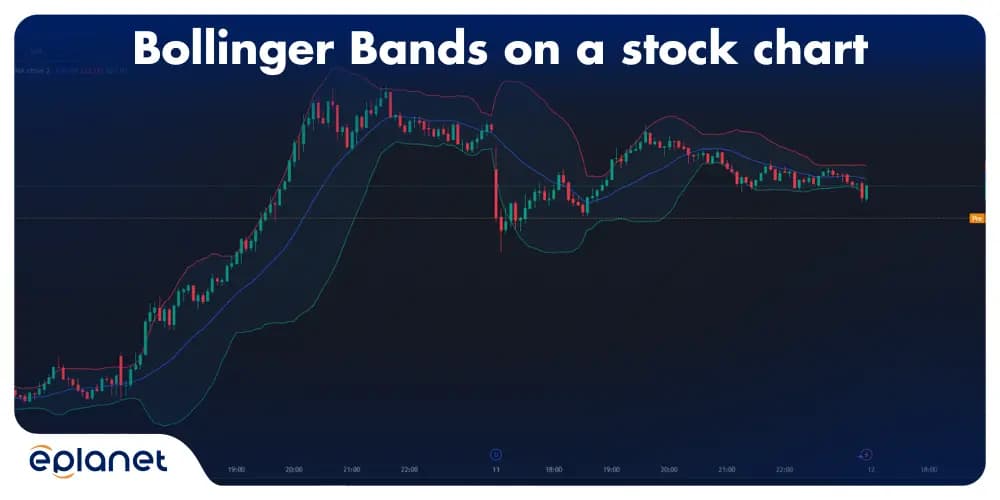
Bollinger Bands are something that people use to look at stocks and stuff. John Bollinger made them back in 1983. So Bollinger Bands have three lines that you can see on a price chart. There is a line in the middle that shows the price over the last twenty days. Then there are two lines, one above and one below that are like boundaries.
Bollinger Bands are a technical analysis indicator that can be used to measure and understand the amount of volatility in a market, as well as the potential for overbought, oversold conditions, or even a possible breakout. However, it’s very important to note that Bollinger Bands should typically be used in conjunction with price action, which are the actual movements of the price itself, as well as other forms of technical analysis, in the form of confirmations or signals. For example, in order to determine whether to continue following along with the trend, or if it’s time to reverse the trend and start going in the opposite direction.
Bollinger Bands can be very effective for analyzing prices because they are dynamic and thus follow and measure the volatility of the market, which is why in practice, many Forex and Gold traders use this indicator. If the bands are converging or narrowing then it can becaues volatility is low the market is poised for a big move - or a big move in the opposite direction of the previous trend. Also, a widening of the bands often means that the market is becoming more and more volatile and thus more active, and therefore, it too can confirm stronger and more consistent movement within a trend.
What Are Bollinger Bands?
Bollinger Bands are like a tool that shows how the market is feeling. They get wider or narrower depending on how crazy the market's. John Bollinger made them in the 1980s. Now they are one of the most popular technical indicators that people who trade use. They are as important to traders as a cup of coffee in the morning.
The good thing about Bollinger Bands is that they are simple. There are three lines that work together.
The line in the middle is like a baseline. It is usually the price over the last 20 days. This is where prices like to be when they are not doing anything.
The other two lines are above and below the middle line. They are usually two deviations away, from the middle line. These lines move with the market. They get wider when the market is crazy and narrower when it is calm.
I still remember when I first learned about Bollinger Bands. I was staying up at night looking at charts and trying to understand what was going on. Then someone showed me Bollinger Bands. It was like everything became clear. It was like someone turned on the subtitles for a movie that I did not understand. Bollinger Bands made it easy for me to see what the market was doing. I was using Bollinger Bands to help me trade. It made a big difference.
Check out John Bollinger’s official Bollinger Bands website
The Math Behind Bollinger Bands (Don't Worry, It's Not That Scary)
Here's where some people's eyes glaze over, but stick with me. The math is actually your friend here, and understanding it gives you a massive edge.
The standard formula uses:
- Period: Usually 20 (but you can adjust this)
- Standard Deviation: Typically 2 (again, adjustable)
- Moving Average: Simple moving average of the closing prices
| Component | Standard Setting | Purpose |
|---|---|---|
| Middle Band | 20-period SMA | Trend direction and mean reversion level |
| Upper Band | SMA + (2 × Standard Deviation) | Resistance and overbought signals |
| Lower Band | SMA – (2 × Standard Deviation) | Support and oversold signals |
The standard deviation part is what makes these bands special. It measures how spread out the prices are from the average. When prices are all over the place (high volatility), the bands widen. When prices are playing nice and staying close to the average (low volatility), the bands tighten up.
How to Use Bollinger Bands Effectively
The Bollinger Band Squeeze: Your Crystal Ball Moment
This is where things get interesting. When the bands squeeze together like an accordion, it's the market's way of saying, "Something big is about to happen." The tighter the squeeze, the bigger the potential explosion.
I've seen traders make their entire month's profit from a single squeeze breakout. It's that powerful.
How to spot it:
- Upper and lower bands are closer together than they've been in at least 6 periods
- Volume often decreases during the squeeze
- Price action becomes range-bound and boring
What to do:
- Set alerts for breakouts above the upper band or below the lower band
- Prepare for increased volatility
- Have your risk management plan ready
The Bollinger Bounce Strategy
This one's built on the idea that prices are like rubber balls – they tend to bounce off the bands and head back toward the middle. It works best in ranging markets where there's no strong trend.
The setup:
- Price touches or penetrates the upper band (potential sell signal)
- Price touches or penetrates the lower band (potential buy signal)
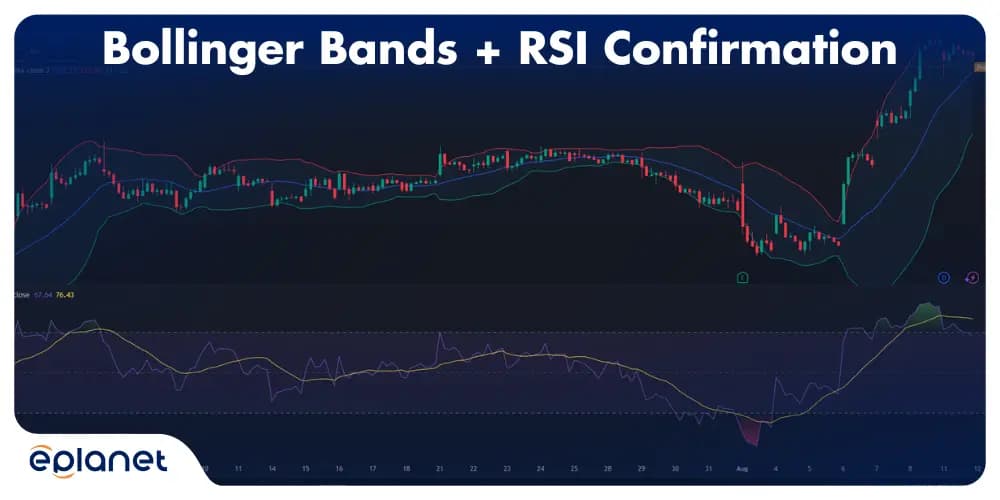
- Look for confirmation with other indicators like RSI or MACD
Walking the Bands (Trend Following)
Sometimes prices don't bounce – they walk along the upper or lower band like they're on a tightrope. This usually happens in strong trending markets.
Upper band walk: Strong uptrend, prices consistently stay near or above the upper band.
Lower band walk: Strong downtrend, prices consistently stay near or below the lower band.
Standard Settings Breakdown
| Timeframe | Period | Standard Deviation | Best For |
|---|---|---|---|
| Day Trading | 20 | 2.0 | Quick scalps and intraday moves |
| Swing Trading | 20 | 2.0 | Multi-day to weekly positions |
| Position Trading | 50 | 2.5 | Long-term trends and major reversals |
| Scalping | 10 | 1.5 | Ultra-short term entries |
Custom Settings for Different Markets
Volatile markets (like crypto): Try 20, 2.5 or even 20, 3.0 to avoid false signals.
Stable markets (like blue-chip stocks): 20, 1.5 might give you more sensitive signals.
Trending markets: Consider using 50, 2 for stronger trend confirmation.
I learned this the hard way when I first started trading crypto with standard Bollinger Band settings. Got whipsawed more times than I care to admit. Once I adjusted for higher volatility, my win rate improved dramatically.
The Rule for Bollinger Bands
If I had to give you one rule to live by with Bollinger Bands, it would be this:
Never trade against the overall trend based solely on a Bollinger Band signal.
This simple rule will save you from more losses than any other piece of advice. Bollinger Bands are excellent for timing entries and exits within the context of the major trend, but they're poor at predicting major trend reversals on their own.
How Reliable Are Bollinger Bands?
The reliability question is like asking how reliable a car is – it depends on how you drive it and maintain it.
High reliability scenarios:
- Bollinger Band squeeze followed by volume expansion
- Multiple timeframe confirmation
- Combined with momentum indicators
- Used in appropriate market conditions
Lower reliability scenarios:
- Used alone without confirmation
- Applied in choppy, news-driven markets
- Ignoring the overall trend context
Research suggests that Bollinger Bands have roughly 65-70% accuracy when used correctly with proper risk management. That might not sound impressive, but in trading, that's actually quite good – especially when you consider that you can control your risk-reward ratio.
The Secret of Bollinger Bands (That Nobody Talks About)
Here's what the textbooks won't tell you: the real power of Bollinger Bands isn't in the signals they generate – it's in helping you understand market psychology.
When bands are wide, traders are emotional – either greedy or fearful. When bands are narrow, traders are complacent. The transitions between these states are where the money is made.
The four market states:
- Expansion: Volatility increasing, strong moves beginning
- Trending: Sustained directional movement
- Contraction: Volatility decreasing, consolidation phase
- Squeeze: Extremely low volatility, breakout imminent
Understanding which state you're in helps you choose the right strategy. It's like having a weather forecast for the markets.
Bollinger Bands vs Other Indicators
Bollinger Bands vs MACD
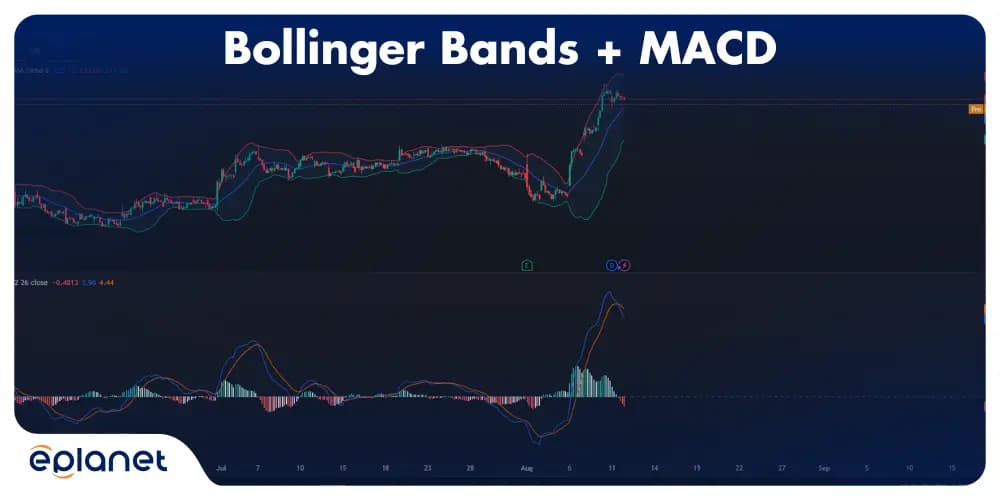
MACD is great for momentum and trend changes, but it's a lagging indicator. Bollinger Bands give you real-time volatility information and can spot potential reversal points before MACD even twitches.
When to use MACD: Confirming Bollinger Band signals, especially trend changes.
When to use Bollinger Bands: Volatility analysis, support/resistance levels, squeeze setups.
Read More: What is MACD?
Bollinger Bands vs RSI
RSI measures overbought/oversold conditions but doesn't adapt to changing market volatility. Bollinger Bands automatically adjust their "overbought" and "oversold" levels based on recent price action.
The combo: Use RSI divergences to confirm Bollinger Band reversal signals. When price hits the upper band and RSI shows bearish divergence, that's a high-probability short setup.
Read More: What is RSI Indicator?
Bollinger Bands vs VWAP
VWAP (Volume Weighted Average Price) is institutional traders' favorite, but it resets daily and doesn't show volatility. Bollinger Bands provide continuous support/resistance levels that don't disappear at market close.
Pro tip: Use VWAP as your overall bias (long above, short below) and Bollinger Bands for precise entry and exit timing.
Which Indicator Is Best for Trading?
Here's the truth bomb: there's no single "best" indicator. But Bollinger Bands are definitely in the hall of fame for good reasons.
What makes Bollinger Bands special:
- They adapt to market conditions automatically
- They provide multiple types of signals (trend, volatility, reversal)
- They work across different timeframes and markets
- They're visual and intuitive
But they're not perfect. In strongly trending markets, the bounce strategy can be a disaster. In sideways markets, trend-following signals can lead you astray.
Advanced Bollinger Band Strategies
The Double Bollinger Strategy
This is where things get sophisticated. Instead of using just one set of Bollinger Bands, you layer two sets with different parameters:
Inner bands: 20, 1 Outer bands: 20, 2
The space between creates four zones:
- Extreme bullish (above outer upper band)
- Moderately bullish (between inner and outer upper bands)
- Moderately bearish (between inner and outer lower bands)
- Extreme bearish (below outer lower band)
This setup gives you much more nuanced signals and better risk management opportunities.
The Bollinger Band %B Indicator
This hidden gem shows exactly where the current price sits relative to the bands. It oscillates between 0 and 1:
- %B above 1: Price is above the upper band (very overbought)
- %B between 0.8-1: Price is near the upper band (overbought)
- %B around 0.5: Price is at the middle band (neutral)
- %B between 0-0.2: Price is near the lower band (oversold)
- %B below 0: Price is below the lower band (very oversold)
The Three-Timeframe Approach
This is my personal favorite for swing trading:
Long-term chart (daily): Determines overall trend direction.
Medium-term chart (4-hour): Identifies entry zones.
Short-term chart (1-hour): Precise entry and exit timing.
Only take trades where all three timeframes align. It dramatically improves your win rate.
Common Bollinger Band Mistakes and How to Avoid Them
Mistake #1: Assuming Every Touch Is a Reversal
When the price touches a band it doesn't always mean its going to reverse. In trending markets prices can stay close to the bands for a time.
Solution: Always look at the trend. When the market is going up focus on bounces off the band. When the market is going down focus on bounces off the band.
Mistake #2: Using Bollinger Bands Alone
Bollinger Bands are helpful. They don't have all the answers. They need confirmation from indicators or price action signals.
Solution: Create a plan that includes checking volume, momentum and support/resistance levels.
Mistake #3: Wrong Time Frame Selection
Using Bollinger Bands on a 1-minute chart for long-term trading doesn't make sense. You need to match your timeframe to your trading style.
Solution: Day traders should look at intraday charts. Long-term traders should use weekly charts.
Mistake #4: Ignoring the Squeeze
traders only pay attention to Bollinger Bands when they're giving signals. The quiet periods are actually where the biggest opportunities are being set up.
Solution: Set alerts for when bands get really tight. These periods often come before the moves.
Do Day Traders Use Bollinger Bands?
Absolutely. In fact, many professional day traders consider Bollinger Bands essential. Here's why they're particularly useful for intraday trading:
Quick volatility assessment: One glance tells you if the market is sleepy or energetic.
Dynamic support and resistance: Levels that adjust throughout the day.
Breakout identification: Perfect for momentum trading strategies.
Risk management: Clear levels for stop-loss placement.
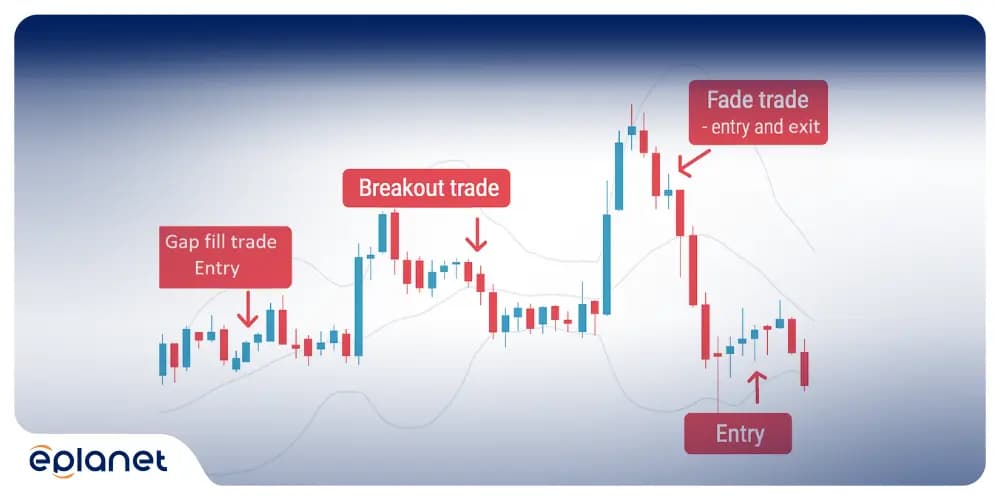
Popular day trading setups:
- Gap fill trades: When a stock gaps up at open, watch for price to return toward the middle band
- Breakout trades: Enter when price breaks through a band with volume
- Fade trades: Counter-trend trades when price hits extreme band levels with divergence
The Best Timeframe for Bollinger Bands
There's no universal "best" timeframe, but here's how to choose:
For Day Trading
Primary chart: 5-minute or 15-minute.
Confirmation chart: 1-hour for trend context.
Filter chart: Daily for overall market bias.
For Swing Trading
Primary chart: 1-hour or 4-hour.
Confirmation chart: Daily for trend direction.
Filter chart: Weekly for major support/resistance.
For Position Trading
Primary chart: Daily.
Confirmation chart: Weekly for trend confirmation.
Filter chart: Monthly for major cycle analysis.
Read More: The Importance of Timeframe in Trading
How to Use 2 Bollinger Bands in Trading
The dual Bollinger Band system is a game-changer for serious traders. Here's how to implement it:
Setup
Fast Bollinger Bands: 10 periods, 1.5 standard deviation.
Slow Bollinger Bands: 20 periods, 2.0 standard deviation.
Trading Signals
Strong buy signal: Price breaks above slow upper band with fast bands expanding.
Moderate buy signal: Price between fast and slow upper bands in uptrend.
Neutral zone: Price between both middle bands.
Moderate sell signal: Price between fast and slow lower bands in downtrend.
Strong sell signal: Price breaks below slow lower band with fast bands expanding.
This system gives you much better signal quality and helps you avoid whipsaws in choppy markets.
Bollinger Band Weaknesses (The Honest Truth)
Every indicator has limitations, and Bollinger Bands are no exception:
Weakness #1: Lagging in Fast Markets
In rapidly moving markets (like during earnings announcements or economic releases), Bollinger Bands can lag behind price action significantly.
What Lagging Actually Costs You: A Real Example
Here is what that lag looks like when real money is involved.
I had a SELL open on XAU/USD, stop loss around 70 pips out. Setup looked fine. Bands normal. No reason to close.
Powell started speaking at 9:30 PM.
At 9:29 the spread started moving. By the time the conference was live, it had widened enough to close my trade at a $37 loss. Price had not actually reached my stop. The bands were not wrong about the setup. They just do not measure what a broker does to spreads when a Fed chair opens his mouth.
After my position closed, price dropped hard in the exact direction I had traded. It went past where my take profit would have been.
The analysis was fine. The spread ate the trade.
This is the part most Bollinger Band guides skip over. The indicator reads price history, not broker conditions. During major news events, those two things stop moving together for a few minutes. That gap is where planned trades get closed in the wrong direction, before the actual move even starts.
Practical fix: On gold or any volatile instrument around Fed decisions, CPI, or NFP, either close the trade manually before the event or use a mental stop instead of a fixed one. The bands cannot protect you from spread expansion. Only you can do that.
Weakness #2: False Signals in Choppy Markets
During periods of high noise and low trend clarity, Bollinger Bands can generate many false signals.
Weakness #3: No Directional Bias
Bollinger Bands tell you about volatility and potential reversal points, but they don't inherently provide directional bias like moving averages do.
Weakness #4: Parameter Sensitivity
Small changes in the period or standard deviation settings can significantly alter signal generation, making optimization tricky.
Success Rate of Bollinger Bands
Let’s talk numbers. Based on extensive backtesting across different markets and timeframes:
| Strategy Type | Approximate Win Rate | Best Markets | Worst Markets |
|---|---|---|---|
| Band Bounce | 60-65% | Range-bound stocks | Strong trending stocks |
| Band Break | 55-60% | Trending markets | Choppy/sideways markets |
| Squeeze Play | 70-75% | Any market | Very low volume periods |
| Combined Approach | 65-70% | Most conditions | Highly news-driven periods |
Important note: These win rates assume proper risk management, confirmation signals, and appropriate market selection. Your results will vary based on your execution and discipline.
When to Buy and Sell with Bollinger Bands
Buy Signals
Strong buy: Price breaks above upper band with expanding volume in established uptrend.
Moderate buy: Price bounces off lower band with RSI showing oversold conditions.
Cautious buy: Price returns to middle band from below in uptrend.
Sell Signals
Strong sell: Price breaks below lower band with expanding volume in established downtrend.
Moderate sell: Price bounces off upper band with RSI showing overbought conditions.
Cautious sell: Price returns to middle band from above in downtrend.
The Context Rule
Never trade Bollinger Band signals in isolation. Always consider:
- Overall market trend
- Volume patterns
- News/events
- Support and resistance levels
- Other technical indicators
How Accurate Is the Bollinger Bands Indicator?
Accuracy is a loaded question in trading. Here's the realistic picture:
In trending markets: 55-65% accuracy for reversal signals, 60-70% for continuation signals.
In ranging markets: 65-75% accuracy for bounce signals.
During squeeze setups: 70-80% accuracy for breakout direction (once the breakout occurs).
The key insight? Accuracy matters less than your risk-reward ratio and position sizing. A 60% accurate system with a 2:1 reward-to-risk ratio will make you money consistently.
Best Strategy for Bollinger Bands
After years of trading and testing, here's my highest-probability Bollinger Band strategy:
The Triple Confirmation Setup
Step 1: Identify market regime (trending vs. ranging) using 50-period moving average.
Step 2: Wait for Bollinger Band squeeze (bands at 20-period low in width).
Step 3: Look for breakout with at least 50% above-average volume.
Step 4: Confirm with momentum indicator (RSI, MACD, or Stochastic).
Step 5: Enter on first pullback to the broken band.
Step 6: Set stop-loss beyond the opposite band.
Step 7: Take profits at 2:1 or 3:1 risk-reward ratio.
This strategy combines the best aspects of volatility analysis, momentum confirmation, and risk management.
Pairing Bollinger Bands with Other Indicators
Bollinger Bands + Volume
Volume is the fuel that powers price movements. When Bollinger Band signals align with volume patterns, the probability of success increases dramatically.
High-probability setups:
- Band breakout with volume 50% above average
- Band bounce with decreasing volume (shows exhaustion)
- Squeeze breakdown with accelerating volume
Bollinger Bands + Moving Averages
Use longer-period moving averages (50, 100, 200) to determine overall trend direction. Only take Bollinger Band signals that align with the major trend.
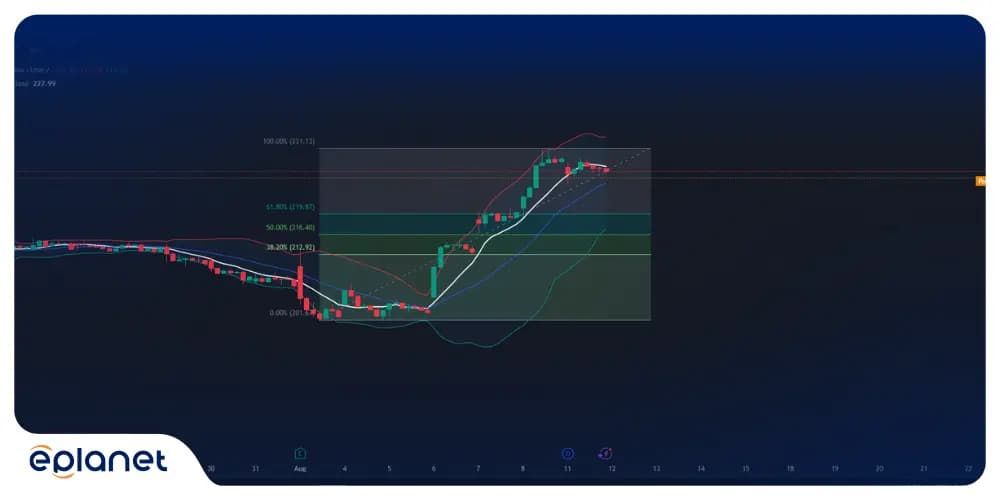
Bollinger Bands + Fibonacci Retracements
When Bollinger Bands align with key Fibonacci levels, you've got institutional-grade support and resistance zones.
Reading a Bollinger Band Indicator
Learning to read Bollinger Bands is like learning to read market emotions:
Band Width Analysis
Expanding bands: Market is becoming more volatile, big moves likely.
Contracting bands: Market is becoming less volatile, consolidation phase.
Extremely narrow bands: Volatility explosion imminent.
Price Position Analysis
Price at upper band: Potential resistance, consider profit-taking.
Price at middle band: Equilibrium, neutral zone.
Price at lower band: Potential support, consider buying.
Band Slope Analysis
All bands sloping up: Strong uptrend in progress.
All bands sloping down: Strong downtrend in progress.
Flat bands: Sideways market, range-trading environment.
Three Lines of Bollinger Bands Explained
The three-line system creates a complete picture of market behavior:
Upper Band (Resistance Level)
- Acts as dynamic resistance in uptrends
- Shows overbought conditions in ranging markets
- Breaking above signals strong bullish momentum
Middle Band (Equilibrium Line)
- Shows the average price over the selected period
- Acts as support in uptrends, resistance in downtrends
- Price tends to return here after extreme moves
Lower Band (Support Level)
- Acts as dynamic support in downtrends
- Shows oversold conditions in ranging markets
- Breaking below signals strong bearish momentum
The genius of this system is that these levels automatically adjust to changing market conditions, unlike static support and resistance lines.
Advanced Tips for Bollinger Band Mastery
Tip #1: Watch the Band Angles
When both upper and lower bands are angled in the same direction, it shows strong trending momentum. When they're angled in opposite directions, expect consolidation.
Tip #2: Use Bollinger Band Width Indicator
This separate indicator shows the width of the bands numerically. Set alerts for 20-period lows in width to catch squeeze setups automatically.
Tip #3: Multiple Standard Deviations
Consider using 1, 2, and 3 standard deviation bands simultaneously. This creates a more nuanced view of support and resistance levels.
Tip #4: Seasonal Adjustments
Some markets have seasonal volatility patterns. Adjust your standard deviation settings accordingly (higher in volatile seasons, lower in quiet periods).
Frequently Asked Questions About Bollinger Bands
What are Bollinger Bands best used for?
Bollinger Bands are best used for identifying volatility shifts, spotting potential reversal points, and timing entries within an existing trend. They are particularly useful for recognising squeeze setups before a breakout and for finding mean reversion opportunities in ranging markets. They work across forex, gold, indices, and stocks.
Do Bollinger Bands work on gold (XAU/USD)?
Yes, and gold is one of the better instruments for Bollinger Band analysis. XAU/USD is highly sensitive to key price levels and reacts strongly to volatility cycles, which makes the bands readable. The squeeze setup on the 5-minute chart is especially effective on gold during the London and New York sessions. One thing to watch is that spreads can widen sharply during news events like Fed decisions or CPI releases, which can trigger stops even when the bands look clean.
What is the best Bollinger Band setting for forex trading?
The standard setting of 20 periods and 2 standard deviations works well for most forex pairs on the 1-hour and 4-hour charts. For gold and other volatile instruments, some traders move to 20 periods and 2.5 standard deviations to reduce false signals during fast moves. For scalping on the 5-minute chart, the default (20, 2) still holds up well as long as you are confirming with price action rather than trading band touches blindly.
Can Bollinger Bands be used for scalping?
Yes. Many short-term traders use Bollinger Bands on the 5-minute chart for scalping entries, particularly on XAU/USD and major forex pairs. The key is to use the bands for context, not as a standalone signal. A candle rejection at the upper band means more when it happens at a known key level than when it happens in open air. Pair with volume or a momentum indicator for better accuracy.
What happens when Bollinger Bands squeeze?
A squeeze happens when the upper and lower bands move close together, meaning volatility has dropped to a low point. It usually signals that a strong move is building. The bands do not tell you which direction the breakout will go, so most traders wait for the first decisive candle outside the bands before entering. Volume expansion alongside the breakout is a useful confirmation signal.
Are Bollinger Bands reliable for day trading?
They are, when used correctly. Bollinger Bands give day traders a real-time read on whether the market is active or flat, where dynamic support and resistance sit, and when volatility is building. The bounce strategy works well in ranging conditions. The squeeze and breakout setup works well before major moves. The mistake most day traders make is treating every band touch as a reversal signal without checking the broader trend first.
Conclusion
Bollinger Bands are not some other tool to help you figure out what is going on in the market. They are like a way to see what people who trade are thinking. They show you when people who trade are feeling good and when they are feeling bad. They show you when people who trade are taking chances and when they are being careful.
The way to do well with Bollinger Bands is not to try to find the way to use them or the perfect plan. It is to understand what Bollinger Bands are telling you about what's happening in the market. Are people who trade feeling emotional or are they feeling okay? Is the market getting more volatile or less volatile? Are things going up and down a lot. Are they staying the same?
If you can understand these things. You practice trading with discipline and you always remember that you should not use just one tool like Bollinger Bands by itself. You should use Bollinger Bands with things like looking at how much people are trading and other tools that help you figure out what is going on.. You should always be smart, about how much risk you are taking.
Your trading account will be happy if you do this.
Key Takeaways
- Bollinger Bands consist of three lines: a middle moving average and two outer bands that expand and contract based on market volatility.
- The squeeze phenomenon: When bands tighten together, it often signals an explosive price movement is coming.
- Mean reversion principle: Prices tend to return to the middle band (moving average) after touching the outer bands.
- Volatility indicator: Wide bands signal high volatility periods, while narrow bands indicate low volatility.
- Multiple timeframe analysis: Combining different timeframes enhances the reliability of Bollinger Band signals.