
Smart money concepts vs ICT: what is the difference and which one do you actually need
The main difference between SMC and ICT is that ICT is built on top of SMC. Same foundation, more terminology. SMC covers Order Blocks, Break of Structure, Change of Character, and liquidity. ICT takes those same concepts and adds layers on top: Fair Value Gaps, Kill Zones, Optimal Trade Entry zones.

The main difference between SMC and ICT is that ICT is built on top of SMC. Same foundation, more terminology.
Most articles will not say that plainly. They will explain both frameworks side by side, list their tools in parallel columns, and conclude somewhere around "both have merit." Technically accurate. Not particularly useful if you are trying to decide where to put your time.
SMC gives you the vocabulary for reading institutional price structure: Order Blocks, Break of Structure, Change of Character, liquidity. ICT takes that vocabulary and adds layers on top. Fair Value Gaps with specific timing rules. Session-based Kill Zones. Optimal Trade Entry zones. If you already understand SMC, a lot of ICT will feel familiar. If you do not yet understand SMC, ICT will feel like a lot of new terminology pointing at the same underlying ideas.
What follows is a direct answer to which one to focus on first, why the learning order matters more than the choice, and what actually separates traders who use these tools well from those who study them indefinitely without results.
Key takeaways
- ICT is not a competing system. It is SMC with extra layers on top. You do not need to choose between them as if they are opposites.
- The learning order is price action first, SMC second, ICT only if you feel you need more after that. Most traders who skip this sequence end up studying more and trading worse.
- Any strategy works if the person using it has solid risk management and the discipline to follow their own rules. The strategy name is not the edge. The execution is.
- Seeing Order Blocks and FVGs everywhere is not competence. It is the most common sign that a trader has studied the concepts but has not yet learned when not to use them.
What SMC actually is
Smart money concepts are built on one idea: large institutional players leave footprints in price structure, and retail traders can read those footprints to position themselves with the money flow rather than against it.
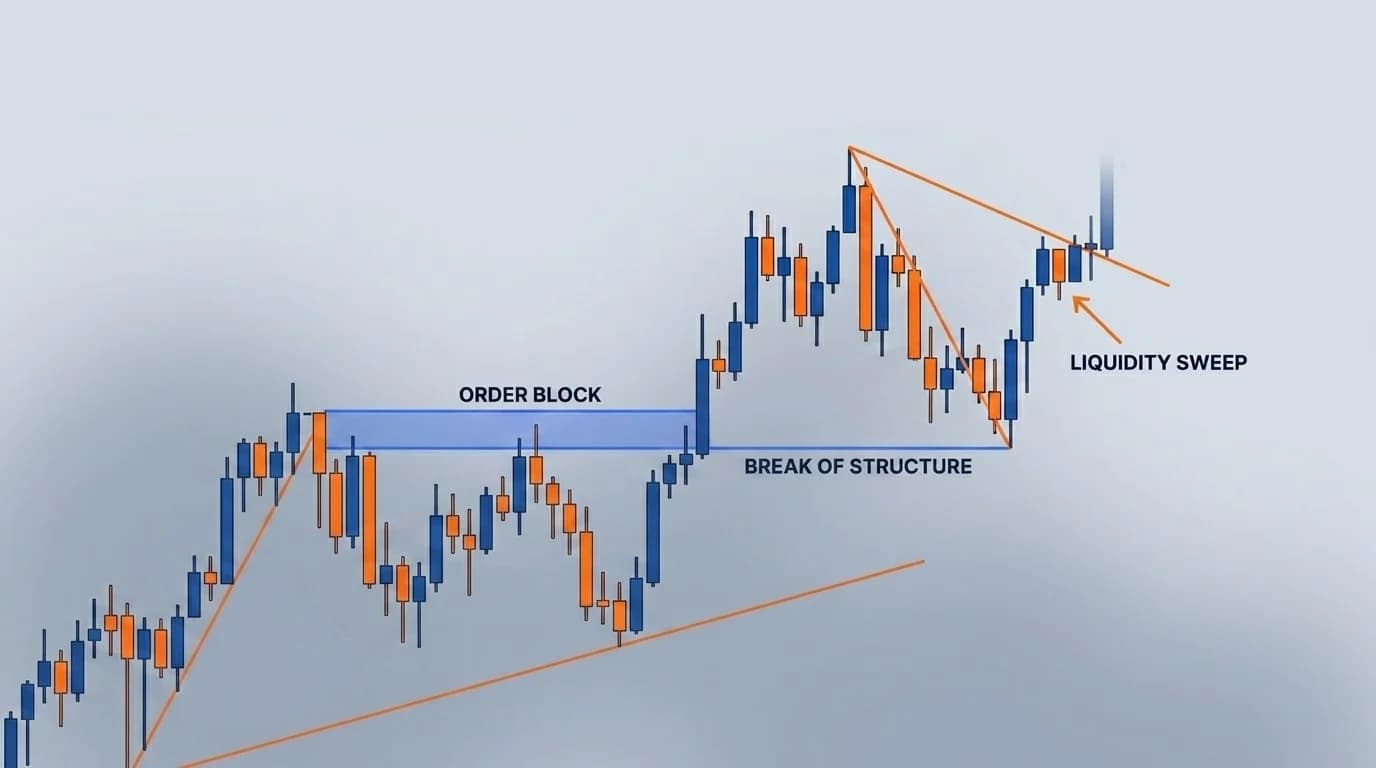
The core tools are Order Blocks, Break of Structure, Change of Character, liquidity grabs, and Supply and Demand zones. These are not new ideas. They are price action concepts with a more specific vocabulary attached to them.
SMC became popular because it gave traders a language to describe things that experienced chart readers had been doing intuitively for years. An Order Block is essentially a specific supply or demand zone. A Break of Structure is a trend continuation signal. A Change of Character is a reversal signal. None of these concepts exist separately from traditional technical analysis. SMC just named them.
What ICT adds
ICT, the methodology developed by Michael Huddleston, takes the SMC foundation and builds additional layers on top of it.
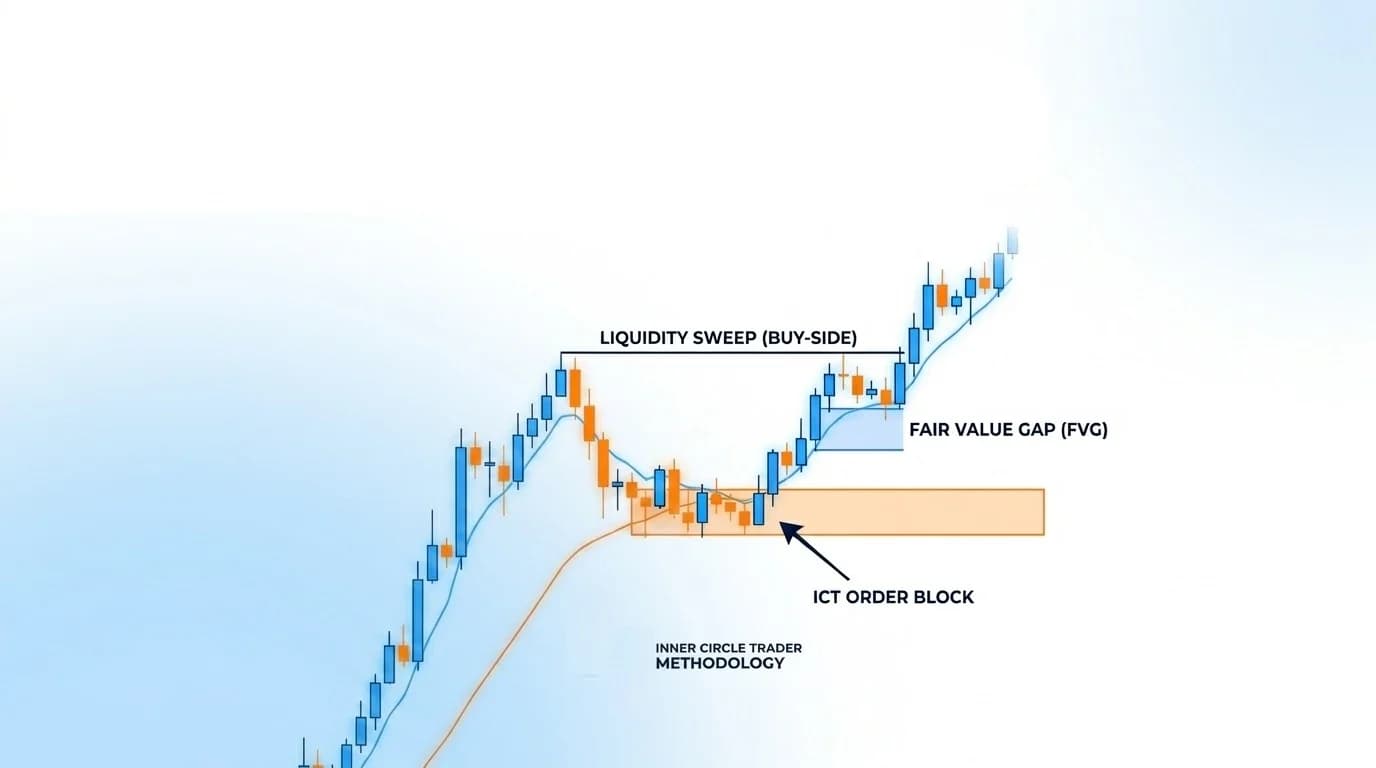
The most practical additions are Fair Value Gaps, Optimal Trade Entry zones, and Kill Zones tied to specific session times. There is also a more detailed model of how institutional order flow works, including Power of Three and specific daily range projections.
Here is the honest picture: most of what ICT teaches is either SMC under a different name or a more granular version of something SMC already covers. Fair Value Gaps are an SMC concept. Breaker Blocks are an SMC concept. ICT formalizes these and wraps a structured trading model around them, but the foundation is the same.
Does ICT give you something SMC does not? Sometimes, for specific traders, yes. For most traders at the 1-2 year mark, the extra terminology creates more confusion than it resolves.
The tools I actually trade with
I trade XAU/USD on the 5-minute chart with a setup built around identifying last week's Higher High rejections. Two SMC concepts show up in my entries consistently.
The first is Breaker Blocks. A Breaker Block forms when an Order Block fails. If price is making Lower Lows and Lower Highs and a previous Order Block gets broken through, that failed Order Block becomes a Breaker Block, and the bias flips.
One trade that shows this clearly: I was watching a bearish sequence on XAU/USD, LL and LH in a row. Price made another LH and I had an Order Block marked at that level. Then price pushed through it and printed a Higher High. The Order Block had failed and converted into a Breaker Block. Structure had shifted bullish. On the pullback to that same level, I entered long. The trade closed at 1:3.
Not complicated. But you need to understand what an Order Block is, and why structure matters, before any of that makes sense. Which is why price action has to come first.
The second tool I use regularly is Fair Value Gaps. My rule is specific: on the 1-hour chart, if price leaves a FVG and does not fill it within 6 hours, that gap is valid. When price returns to that zone later, it becomes a potential entry point. That 6-hour filter came from watching FVGs on live charts over a long time. You will not find it in any ICT course. You develop rules like that by actually trading.
The "trade like institutions" claim
This is where most ICT marketing loses me.
The pitch is that ICT gives you access to how large banks and institutional players actually move markets. That you are learning something insider, something other strategies do not teach.
I think it is overhyped. ICT is a strategy. A good one, for the right trader, but a strategy. Any strategy can work if the person using it manages risk properly and has the discipline to follow their rules. The edge does not come from the strategy name.
I grew a $5,000 account to over $70,000 using a setup built around a specific price action pattern on XAU/USD with SMC confirmation. Not because SMC is better than ICT. Because I found something that made sense to me, tested it enough to trust it, and did not deviate from it when trades went against me.
The traders in my signal group who struggle are almost never struggling because their strategy is wrong. They see an Order Block everywhere. Every FVG looks valid. Every breakout feels like confirmation. They rush entries. They override their own rules.
More ICT concepts do not fix that. They usually make it worse because they give traders more reasons to enter trades that do not qualify.
The learning sequence
If you are at the 1-2 year mark and trying to figure out where to focus, here is what I would tell you.
Start with price action. Not SMC, not ICT. How to read candles, how to identify structure, how to recognize when a trend is continuing versus when it is exhausting. Everything else sits on top of this. Without it, SMC is just a label and ICT concepts are just more labels.
Once you have price action, add SMC. Order Blocks, Break of Structure, Change of Character, how liquidity works. For most traders, this combined with solid price action is enough to build a complete system.
ICT is optional. If you have studied SMC and feel comfortable with it, some ICT concepts add useful detail, particularly around Fair Value Gaps and session timing. But if SMC already answers your questions about why price moves where it does, you do not need to go further.
The problem is that many traders jump to ICT before they have solid price action. They start watching 6-hour ICT breakdowns on YouTube before they can read a clean chart. They build complexity on an unstable base and wonder why nothing works.
How to decide
One simple question for you to ask yourself: do you have a solid price action foundation or are you still trying to work it out?
If you have not yet grasped reading market structure and how price behaves, sticking to price action and a basic SMC set of tools is best for now, until you have a solid grasp of reading markets.
If you have a working price action foundation and SMC makes sense to you, you do not need ICT. Stick with the SMC tools you have mastered. Develop specific rules around those tools to create a filter or trading rule set, like my 6-hour FVG filter, and trade those rules consistently.
If you have solid SMC already and wish to consider how ICT could enhance your entries and timing, study it selectively. Take on board anything that actually adds value and leave the rest. You do not have to study the entire methodology.
SMC and ICT are two different levels within the same building. You need a solid ground floor, price action and basic SMC, before moving to the extra floors, more advanced SMC tools and ICT.
What actually determines results
I have had $50 stop losses trigger at $110 losses because of execution quality at a bad broker. I have seen traders with technically correct analysis blow accounts because their position sizing was wrong. I have watched someone understand Order Blocks well and still lose consistently because they entered every time they thought they saw one rather than waiting for actual confirmation.
Strategy is not what separates profitable traders from unprofitable ones. Risk management and emotional discipline are. A trader with average SMC knowledge and strong risk rules will outperform a technically advanced trader who overtrades, moves stop losses, and lets losses run.
ICT will not give you discipline. SMC will not give you discipline. Trading real money under real pressure, following your own rules, and being honest with yourself about where you fail will do that.
Pick the framework that makes the most sense to you. Learn it properly. Then spend most of your energy on executing it consistently.
That is what nobody says in the SMC vs ICT debate, and it is the only thing that matters.
The bottom line
SMC and ICT are not rivals. ICT is what you get when you take SMC and add more detail to it. For most traders, that extra detail is not what is missing.
What is usually missing is a solid price action foundation, a set of specific rules developed from real screen time, and the discipline to follow those rules when the market is moving and the pressure is real.
Learn price action. Add SMC when you are ready. Look at ICT only if SMC leaves genuine gaps in your system. And at every stage, spend more time executing than studying.
The traders who get this right are not the ones who know the most concepts. They are the ones who know a few concepts well enough to trade them without hesitation.
Frequently Asked Questions
Is SMC better than ICT?
Neither is better. ICT is built on SMC. If you have a solid SMC foundation, adding ICT selectively can sharpen specific entries. If you do not have that foundation yet, jumping to ICT just adds terminology without adding clarity.
Can I use both SMC and ICT in the same trading system?
Yes, and many traders already do without realizing it. Fair Value Gaps and Breaker Blocks appear in both frameworks. If you are using Order Blocks, Break of Structure, and FVGs together, you are already using a combination of both.
Do institutions actually trade the way ICT describes?
Probably not in the exact way the methodology presents it. The ICT model is a retail trader's interpretation of institutional behavior, not a confirmed account of how banks operate internally. It is useful as a framework for reading price structure. Whether it reflects exactly what institutions do is a separate question, and the honest answer is: nobody outside those institutions knows for certain.
I have been studying SMC for 6 months and I am still not profitable. Should I switch to ICT?
Almost certainly not. Six months of studying is not the same as six months of trading with real rules and real risk. Before switching frameworks, ask whether the problem is the strategy or the execution. In most cases, it is the execution.
What is the one SMC concept that actually shows up in live trading?
Order Blocks are the foundation. Everything else, including Breaker Blocks and Fair Value Gaps, builds on your ability to identify where institutional orders were placed and whether price respects or breaks through those levels. Start there.
How long does it take to get good at reading price action before adding SMC?
There is no fixed timeline. The real test is whether you can look at a clean, unmarked chart and identify structure, trend direction, and key levels without needing indicators or labels. When you can do that consistently, you are ready to add SMC on top.