
Forex Risk Management Strategies That Actually Protect Your Capital
Forex risk management is the set of rules you use to limit how much you can lose on any single trade, any single day, and across your entire account. Before a losing streak wipes out what took months to build.

Most forex traders blow their accounts not because they picked the wrong setup. They blow them because they risked too much on the right one.
Forex risk management is how you decide how much capital to put on the line per trade, where your exit is if the trade goes wrong, and what rules protect your overall account when the market moves against you for a week straight. None of it is complicated. Most of it just requires you to do the math before you enter, not after.
What follows covers position sizing, stop loss placement, risk-reward ratios, leverage, and account-level rules. All of it comes from real trading experience, including some expensive mistakes.
Key Takeaways
- Never risk more than 1 to 5% of your account on a single trade. Position sizing kills more accounts than bad setups.
- A 1:2 risk-to-reward ratio means you can be wrong half the time and still make money.
- Leverage is not free money. It amplifies losses at exactly the same rate it amplifies wins.
- A stop loss is not optional, even when the distance to liquidation "looks safe".
- How your broker executes your stop loss matters as much as where you place it.
What Is Forex Risk Management?
Forex risk management is the process of controlling how much capital you expose to the market at any given time. It covers three things: how much you risk per trade, how you structure your entries and exits, and how you protect your account from the kind of loss that ends your trading career.
Most beginners skip this completely. They find a setup they like, put too much money on it, and discover risk management the hard way after a few bad weeks. Every trade has a chance of going wrong. Risk management is what ensures that when a trade goes wrong, and it will, it does not take your account with it.
Why Most Traders Lose Before They Even Find a Bad Setup
Here is something that took me years to fully accept: most retail traders do not lose because their analysis is wrong. They lose because of how much they risk when they are wrong.
I have seen traders with genuinely solid setups, clear market structure reads, and reasonable entry logic blow their accounts in a matter of days. Not because the strategy failed. Because they were risking 20%, 30%, sometimes more on a single position. A losing streak of three or four trades is completely normal at any win rate. It wiped them out before their edge had a chance to play out.
I ran a signal group for a period of time. One day I sent five signals. Four of them hit stop loss. In a normal position-sized world, that is a bad day but a manageable one. For some of my followers, it was a catastrophic one. They were risking 40%, 70%, in a few cases 100% of their capital on a single signal. Some lost their entire accounts.
That day had nothing to do with analysis. It had everything to do with position sizing.

Position Sizing: The Variable Most Traders Ignore
Position sizing answers one question: how many lots do you put on this trade? Most traders answer it with a gut feeling. That is the problem.
The standard starting point is 1 to 5% of your account per trade. For most people, 2% is where you want to be while you are still building consistency. Here is what that actually looks like in practice.
Say your account is $2,000 and you are risking 2%. That is $40 maximum loss on the trade. Now you go to the chart and find your stop loss placement based on market structure, not a number you reverse-engineered from what you want to risk. If that stop loss sits 20 pips away on XAU/USD, you have everything you need.
One pip on a standard gold lot is roughly $10. So:
$40 / (20 pips x $10) = 0.2 lots
That is your position size. You size to the stop, not to the potential win.
I grew a $5,000 account to over $70,000 over two years trading XAU/USD with this exact logic. The lot sizes I was trading at month one and month eighteen looked very different, but the percentage never changed. 5% maximum per trade, three trades per day at most. The account compounded. The lot size followed it. That is the whole system.
How to Calculate Lot Size in Forex
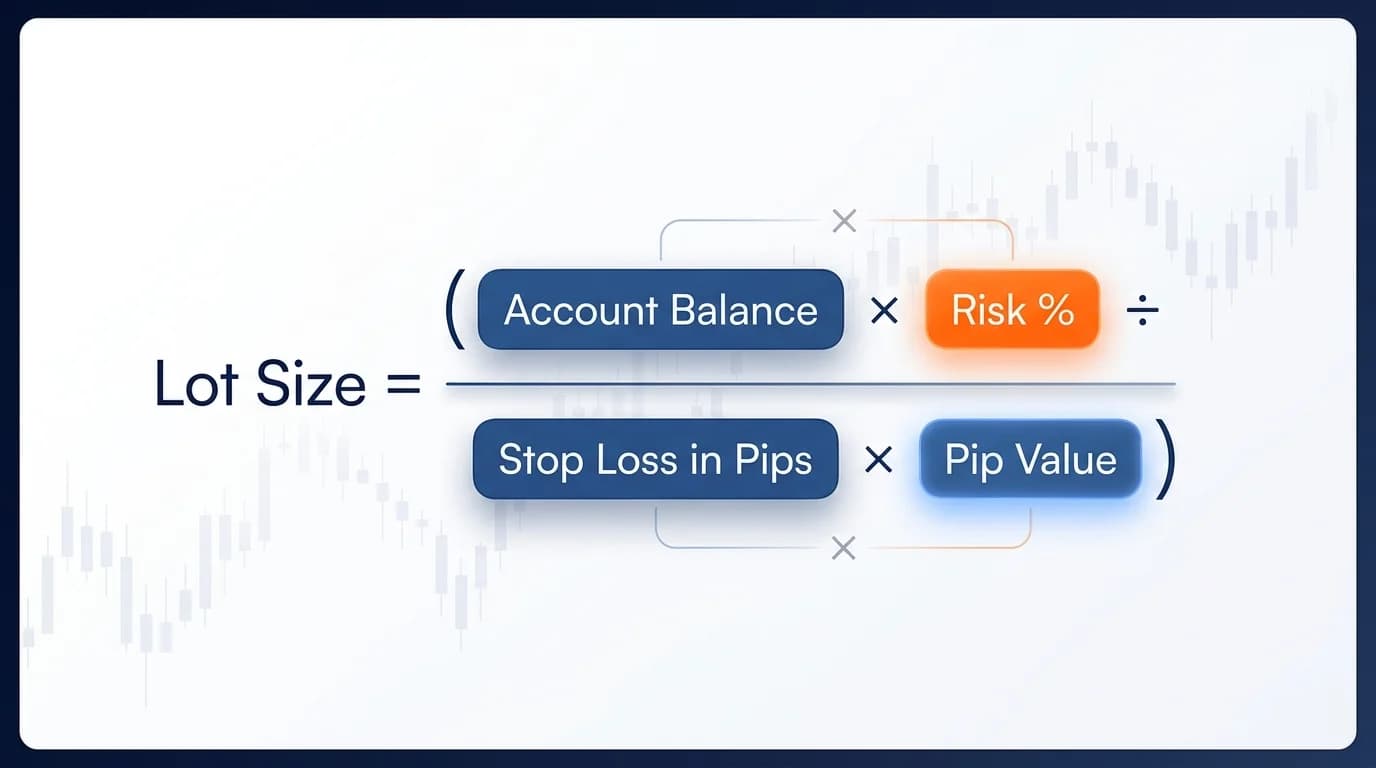
Lot size calculation is one of those things that sounds technical but comes down to three numbers: your account size, your risk percentage, and your stop loss in pips.
The formula:
Lot size = (Account balance x Risk %) / (Stop loss in pips x Pip value)
Pair-specific pip values (for a mini lot / 0.1 lot):
| Instrument | Pip Value per 0.1 Lot |
|---|---|
| EUR/USD | $1.00 |
| GBP/USD | $1.00 |
| USD/JPY | ~$0.92 |
| XAU/USD (Gold) | $1.00 per 0.10 pip move |
For gold specifically, one full pip on a standard lot (1.0) is $10. On a micro lot (0.01), it is $0.10. Gold moves fast and the values add up quickly, which is why position sizing on XAU/USD is not something to eyeball.
A quick way to confirm: before entering any trade, run the numbers. Your stop loss distance and lot size should mean that if the trade hits stop, you lose exactly what you planned to lose. Nothing more.
You can also use our Forex lot size calculator to determine the correct lot size for your trade.
Risk-Reward Ratio: The Math Behind Profitability
The risk-reward ratio is the relationship between how much you stand to lose and how much you stand to gain on a trade.
A 1:2 ratio means you risk 1 to make 2. If your stop loss is $50, your take profit is $100.
Win rate matters less than most traders think. At a 1:2 ratio, you can be wrong on half your trades and still be profitable. Let's say you take 10 trades and win five:
- 5 wins x $100 = $500
- 5 losses x $50 = $250
- Net profit: $250
A 50% win rate with 1:2 risk-reward is profitable. A 70% win rate with a 1:0.5 ratio is not.
I use 1:2 as a hard gate on every trade I take. If the setup does not offer at least 1:2 given my entry and stop loss placement, I skip the trade. There is no negotiating with that rule. A trade that offers 1:1.8 because the next resistance level is slightly closer than I want is a trade I do not take.
This is not a preference. It is arithmetic.
Stop-Loss Strategies That Work in Real Market Conditions
A stop loss closes your trade automatically if price moves against you by a set amount. You place it before you enter. You do not move it closer when the market gets near it.
Where you place it matters more than most traders realise. The two approaches worth knowing are structure-based and ATR-based.
Structure-based means you set your stop just beyond a swing high, swing low, support zone, or resistance level. If price breaks through that level with conviction, the trade premise is gone anyway. Your stop is just confirming what the chart already told you.
ATR-based means you use the Average True Range, which measures how much the market typically moves in a given period, and set your stop at 1x to 1.5x that value. It gives the trade room to breathe without overexposing you to a normal intraday swing. Some traders also use a fixed pip distance for simplicity, though that approach ignores what the market structure is actually doing.
My preference is structure-based. The stop goes where the trade is wrong, not where the math is convenient.
When Your Stop Loss Is Right and the Fill Is Not
I traded with a broker for over a year without a major problem. Then one day I entered a gold trade during the New York session, regular conditions, nothing out of the ordinary, with a $50 stop loss in place. The stop triggered. My account was debited $110.
When I contacted support, they told me not to trade during news hours. It was not a news hour.
Slippage on stop losses is more common than brokers publicly acknowledge. A $50 stop that costs you $110 is not a minor inconvenience. Run that across 100 trades and the edge from your strategy is gone before you even have a chance to see it work. The spread on the account is irrelevant at that point.
I switched brokers, made a small deposit, ran a few trades, and withdrew within 30 minutes. Clean process, no delays. I have not had the same problem since. Where your stop is placed is only half the equation. How your broker fills it is the other half.
Leverage and Risk Management: How to Use It Without Getting Destroyed
Leverage is the ability to control a position larger than your actual capital. A 1:100 leverage ratio means $1,000 can control a $100,000 position.
Leverage does not change your strategy. It changes what happens when your strategy is wrong.
Most brokers in the retail space offer leverage up to 1:500. This sounds like a free ride. It is the opposite. At 1:500, a 0.2% adverse move wipes your entire position. Markets can and do move 0.2% in seconds during news events.
The correct way to think about leverage: use only as much as your position sizing requires, not as much as the broker allows.
If your position size calculation tells you to trade 0.5 lots and your account can technically handle 5 lots at the leverage ratio offered, trade 0.5 lots. The extra leverage is not an invitation. It is a trap for people who confuse what they can access with what they should use.
One of the more painful lessons I saw play out was a leveraged BTC trade with $700 capital at 50x leverage. The position was left open overnight with no stop loss because the liquidation distance looked safe on paper. A macro news event hit during the night. The account was fully liquidated by morning.
The liquidation distance "looked safe." It looked safe until it did not.
Account Management in Forex: The Daily and Weekly Rules That Protect You
Trade-level risk management is not enough on its own. You also need account-level rules that govern how much damage a bad day or a bad week can do to your overall capital.
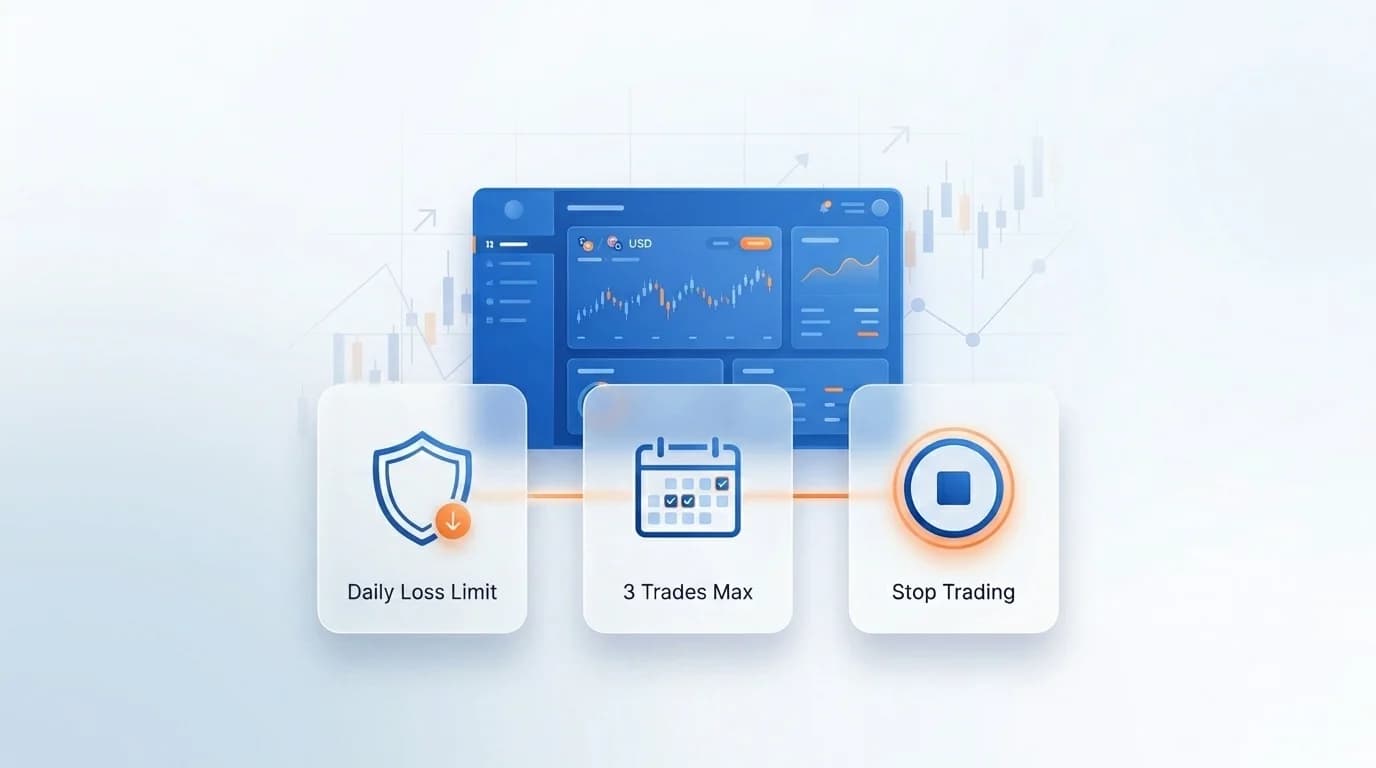
Daily loss limit. Decide in advance the maximum percentage of your account you will lose in a single day before you stop trading. A common figure is 3 to 5%. When you hit that limit, the session is over. No exceptions. No "one more trade to recover."
Trade cap per day. I set a maximum of three trades per day regardless of how many setups appear. Once that limit is reached, the screen goes off. The reason is simple. If you take three trades and all three hit stop loss, you are down but recoverable. If the market looks active and you keep going, bad days become catastrophic ones.
Recovery trading is gambling. The most dangerous period in any trading session is right after a loss. The instinct to recover immediately is nearly universal among traders and almost always makes things worse.
I learned this from a managed account I was running. A client gave me $500 at 1:500 leverage. I traded XAU/USD exclusively, risked 5% maximum per trade, and had a hard cap of three trades per day. The account grew steadily. Then I took two consecutive stop losses and, overconfident from strong demo performance on the same strategy, I doubled my position size and re-entered. Stop loss hit again. I lost about 30% of the profits I had built up to that point in a single session.
I stopped. Went to demo. Applied the exact same strategy on the same timeframe, walked away, came back to find the demo trade deeply in profit. The strategy was not broken. My execution in live conditions, driven by the need to recover, had been the problem.
A good strategy can be destroyed by the person trading it.
Weekly mapping. Good account management also means planning before the week begins. I map support and resistance zones every Sunday before markets open. The zones are drawn before emotions are involved. When Tuesday or Wednesday arrives and price is approaching one of those levels, I already know what I am looking at. I do not need to decide in the moment.
Managing Risk Around News Events
Scheduled news events are a separate category of risk that requires a separate set of rules.
The Non-Farm Payrolls, Fed Chair press conferences, CPI releases, and central bank rate decisions all have one thing in common: they can move price by hundreds of pips in seconds. In that environment, stop losses may not fill at your intended price. Spreads can widen aggressively. Positions that looked safe suddenly are not.
I had a SELL position on XAU/USD open just before a Fed Chair press conference. My stop loss was roughly 70 pips from price. That felt comfortable. At about a minute before the conference started, the spread began widening. When the conference started, the spread widened enough that it triggered my stop, even though the actual market price had not moved to my stop level naturally. The trade closed at a $37 loss. After it closed, price dropped exactly the way I had expected. The take profit I had set would have been hit easily.
Three approaches that work:
Close before the event. If a trade is open and a major data release is approaching, consider closing it for a smaller gain rather than holding through uncertainty.
Wait until after. Do not enter new positions in the 30 minutes before and 15 minutes after a major scheduled release.
Manage manually. If you choose to hold through news, manage the position actively instead of relying on static stop losses. Spread widening can trigger a stop that is not at real market risk.
The calendar for scheduled events is widely available. There is no reason to be caught off guard by a CPI release or an interest rate decision.
Leverage, Demo, and the Gap Between What You Practice and What You Trade
Demo accounts are genuinely useful. They are also regularly misused in ways that make traders worse.
The problem is not demo itself. The problem is that most traders use it without replicating live conditions. They over-leverage because there is no real consequence. They reset the balance when it drops. They trade without any risk management because no actual money is at stake.
That version of demo teaches nothing useful.
A demo account used properly looks exactly like a live account except for the source of funds. Same starting balance as your intended live capital. Same risk percentage per trade. Same daily trade cap. Same stop loss discipline. If the account drops 20% on demo and you would quit trading live, quit demo too and start over.
My live win rate on primary setups runs at 70 to 75%. My demo win rate on the same setups is around 85%. That gap is not the strategy. It is psychological and execution-based. When real money is on the line, the emotional pressure of watching a position move against you for 10 minutes before it turns is genuinely difficult. On demo, you handle that without a second thought. In live trading, most beginners do not.
Demo teaches you to read the market. Live trading teaches you to read yourself. You need both.
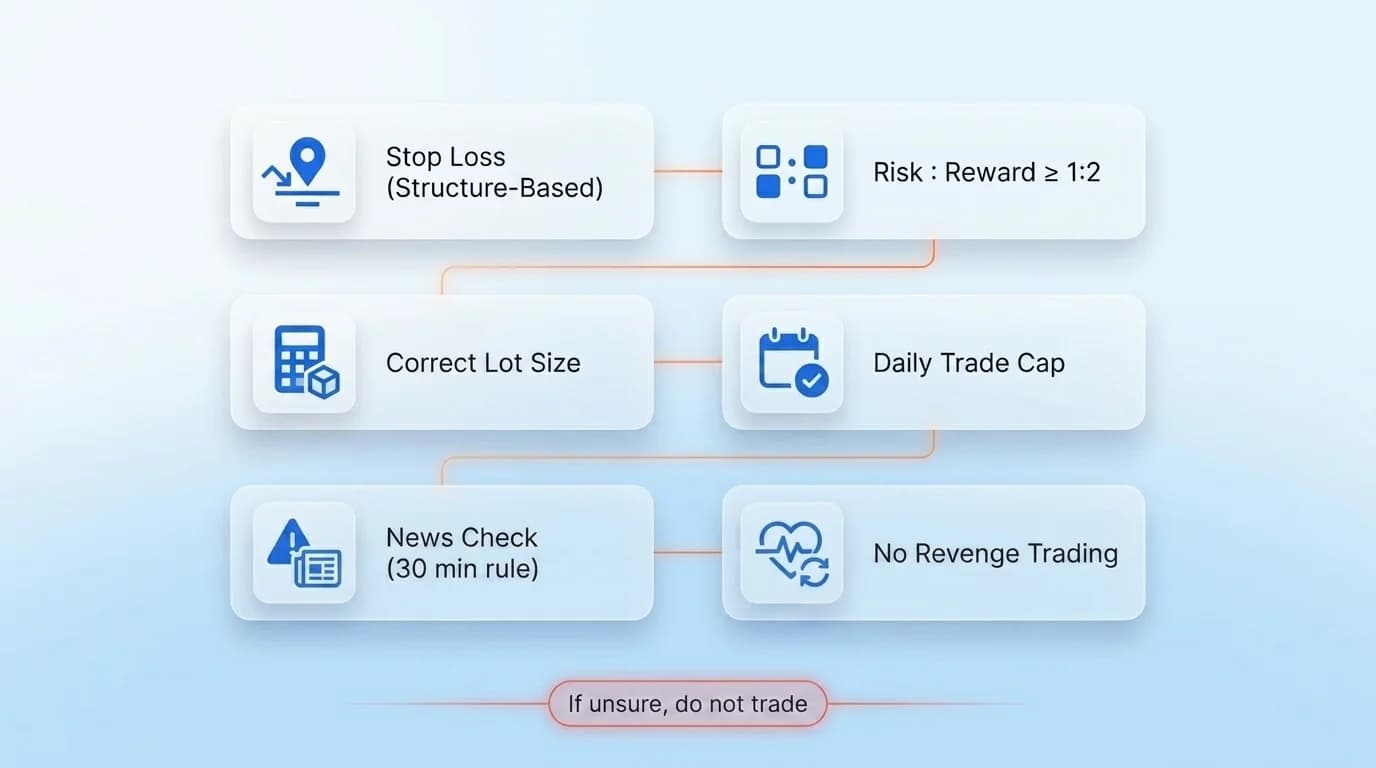
A Forex Risk Management Checklist
Before you enter any trade, run through this:
- Have you set your stop loss based on chart structure, not a round number?
- Does the trade offer at least 1:2 risk-to-reward to a logical target?
- Is your lot size calculated so that hitting the stop costs you exactly what you planned?
- Are you within your daily trade cap?
- Is a major news event scheduled in the next 30 minutes?
- Is this trade based on your strategy, or are you entering because you want to recover from the last loss?
If any answer is no or "I am not sure," the trade does not go on.
FAQ
What is forex risk management?
Forex risk management is the practice of controlling how much capital you expose to loss on any trade or series of trades. It includes position sizing (how many lots you trade), stop loss placement (where the trade closes if it goes wrong), risk-to-reward ratios (the relationship between your potential loss and gain), and account-level rules like daily loss limits and trade caps. The goal is to keep individual losses small enough that a losing streak does not end your trading.
How do you calculate lot size in forex?
Lot size is calculated using three variables: your account balance, your risk percentage, and your stop loss in pips.
Formula: Lot size = (Account balance x Risk %) / (Stop loss in pips x Pip value)
Example: $2,000 account, 2% risk ($40), 20-pip stop loss, trading EUR/USD where one pip on 0.1 lot = $1.
$40 / (20 x $1) = 2.0 mini lots (0.2 standard lots).
For gold (XAU/USD), one pip on a standard lot is approximately $10. If you risk $50 with a 20-pip stop: $50 / (20 x $10) = 0.25 lots.
Always run this calculation before entering. The lot size should be a result of the math, not a guess.
What is a good risk-reward ratio in forex?
1:2 is the minimum worth working with. That means for every dollar you risk, you are targeting two in return. At that ratio, you only need to win half your trades to be profitable. That takes the pressure off chasing a high win rate and lets the math do the work over time.
Some traders use 1:3 or higher, which requires fewer wins but demands more patience waiting for price to reach a further target. The ratio that actually works is whichever one you can apply consistently based on your setups and timeframe. A 1:3 ratio you abandon halfway through a trade is worth less than a 1:2 ratio you hold to.
How much should I risk per trade in forex?
For most retail traders, 1 to 2% per trade is the right starting range. At 2% risk, a losing streak of ten consecutive trades, which is statistically possible even with a solid strategy, would cost you around 18% of your account. Painful but survivable. At 10% per trade, that same streak wipes you out entirely.
The traders I have seen blow accounts fastest are rarely the ones with bad setups. They are the ones risking 20 or 30% per trade and hitting two or three losses in a row. The strategy never had a chance to prove itself because the position sizing was too large for the account to absorb a normal drawdown.
How much leverage is safe in forex?
The leverage your broker offers and the leverage you should use are two different numbers. Retail brokers commonly offer up to 1:500. That does not mean you should use it.
Effective leverage, meaning the actual exposure relative to your account balance after you size the position correctly, should generally stay between 5:1 and 10:1 for most traders. At 10:1 effective leverage, a 10% adverse move costs you your account. At 500:1, a 0.2% move does the same damage.
The way to manage this is through position sizing, not by choosing a lower leverage tier. Size the trade correctly based on your stop loss distance and risk percentage, and your effective leverage takes care of itself.
What is a daily loss limit and should I use one?
A daily loss limit is a pre-set maximum you are willing to lose in a single trading session before you stop for the day. When you hit it, the session ends. Not "one more trade to recover." Ended.
The logic is simple: bad days cluster. If you are down two or three trades in a morning, the conditions that produced those losses, whether that is a choppy market, a news-driven environment, or just an off day, are probably still in play. Adding more trades into that environment is how manageable losses become catastrophic ones.
A figure of 3 to 5% of your account per day is a reasonable starting point. Some prop trading firms use stricter limits. The exact number matters less than having one and following it.
Can you lose more than you deposit in forex?
With most retail brokers, no. Negative balance protection means your account cannot go below zero even if a trade moves sharply against you. Your maximum loss is your deposited capital.
That said, not every broker offers this, and the protection does not prevent your account from being fully wiped in a single session if you are overleveraged and a major news event hits. The stop out level on your account type is the relevant number to know. For example, an account with a 50% stop out closes your open positions automatically when your margin level falls to 50%, before your balance reaches zero. Knowing your broker's stop out level and keeping your effective leverage low means you are unlikely to hit it in normal trading conditions.
Conclusion
Most trading content talks about setups. Which indicator to use. Which pattern to look for. That information is not useless, but it is not what decides long-term results.
What does? Position sizing. Stop loss discipline. The rules you set around leverage, recovery trading, and news events, and whether you actually follow them when the market is moving against you.
The traders I have watched build sustainable results over years share one trait. They know exactly how much they are risking before they enter. Not roughly. Exactly. And they do not change that number because a trade is looking good or because the last one hit stop.
That is the strategy. Everything else is analysis.
If you want to trade in an environment where your risk management actually holds up, eplanet Brokers offers a Gold Special account with spreads from 0.0 pips on XAU/USD, tight stop loss execution, and transparent conditions across major pairs. You can open a demo account and test everything before committing live capital.