
What Is Slippage in Trading? Causes, Types and How to Reduce It
Slippage is the difference between the price you intended to trade at and the price your order actually executed at. It affects every order type, entries, exits, and stop losses, and in fast-moving markets the gap between the two can be larger than most traders expect.

Slippage is the difference between the price you expected your order to execute at and the price it actually filled at. It happens on both entry orders and exit orders, and when it hits your stop loss, it can cost you significantly more than you planned to risk.
Key Takeaways
- Slippage is the gap between your intended execution price and the price your order actually fills at. It affects entries, exits, and stop losses.
- The four main causes are market volatility, low liquidity, large order size relative to available depth, and execution latency.
- Stop losses are submitted as market orders when triggered, which means they carry the same slippage risk as any other order.
- High-impact news events, market open windows, and the US-Asian session rollover are the periods where slippage risk is highest.
- Not all slippage is a market problem. Consistent abnormal slippage during normal conditions points to broker execution quality, not market structure.
What Does Slippage Mean in Trading?
Slippage is what happens when the price shown on your screen and the price your order actually executes at do not match. Slippage occurs when an order is executed at a price greater or lower than the quoted price, typically during periods of high volatility or low market liquidity.
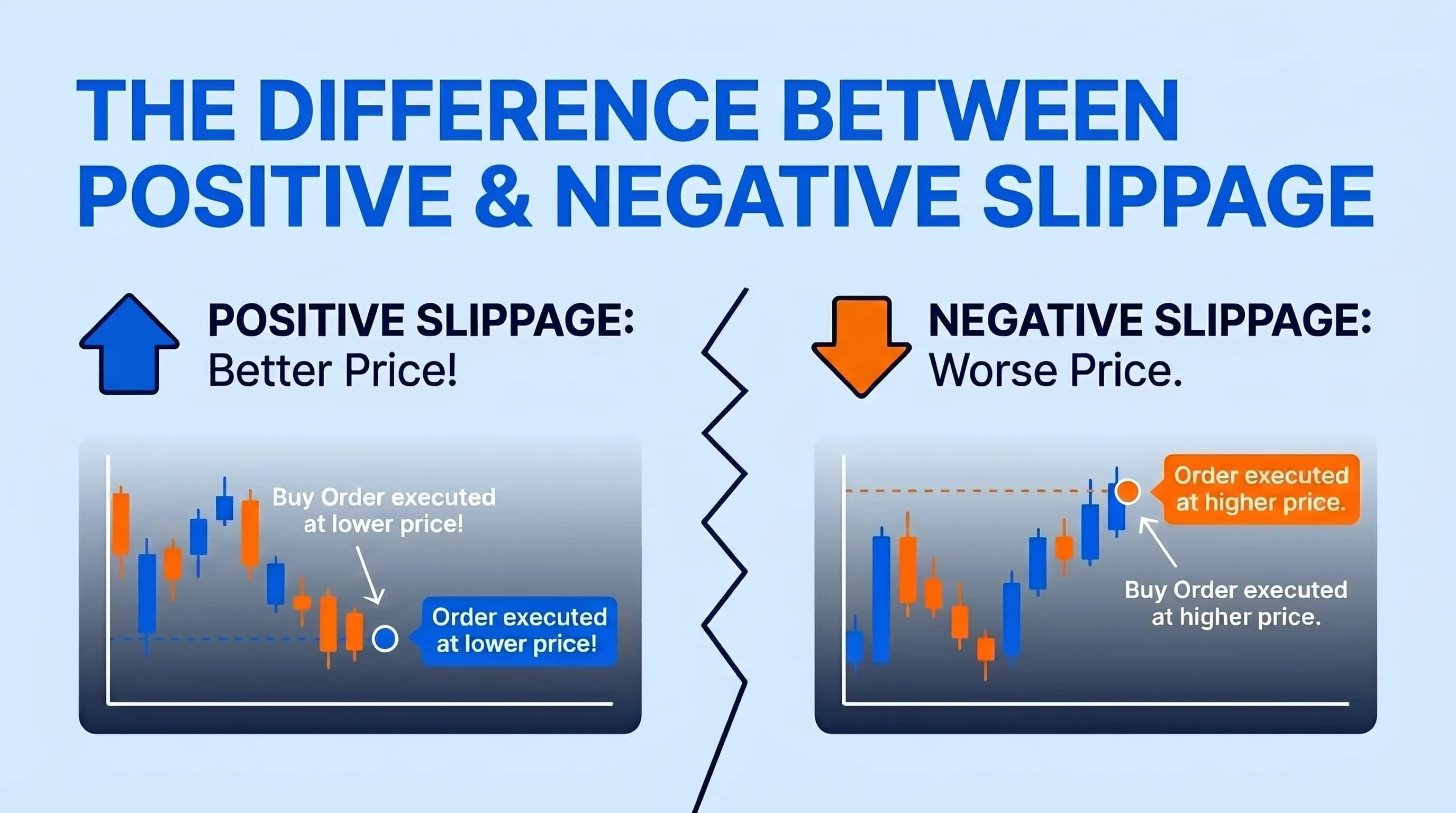
Three outcomes are possible when you place any order. Your order fills at exactly the price you requested: that is zero slippage. It fills at a better price than you expected: that is positive slippage. Or it fills at a worse price: that is negative slippage. Most traders encounter all three eventually, but negative slippage is the one that eats into your edge.
One thing worth understanding early: slippage is not a glitch or a platform error. It is a product of how markets actually work. The price displayed on your chart represents the last traded price, not a guarantee of supply at that level. By the time your order reaches the broker's matching engine, that liquidity may already be gone, and the system fills you at the next available price.
What Causes Slippage in Forex and Gold Markets?
The four main drivers of slippage are market volatility, low liquidity, large order size relative to available depth, and latency between your terminal and the broker's server.
Volatility is the most obvious one. When price is moving fast, during a news release for example, the market can trade through multiple price levels before your order even reaches the book. The price you clicked and the price you get are different because the market moved in the fraction of a second between intention and execution.
Liquidity depth is less visible but just as important. Every price level in the order book has a limited volume of orders sitting at it. If your order size is larger than what is available at the best price, the matching engine works its way down to the next level, then the next, until the full order is filled. The result is an average execution price worse than the quote you saw.
Latency adds another layer. Physical distance between your trading terminal and the broker's server creates a processing delay. Even 50 milliseconds is enough time for price to move against an incoming trade. This is why brokers with low-latency execution infrastructure can reduce slippage exposure for active traders.
On XAU/USD specifically, slippage conditions are worth paying close attention to. Gold is one of the most liquid instruments available to retail traders during the London and New York sessions, but that liquidity thins significantly around market rollovers and low-volume windows. Spreads can widen sharply during these periods, which brings us to something traders frequently misunderstand.
What Is the Difference Between Positive and Negative Slippage?
Negative slippage means your order executed at a worse price than you intended. You paid more to buy or received less to sell. Positive slippage means you got a better price than you asked for. The Corporate Finance Institute defines it plainly: positive slippage gets you a better price than expected, while negative slippage leads to a loss relative to your intended fill.
In practice, positive slippage does happen, particularly on limit orders placed during fast-moving markets where price gaps past your level and then reverses. But if you are consistently trading in conditions that produce slippage, you will experience far more negative than positive outcomes. The conditions that cause slippage tend to work against you, not for you.
Most traders only notice slippage when it hurts. What they miss is that positive slippage on entries and negative slippage on stops tend to net out badly, because the size of the negative event (a stop loss doubling) is far more damaging than the positive events (an entry filling a pip or two better).
Does Slippage Happen on Stop Losses Too?
Yes, and this is where slippage causes the most damage. When price touches your stop level, the stop loss order converts into a market order and executes at the next available price. That means it carries every execution risk of any other market order: volatility, liquidity, latency.
This is more common than most traders realise, and the numbers can be jarring. A $50 stop loss can execute as a $110 loss, which is 120% slippage, in conditions that do not look unusual from the outside. In one case on XAU/USD during a New York session with a SELL position open, the stop triggered not at the intended price but at more than double the intended loss. The session was not a major news release hour. Market conditions were not visibly extreme. The stop simply executed at the next available price, which had moved significantly by the time the order reached the broker's matching engine.
Stop-loss slippage is not always a volatility problem. Sometimes it is a broker execution quality problem, and normal-looking market conditions will not tell you which one you are dealing with until you look at the execution data.
There is also a specific mechanism worth knowing about: spread widening. When you have a position open and the spread widens, the market price does not need to actually move to your stop level for the stop to trigger. The widened spread does it. This feels different from traditional slippage, but the result is the same. You exit the trade at a price worse than you set.
When Is Slippage Most Likely to Occur?
Slippage risk rises sharply around predictable events. If you know when to expect it, you can either avoid those windows or adjust your position management to account for them.
Major economic releases are the highest-risk moments. Events like CPI, Non-Farm Payrolls, and Fed Chair press conferences reliably produce rapid price movement and spread expansion. Brokers and liquidity providers widen quotes during these windows to protect themselves, which means your orders fill at wider prices, and any stop losses in play can trigger from spread widening rather than true price movement.
A SELL position on XAU/USD with a stop loss roughly 70 pips away from current price should have had reasonable buffer. The position was entered with full awareness that a Fed Chair press conference was on the economic calendar. At the moment the conference began, the spread widened sharply and triggered the stop. Price then moved heavily in the direction of the original SELL trade, past the take profit target that had been set. The analysis was right. The execution window ended the trade.
Beyond news events, there are three other high-risk windows to know:
Market open and close transitions. The opening of the London and New York sessions brings a surge of volume that creates short-term execution volatility before the order book settles.
The rollover between US and Asian sessions. This is the lowest-liquidity window in the 24-hour trading cycle. Order books thin out and spreads on most instruments widen. Executing trades during this window increases slippage exposure.
Off-hours on instruments with defined trading windows. Gold sees very different liquidity conditions between the London-New York overlap and the late Asian session. The same setup will execute differently depending on when you take it.
Slippage Risk by Market Condition
| Condition | Risk Level | Why It Happens | What to Do |
|---|---|---|---|
| High-impact news release | Very High | Spreads widen, price moves fast, liquidity providers pull quotes | Close or manually manage stops before the event |
| Market open (London / NY) | Moderate | Surge of orders creates short-term volatility | Wait 5-10 minutes for the book to settle before entering |
| US-Asian session rollover | High | Lowest liquidity window in the 24-hour cycle | Avoid new entries; pre-set stops can trigger from spread widening |
| Normal session hours | Low | Deep liquidity, competitive spreads, stable execution | Standard risk management applies |
| Low-volume instruments | High | Thin order books mean small orders move price | Trade liquid instruments; avoid low-volume pairs during quiet hours |
How Does Slippage Affect Your Trading Strategy?
A strategy with a genuine edge can still underperform if slippage is consistently eroding execution quality. This is one of the most underappreciated gaps between how a strategy looks in backtesting or demo trading and how it actually performs on a live account.
Demo accounts replicate price data but not execution reality. There are no competing orders, no latency effects, and no real liquidity depth being consumed. A strategy showing an 85% win rate on XAU/USD setups in demo can realistically produce a 70-75% win rate in live conditions on the same setups. That gap is not strategy failure. It is execution drag, and slippage accounts for a meaningful portion of it.
The same problem appears on entries. A buy limit on EUR/USD placed ahead of a CPI release is a clean idea on paper: price drops to the limit, fills the order, then moves in the predicted direction. In practice, during a CPI release, price can gap through the limit level entirely, moving too fast for the order to be matched at the intended price, and the order never fills. The analysis was correct. The direction was correct. But the trade did not execute, because slippage affected the entry in a way demo trading would never have revealed.
Experienced traders build execution testing into their broker evaluation process for exactly this reason. A broker that handles fast-market entries and exits consistently is part of your edge, not a variable you can ignore when comparing advertised spreads.
Is Slippage Caused by the Broker or the Market?
Both, but they need different responses.
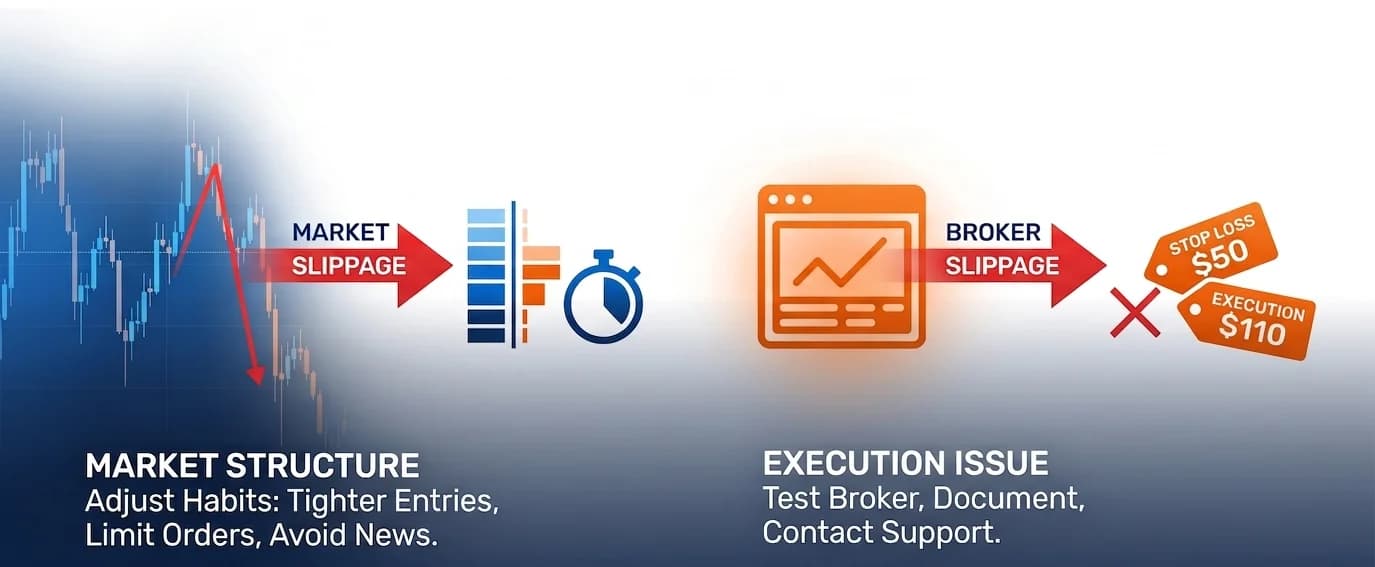
Normal market slippage comes from market structure. When price moves fast, liquidity thins, or your order size exceeds available depth, you will not get the price you asked for. This happens across all brokers, all platforms, all instruments. Managing it means choosing when to trade, what order types to use, and how to size positions relative to liquidity.
Abnormal slippage is a different problem. When a stop loss executes at more than double its intended level during a normal session, not a news hour, not a rollover window, not a visible volatility event, that is a broker execution quality issue. A $50 stop loss that costs $110 is not a spread problem. It is a broker problem.
Two different problems, two different fixes. For normal slippage, adjust your habits: tighter entries, avoid news windows, use limit orders where you can. For abnormal slippage, test the broker with real money, document the execution, contact support, and make a decision. A support team that responds with a template blaming conditions that were not present is telling you something useful about how they operate.
Choosing a broker based on advertised spread is the wrong filter. A broker with slightly higher commission but clean, consistent execution will cost you less over time than one with tight advertised spreads and fills you cannot rely on.
Read More: How to choose a forex broker
How Can You Reduce Slippage When Trading?
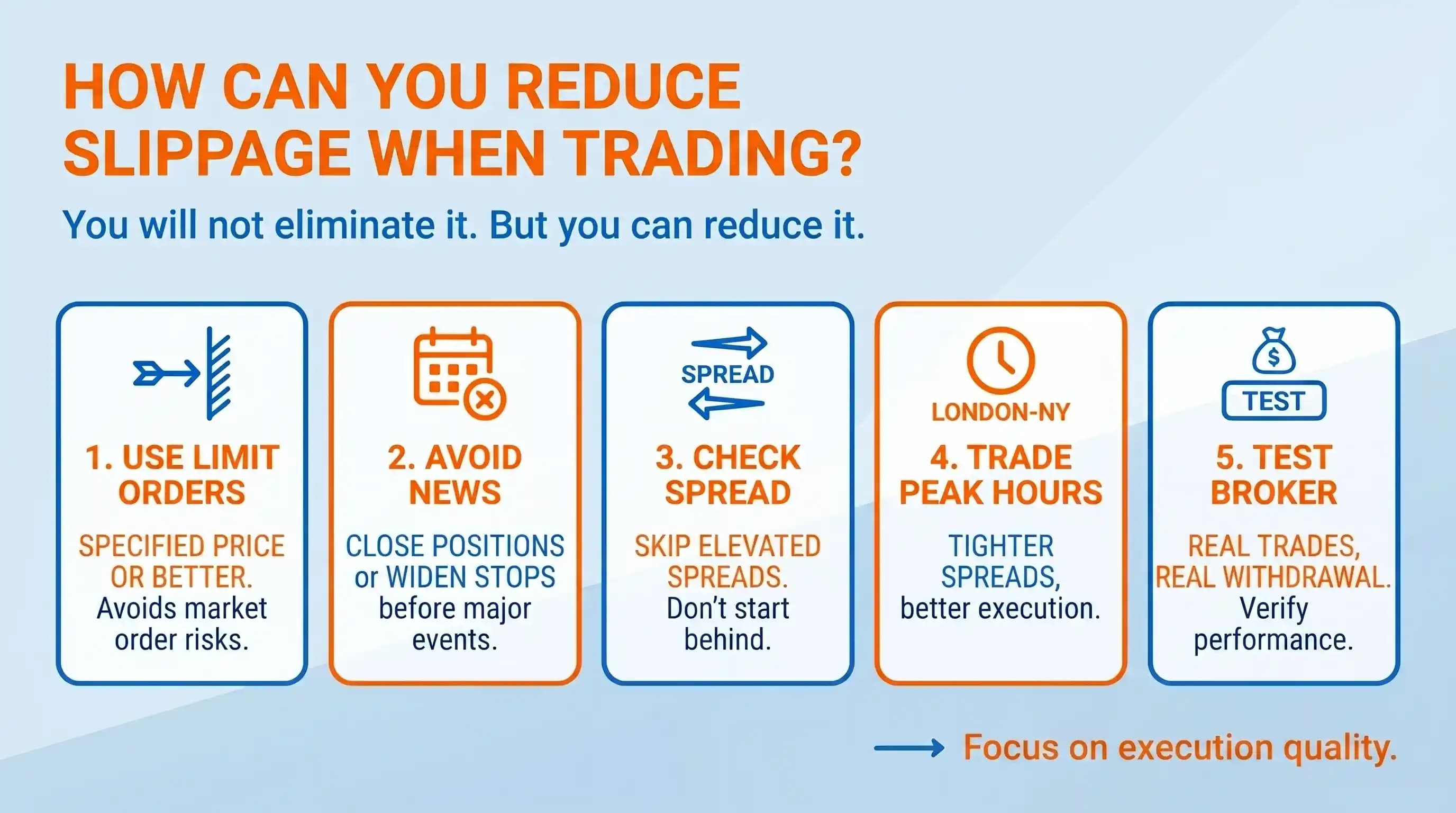
You will not eliminate slippage. No trader does. But you can reduce how often it hits you and how much it costs when it does.
Use limit orders on entries where possible. A limit order fills at your specified price or better. It removes the worst-case negative slippage that market orders are exposed to.
Avoid placing market orders around high-impact news. If a scheduled event is on the economic calendar, either close active positions before it or widen your stops manually to account for spread expansion. A stop 70 pips away is not necessarily safe during a major press conference if spreads can widen that much in seconds.
Check spread conditions before entering. Most platforms show live spread. On XAU/USD, develop a sense of what spread looks like during your normal trading window and skip entries when it is already widened. Starting a trade when spread is elevated means you are behind before price moves a single pip.
Trade during peak liquidity hours. The London-New York overlap produces the best execution conditions for most forex and gold instruments: tighter spreads, deeper order books, more predictable fills.
Test your broker before committing serious capital. Make a small deposit. Execute real trades. Then withdraw. A broker whose execution holds up under normal and fast-market conditions is showing you something no review site can measure. Real money, real trades, real withdrawal. That is the only test that tells you anything useful.
Read More: How to evaluate a forex broker
Conclusion
Slippage is not something you can avoid completely, but it is something you can manage once you understand where it comes from.
The market-side causes are predictable: volatility around news events, thin liquidity during rollover windows, and order sizes that exceed available depth at the top of the book. You can work around all of these by choosing when to trade, using limit orders on entries, and keeping position sizes proportionate to the instrument's liquidity.
The broker-side causes are a different matter. A stop loss that executes at more than double its intended loss during a normal session is not a market structure problem. It is an execution quality problem, and the right response is to test it, document it, and act on what you find. How a broker performs under real money conditions, and how they respond when something goes wrong, tells you more than any advertised spread figure.
The traders who manage slippage well are not doing anything complicated. They know which windows to avoid, they test their broker's execution before committing serious capital, and they treat execution quality as part of their risk management rather than an afterthought.
Frequently Asked Questions
What is slippage in simple terms?
The price on your screen is the last traded price, not a guaranteed fill. Slippage is the gap between what you expected and what you actually got, and it happens because markets move faster than orders can always be matched.
Does slippage only happen in volatile markets?
No. Volatile conditions make it more common, but slippage also happens during low-liquidity windows like the US-Asian session rollover. And it can come from broker execution issues during sessions where nothing looks unusual at all.
Can slippage work in my favour?
Sometimes. Positive slippage means you filled at a better price than you asked for. It is less common than negative slippage, but limit orders during fast moves are where it tends to show up, when price gaps through your level and you get a better entry than planned.
How do I know if my broker is the problem?
Test it with real money during normal hours. If stop losses are consistently filling well below the trigger price with no news or liquidity event to explain it, start documenting. Then contact support and watch how they handle it. The response tells you as much as the fill data.