
Support and Resistance Role Reversal: A Comprehensive Guide in 2026
Support and resistance role reversal represents a fundamental market dynamic where former support levels transform into resistance zones and previous resistance areas convert into support. This phenomenon occurs when price breaks through a significant level, causing traders to reassess their positions and market participants to establish new buying or selling zones. Mastering this concept enables forex traders to anticipate price reactions, improve entry and exit timing, and develop more effective trading strategies based on institutional behavior patterns.
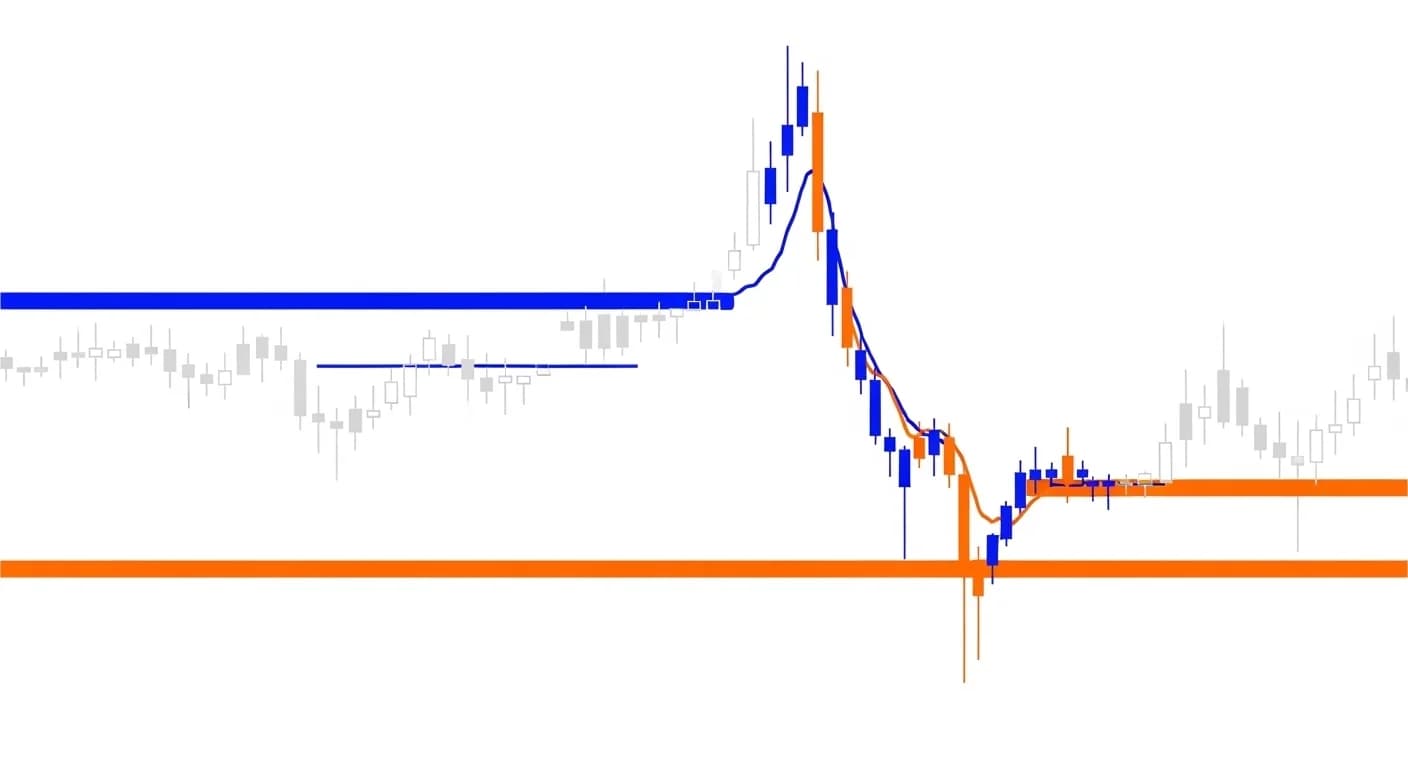
Key Takeaways
- Former support levels frequently transform into resistance zones after price breaks below them, creating selling opportunities for traders who understand this reversal pattern.
- Resistance levels that price successfully breaks above often become new support zones, providing strategic entry points for continuation trades.
- The strength of a role reversal corresponds directly to the significance of the original level, with multiple touches and longer timeframes producing more reliable reversals.
- Volume and price action confirmation at reversed levels validate the transformation and increase the probability of successful trades.
- Institutional traders actively use these reversed levels for order placement, making them critical zones for retail trader analysis.
Understanding Support and Resistance Basics
Support represents a price level where buying pressure overcomes selling pressure, preventing further downward movement. Resistance functions as the inverse, representing a level where selling pressure exceeds buying interest, halting upward price advancement.
These levels form through repeated price interactions. When price approaches a specific level multiple times without breaking through, market participants develop expectations. Traders place orders near these zones, creating clusters of buy or sell interest that reinforce the level's significance.
The psychological component of support and resistance stems from trader memory. Participants who bought at a previous low expect similar buying opportunities at that same level. Conversely, traders who sold at a previous high anticipate similar selling conditions when price returns.
Read More: What Does Support and Resistance Actually Mean?
The Mechanics of Role Reversal
Role reversal occurs when price decisively breaks a significant support or resistance level. The broken level does not disappear but transforms its function in the market structure.
When price breaks above resistance, former sellers who established positions at that level become trapped. These participants now wait for price to return to their entry point to exit breakeven or at minimal loss. Their pending sell orders accumulate at the former resistance level, transforming it into new resistance. Additionally, traders who missed the initial breakout see the return to the broken level as a second opportunity to enter long positions, adding buying pressure that creates support characteristics.
The opposite mechanism applies when price breaks below support. Former buyers become trapped below their entry points. When price rallies back to the broken support level, these participants exit their losing positions, creating selling pressure that establishes resistance. New short sellers also view this level as an optimal entry point for downward moves, reinforcing the resistance qualities.
| Scenario | Original Function | New Function | Trader Behavior |
|---|---|---|---|
| Price breaks above level | Resistance | Support | Former sellers exit, new buyers enter |
| Price breaks below level | Support | Resistance | Former buyers exit, new sellers enter |
How Support Becomes Resistance
Support levels transform into resistance through a specific sequence of market events. Initially, support forms through repeated successful defense of a price zone. Buyers consistently enter at this level, preventing downward breaks. The accumulation of buying interest creates a floor that appears stable.
When price eventually breaks below this support, the market structure changes. The break indicates that selling pressure has overwhelmed the accumulated buying interest. Traders who purchased at the support level now hold losing positions. These participants establish exit orders at their original entry points, hoping to minimize losses when price returns.
The former support level now contains concentrated selling pressure from trapped buyers. When price rallies back to test this zone, multiple factors create resistance. Trapped traders execute exit orders, introducing sell orders into the market. Short sellers identify the level as a logical entry point for downward trades, adding additional selling pressure. The combination transforms the former support into effective resistance.
The strength of this new resistance depends on several factors. Support levels that held for extended periods or across higher timeframes create stronger resistance upon reversal. Multiple touches at the original support level indicate greater trader participation and memory, intensifying the resistance characteristics after the break.
How Resistance Becomes Support
Resistance levels convert to support through a parallel but opposite process. Resistance initially forms when price repeatedly fails to advance beyond a specific level. Sellers consistently emerge at this zone, creating a ceiling that prevents upward movement. The accumulation of selling interest establishes the resistance characteristics.
A breakout above resistance signals that buying pressure has exceeded the accumulated selling interest. This break fundamentally alters the market dynamic. Traders who sold at the resistance level now face losing positions as price moves against them. These participants place buy orders at their original entry levels, planning to exit positions when price retraces.
When price pulls back to retest the broken resistance level, the zone now contains concentrated buying pressure. Trapped sellers execute buy orders to close their losing positions. New buyers view the former resistance as a logical support zone, representing the last point where sellers were in control before buyers dominated. This dual source of buying interest transforms the former resistance into functional support.
The conversion's reliability increases with the resistance level's significance. Resistance that formed over longer timeframes or contained multiple rejection points creates stronger support after breaking. The number of market participants who remember and traded at the original level directly correlates with the support's strength after reversal.
Identifying Valid Role Reversals
Valid role reversals exhibit specific characteristics that distinguish them from temporary price fluctuations. Recognition of these attributes enables traders to differentiate high-probability opportunities from false signals.
A decisive break represents the primary requirement for valid role reversal. Price must move clearly beyond the level with conviction, not merely pierce it briefly before returning. Strong breakout candles with substantial range and volume indicate genuine breaks rather than stop hunts or temporary violations.
The retest provides confirmation of the role reversal. After breaking a level, price typically returns to test the zone from the opposite side. This retest occurs because markets rarely move in straight lines and because participants need time to adjust positions. A successful retest, where the level holds its new function, validates the reversal.
Time spent at the original level before the break influences reversal strength. Levels that contained price for weeks or months carry more significance than those formed over days. Extended consolidation periods allow more traders to establish positions and develop expectations around the level.
Multiple touches at the original level increase reversal reliability. Each touch represents additional market participant involvement and memory formation. Three or more touches typically indicate a well-established level that will function effectively after reversal.
Validation Criteria:
- Clean break with strong momentum and volume
- Retest of broken level from opposite side
- Clear rejection at the reversed level
- Confluence with other technical factors
- Appropriate timeframe significance
Note: Role reversals are only valid when they form at clearly defined structural levels. For a step-by-step explanation of how to define these levels correctly, see our guide on drawing support and resistance.
Timeframe Considerations
Support and resistance role reversals function across all timeframes but operate with varying significance and reliability. Understanding timeframe dynamics improves trade selection and position management.
Higher timeframe levels carry greater significance. Weekly and monthly support and resistance zones involve more participants and represent longer-term market consensus. When these levels experience role reversal, the transformation typically produces stronger and more reliable reactions. Institutional traders primarily focus on daily and weekly charts, making these timeframe reversals particularly important.
Lower timeframe reversals occur more frequently but exhibit less reliability. Hourly and 15-minute support and resistance levels reverse regularly, but the transformations often fail to hold. These reversals serve better for intraday trading tactics rather than position trading strategies.
The ideal approach combines multiple timeframe analysis. Traders identify major support and resistance levels on weekly and daily charts, then use lower timeframes to refine entry points when these levels reverse. A monthly resistance level that breaks and converts to support provides a high-probability zone, while the hourly chart offers precise entry timing when price retests that support.
| Timeframe | Reversal Strength | Ideal Use | Holding Period |
|---|---|---|---|
| Monthly | Highest | Position trades | Weeks to months |
| Weekly | High | Swing trades | Days to weeks |
| Daily | Moderate | Short-term swings | Hours to days |
| 4-Hour | Low-Moderate | Intraday | Minutes to hours |
| 1-Hour | Low | Scalping | Minutes |
Trading Strategies Using Role Reversals
Effective trading strategies incorporate role reversals as primary decision points for entries, exits, and risk management. Several approaches utilize this phenomenon with different risk-reward profiles.
The breakout-retest strategy represents the most direct application. Traders wait for price to break a significant support or resistance level, then enter positions when price retests the broken level from the opposite side. Entry occurs when the level demonstrates its new function through rejection of the test. Stop losses place just beyond the reversed level, while profit targets aim for the next major support or resistance zone.
The anticipation strategy requires more advanced skills but offers superior risk-reward ratios. Traders identify potential role reversal setups before they occur by analyzing weak support or resistance levels. Positions enter just before the anticipated break, with the expectation that the level will fail and reverse. This approach demands precise timing and stricter risk management due to the premature entry.
The confirmation strategy prioritizes safety over optimal entry. Traders wait for multiple retests of a reversed level, entering only after the reversal demonstrates reliability. This conservative approach sacrifices some profit potential but significantly reduces false signal risks.
Breakout-Retest Strategy Example:
- Identify significant resistance level with multiple touches
- Wait for decisive break above resistance with volume confirmation
- Monitor for pullback to former resistance
- Enter long position when level holds as support
- Place stop loss below the new support zone
- Target next resistance level or use trailing stop
Volume and Price Action Confirmation
Volume analysis enhances role reversal trading by confirming the legitimacy of breaks and reversals. Price movements accompanied by appropriate volume patterns indicate genuine market shifts rather than temporary fluctuations.
Breakout volume should significantly exceed average volume. A break above resistance or below support requires conviction from market participants. High volume during the break signals broad participation and increases the probability that the level will effectively reverse its function. Low volume breaks often lead to false breakouts that quickly reverse.
Retest volume characteristics differ from breakout volume. When price returns to test a reversed level, volume typically remains lower than breakout volume but should still show meaningful participation. Declining volume during successful retests suggests that fewer participants oppose the new level function, supporting the reversal's validity.
Price action patterns at reversed levels provide additional confirmation. Rejection candles with long wicks demonstrate that the reversed level actively repels price in its new capacity. Engulfing patterns or pin bars at reversed levels indicate strong participation and increase trade probability.
The relationship between price action and volume reveals market dynamics. A retest of former resistance now functioning as support should produce buying pressure that quickly pushes price away from the level. Prolonged consolidation at the reversed level or weak rejection patterns suggest the reversal may lack strength.
Combining Role Reversals with Other Technical Tools
Role reversals gain effectiveness when integrated with complementary technical analysis methods. The confluence of multiple factors at reversed levels significantly improves trade probability and outcome.
Fibonacci retracements frequently align with role reversal levels. Former support or resistance often coincides with key Fibonacci ratios such as 38.2%, 50%, or 61.8%. When a reversed level also represents a major Fibonacci retracement, the zone gains additional significance as both technical factors support the same price level.
Moving averages provide dynamic support and resistance that can reinforce static role reversals. A former resistance level that aligns with a major moving average such as the 200-period or 50-period creates a stronger support zone after breaking. The combination of remembered price level and current moving average support attracts more participants.
Trendlines and channels add directional context to role reversals. A resistance level that breaks upward during an established uptrend carries more significance than the same break during a ranging market. The trend provides momentum that supports the continuation after the retest, increasing the reversal's effectiveness.
Candlestick patterns at reversed levels signal immediate price action. A bullish engulfing candle at a former resistance now functioning as support combines pattern recognition with level analysis. The candlestick provides entry timing while the reversed level establishes the strategic significance.
Common Mistakes and How to Avoid Them
Traders frequently encounter specific errors when applying role reversal concepts. Recognition and avoidance of these mistakes improves trading outcomes.
Premature entry represents the most common error. Traders enter positions immediately after a level breaks, anticipating the reversal without waiting for confirmation. Price often continues beyond broken levels before reversing, stopping out early entries. The solution requires patience to wait for the retest and rejection before establishing positions.
Ignoring timeframe significance leads to trading unreliable reversals. A 15-minute support level breaking and reversing lacks the strength of a weekly level transformation. Traders must assess whether a level possesses sufficient timeframe importance to warrant position establishment. Focus on daily and weekly reversals reduces false signals and improves win rates.
Inadequate stop loss placement creates unnecessary losses. Some traders place stops too close to reversed levels, resulting in stops triggered by normal price fluctuation before the trade develops. Others place stops too far away, risking excessive capital on single trades. Appropriate stop placement accounts for average true range and provides sufficient buffer while maintaining acceptable risk.
Failure to consider context undermines role reversal trading. A resistance level that breaks during extremely low liquidity or during major news events may not reverse reliably. Market conditions, trending environments, and broader technical structure all influence whether a reversed level will hold. Contextual analysis prevents trades in unfavorable conditions.
Mistake Prevention Checklist:
- Wait for retest confirmation before entry
- Verify timeframe significance (daily or higher preferred)
- Calculate appropriate stop distance using ATR
- Assess overall market context and trend
- Confirm volume supports the reversal
- Check for confluence with other technical factors
Psychological Factors Behind Role Reversals
Understanding the psychological mechanisms that create role reversals deepens comprehension and improves application. Market psychology drives the transformation of support to resistance and vice versa.
Trader memory creates the foundation for role reversals. Participants remember significant levels where they previously entered or exited positions. When price returns to these remembered levels, traders naturally consider similar actions. This collective memory generates clustered orders that reinforce the reversed level's new function.
Loss aversion powerfully influences trapped traders. Participants holding losing positions after a level breaks prioritize exiting those positions at breakeven or minimal loss. This psychological pressure creates concentrated order clusters at broken levels as traders place exit orders at their original entry points. The accumulated orders transform the level's function.
Recency bias affects how traders perceive levels. A resistance level that recently broke becomes psychologically significant as the last point where sellers controlled the market. When price returns to this level after breaking it, traders view the zone as a logical support area where buyers should emerge. This bias reinforces the support characteristics.
Fear of missing out drives participation at reversed levels. Traders who missed the initial breakout see the retest as a second opportunity. This creates buying pressure at former resistance now functioning as support or selling pressure at former support now functioning as resistance. The FOMO participation adds to the reversal's strength.
Advanced Applications and Nuances
Sophisticated traders employ advanced techniques when working with role reversals, extracting additional value from this market dynamic.
Role reversal zones rather than exact levels provide more realistic expectations. Support and resistance function across price ranges, not at precise points. Former resistance might become support across a 20-30 pip zone rather than at a single price. Trading these zones with appropriate order placement improves fill rates and reduces missed opportunities.
Multiple role reversals at the same level indicate extremely significant zones. When a level repeatedly changes function between support and resistance, the zone demonstrates exceptional market memory and participant awareness. These multi-reversal levels warrant increased position sizing and confidence when trading future interactions.
Failed role reversals signal strong continuation moves. When price breaks a level but the reversal fails to hold on retest, the failure indicates powerful directional momentum. A former resistance that breaks, pulls back, but fails to provide support suggests continued upward pressure. These failures often precede accelerated moves in the breakout direction.
Partial role reversals occur when a level's function partially transforms. Former strong resistance might become weak support, holding briefly before eventually failing. Recognition of partial reversals helps traders manage positions more effectively and anticipate potential failures.
| Advanced Concept | Description | Trading Implication |
|---|---|---|
| Role Reversal Zones | Levels function across price ranges | Use zone-based entries and stops |
| Multiple Reversals | Same level reverses function repeatedly | High confidence zones for increased size |
| Failed Reversals | Reversed level fails to hold on retest | Strong continuation signal in breakout direction |
| Partial Reversals | Level partially transforms function | Anticipate potential failure, tighter stops |
Practical Examples from Forex Markets
Real market examples demonstrate how role reversals function across different currency pairs and market conditions.
The EUR/USD pair frequently exhibits clear role reversals at major psychological levels. The 1.2000 level historically functioned as strong resistance during 2020. When price broke above this level in early 2021, subsequent pullbacks to 1.2000 found consistent support. Traders who recognized this transformation could enter long positions at the former resistance with well-defined risk parameters.
GBP/USD demonstrates role reversals at trendline intersections. A descending trendline that acts as resistance during a downtrend can transform into support after price breaks above it. The combination of trendline and horizontal level creates a particularly significant zone. Pullbacks to these zones after breaks provide high-probability entry opportunities.
USD/JPY shows role reversals at round number levels. The 110.00 level alternates between support and resistance based on prevailing trends. When 110.00 resistance breaks during uptrends, subsequent retests find support. The psychological significance of round numbers enhances the reversal effect as more traders focus on these levels.
Gold (XAU/USD) exhibits powerful role reversals at weekly levels. Former weekly resistance zones become monthly support areas, providing stable entry points for position trades. The longer timeframe and increased market participant awareness create reliable reversals that hold for extended periods.
Integration into Overall Trading Strategy
Role reversals should integrate into comprehensive trading strategies rather than function as standalone signals. Proper integration improves consistency and overall performance.
Market structure analysis provides context for role reversals. Understanding whether the market trends, ranges, or transitions between states influences how to trade reversed levels. During strong trends, reversed levels offer continuation entries. In ranging markets, reversals provide range boundary reinforcement.
Position sizing adjustments based on reversal quality optimize risk-reward outcomes. Higher timeframe reversals with strong confirmation warrant larger positions. Lower timeframe or weak reversals justify reduced size. This variable position sizing aligns capital allocation with opportunity quality.
Trade management rules should account for role reversal characteristics. Initial stops place beyond the reversed level, but trailing stops can tighten as price moves favorably. Partial profit taking at intermediate levels while letting portions run captures both quick gains and extended moves.
Journal analysis of role reversal trades reveals personal performance patterns. Tracking which timeframes, currency pairs, and market conditions produce best results enables strategy refinement. Systematic review identifies strengths to emphasize and weaknesses to address.
Conclusion
Support and resistance role reversal represents a foundational market dynamic that enables traders to anticipate price behavior at critical levels. Former support transforms into resistance after breaks, while broken resistance becomes new support through the interaction of trapped traders and market participants seeking optimal entries.
Successful application requires patience to wait for confirmation, discipline to follow established rules, and analytical skill to identify high-quality setups. Integration with complementary technical tools, proper timeframe selection, and contextual analysis significantly improve outcomes.
Mastery develops through deliberate practice and systematic review of both successful and unsuccessful trades. Traders who consistently apply role reversal principles with appropriate risk management gain an enduring edge in forex markets. The concept's universality across instruments and timeframes ensures its continued relevance regardless of market conditions or trading style.
Begin incorporating role reversal analysis into daily chart review. Mark significant support and resistance levels, monitor for breaks, and track subsequent retests. This focused practice accelerates pattern recognition and develops the intuition necessary for effective real-time application.