
Which Forex Account Type Is Best for Day Traders?
Most articles on this topic will tell you to pick the account with the tightest spread. That advice is incomplete, and if you follow it the way I did early in my trading career, you will end up regretting the broker you chose.

The best forex account type for day traders depends on your capital level. Below $1,000, a standard account is the right starting point. Between $1,000 and $3,000, ECN makes more sense. Above $3,000, ECN Pro or Zero spread accounts are worth the higher commission.
That is the short answer. The longer one is that account type is only half the decision, and most traders focus on the wrong half. I have been trading financial markets for over five years, the last three almost exclusively on XAU/USD. Over that time I have chosen brokers the wrong way, had a $50 stop loss trigger at $110, and missed a trade that would have hit take profit because my account spread was too wide to fill the order. What follows comes from those situations.
Key Takeaways
- Match your account type to your capital level, not to the lowest spread you can find at a single point in time. Spread testing at one moment does not reflect actual trading conditions.
- Below $1,000, a standard account is good for learning real market mechanics. Between $1,000 and $3,000, move to ECN. Above $3,000, ECN Pro or Zero spread accounts are worth the higher commission.
- Account type affects order fills. A wider spread account can prevent a buy stop from triggering even when price reaches your level. Same broker, tighter account, your friend gets filled. You do not.
- Spread widening during major news events happens regardless of account type. The broker's liquidity infrastructure matters more than the account label in those moments.
- Always run a deposit, trade, and withdrawal test before committing serious capital to any broker. A referral from a trader you trust is a starting point, not a guarantee.
The Problem With How Most Day Traders Choose an Account
When I was first choosing brokers and account types for day trading, I was doing what most traders do. I would open an account, check the live spread on a few pairs, compare it against another broker, and pick the lower one.
The problem with that approach is that spreads are not static. At the exact moment I was testing, a good broker might have had a temporarily wide spread and a poor broker might have been unusually tight. I chose several brokers this way and I regretted most of those decisions. The spread I saw during testing was not the spread I traded with.
This is before we even get into what happens during news events, which is where account type differences actually start to matter.
The Four Main Forex Account Types
Before comparing them, it helps to understand what each account type actually is.
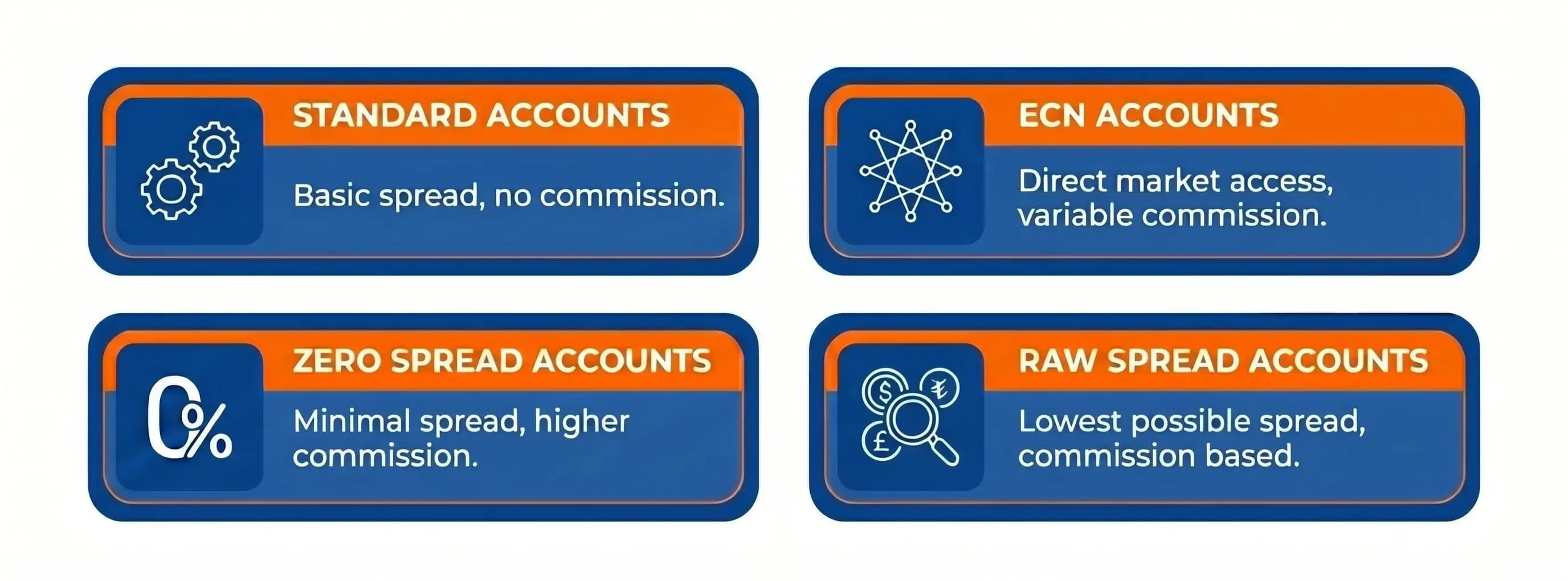
Standard accounts offer fixed or semi-fixed spreads with no separate commission. The broker builds their cost into the spread. Simple and transparent on paper, but the spread is typically wider.
ECN accounts (Electronic Communication Network) connect you directly to liquidity providers. Spreads are tighter, usually raw or near-raw, but you pay a commission per lot traded. You see where the market actually is.
Zero spread accounts offer spreads from 0.0 pips on major pairs and instruments like XAU/USD. Costs are recovered through commission rather than spread. Not all zero-spread accounts are truly zero at all times, particularly during high-impact news.
Raw spread accounts are similar to ECN, offering the tightest available spreads plus commission. These are typically positioned for high-volume traders where every pip matters.
Which Account Type Is Right for Day Traders, by Capital Level
This is the question I get most often from traders who ask me for account advice. My first question back to them is always the same: how much is your margin?
The account type that makes sense is not the same across all capital sizes. Here is how I actually think about it.
Below $1,000: A standard account works well here. Not because it is the best account structurally, but because at this stage you are still learning how the market actually behaves. A standard account teaches you things you cannot learn on paper: how spreads move across different sessions, what slippage looks like in practice, what happens when an order does not fill. I learned basic but important mechanics on standard accounts. The wider spread costs you a little more per trade, but at small position sizes that cost is not significant enough to matter as much as the market education you get.
$1,000 to $3,000: ECN becomes worth it here. You are taking trades with enough size that tighter spreads and cleaner execution start to make a measurable difference to your results. Commission is a real cost now but it is predictable, which matters more than it sounds. You know what you are paying. With a standard account at this level, variable spread behaviour during busy sessions starts to affect you in ways you cannot plan around.
Above $3,000: ECN Pro or Zero spread accounts. At this level, I would pay a higher commission without hesitation to get away from spread-related problems that cost me real money. Spread does not just affect your entry cost. It can prevent your order from opening entirely. It can close a sell position early by adding pips to the ask side. These are not edge cases. I have experienced both.
The Trade I Missed Because of Account Type
This happened when gold was approaching the $2,500 level. I had a buy stop order at $2,412 with a stop loss at $2,408 and a take profit at $2,428. That is a clean 1:2 risk-to-reward setup.
Price came to my order level. My position did not open. The spread at that moment was too wide for the order to trigger on my account.
A friend of mine, on the same broker, with a different account type that had tighter spread conditions, got filled on the same move.
Same broker. Same signal. Same price. Different account, different outcome.
That trade would have hit take profit. Missing it had nothing to do with my analysis and nothing to do with the market. It was purely an account condition problem that I could have solved by choosing a tighter spread account for that capital level.
Spread Widening During News Events: Is Any Account Safe?
The short answer is no, and this is something traders do not fully understand until it happens to them.
During a Fed chair press conference, I had an open sell position on XAU/USD with my stop loss sitting roughly 70 pips away from price. That felt like a safe distance. At the moment the conference started, the spread widened aggressively on my broker and triggered my stop loss before the actual market price had moved anywhere near my stop level. After my position closed, price dropped heavily and moved well beyond where my take profit had been.
The important point here is that this happened regardless of account type. Even on a zero spread account, during a major news event, a broker that is not well-capitalised or properly connected to deep liquidity can show a dramatic spread spike. The account type label does not protect you from that. The broker's infrastructure and liquidity access does.
This is why I now manage positions manually during scheduled high-impact news events instead of relying on static stop losses. It is also why I treat the quality of the broker as more important than the type of account on that broker.

The Slippage Problem No One Talks About
I traded with a broker for over a year without serious problems. Then one trade during normal New York session hours, no news event, my $50 stop loss triggered at a $110 actual loss. More than double what I had planned to risk.
When I contacted support, the response was a template reply telling me not to trade during news hours. It was not a news hour.
I closed the account and moved to a new broker based on a referral from another trader, which is the most reliable signal available when written reviews cannot be trusted. The new broker had tighter spreads on gold, slightly higher commission, and I tested it with a small deposit first, executed a few trades, and withdrew before transferring full capital.
I should mention that even referrals can mislead you. The withdrawal test I ran with the second broker worked fine. Larger withdrawals later became a problem. That experience reinforced one thing clearly: do the withdrawal test before you commit serious money, not after.
What Account Type Cannot Fix
There is a version of this topic that treats account selection as the main variable in trading performance. It is not.
A bad account type can cost you specific trades. Bad slippage can turn a planned $50 loss into a $110 loss. Spread conditions can prevent your order from filling at the price your system identified. These are real costs worth managing.
But account type does not fix poor position sizing. It does not fix emotional decisions after a losing streak. It does not fix the problem of trading a strategy you do not fully understand. Most traders lose money because of those things, not because they chose ECN over standard.
At position sizes of 0.05 to 0.1 lots on gold, which is where I operate most of the time, commission differences between account types are almost irrelevant. What matters is execution reliability and what the broker actually does when something goes wrong.
FAQ
What is the best forex account type for day trading?
For most day traders, ECN or Zero spread accounts perform best because they offer tighter spreads and more predictable execution. The right choice depends on your capital level. Standard accounts work for traders starting below $1,000. ECN makes more sense between $1,000 and $3,000. Above $3,000, ECN Pro or Zero spread accounts are worth prioritising even if commission is slightly higher.
Does account type affect how my orders get filled?
Yes, directly. A buy stop order placed at a specific price may not trigger if the spread on your account is too wide at that moment. This can happen even when price technically reaches your entry level. Traders on tighter spread accounts at the same broker can get filled on the same move while you do not.
Is a zero spread account really zero spread?
Not always, particularly during high-impact news events. Zero spread accounts offer spreads from 0.0 pips under normal conditions, but most brokers widen spreads during major announcements regardless of account type. The broker's liquidity connections matter more than the account label during those windows.
Which account type has better execution quality, ECN or standard?
ECN accounts generally offer better execution because orders are routed directly to liquidity providers rather than through the broker's internal dealing desk. Execution quality still varies significantly between brokers even within the same account type. The broker matters as much as the account structure.
Should I test a broker with a demo account before depositing?
Demo accounts are useful for learning the platform and testing a strategy, but they do not reflect live execution quality. The only reliable test is a small live deposit. Place a few trades, then withdraw. If the withdrawal process is clean and funds arrive without unexplained delays, that tells you more about the broker than any review site or demo account result.
How much does commission matter compared to spread for day traders?
It depends on your position size. At small lot sizes, 0.05 to 0.1 lots on instruments like gold, the difference in commission between account types is minor. Spread reliability and execution quality matter far more at that scale. Commission becomes a meaningful calculation at higher lot sizes or high-frequency trading volumes.
Conclusion
The question of which account type is best for day traders has a real answer, but it is not the one most articles give you.
It is not about finding the tightest spread at the moment you are comparing brokers. It is not about the lowest commission rate. The account type that works best for you is the one that fits your current capital level, on a broker that executes reliably when markets are moving and pays out when you withdraw.
A buy stop that does not fill when price reaches your level costs you a trade your analysis got right. A $50 stop loss that exits at $110 costs you an edge that was working. Those are account and broker problems, not market problems. Both have happened to me, and both were avoidable.
Start with the right account for your capital level. Test the broker before committing real money to it. The account type is one part of what determines your actual trading conditions. The broker running it is the other part, and that one matters more.