
Important points in account management in forex
Most traders who blow their accounts are not undone by bad analysis. They are undone by having no rules around how much to risk, when to stop, and how to size each trade.

The main goal of every trader in the forex market is to grow their account over time. But most traders who lose their capital do not lose it because their analysis was wrong. They lose it because they had no rules around how much to risk, when to stop, and how to size their positions correctly.
Account management in forex, also known as money management or risk management, is the set of rules that controls these decisions. It determines how much of your capital is at risk on each trade, how you calculate your position size, and how you protect your profits when a trade moves in your favour.
There is a well-known saying among experienced traders: if you follow proper risk management rules on every trade, it is almost impossible to lose your entire account, even without any knowledge of technical or fundamental analysis. That may sound like an exaggeration. After years of trading and working directly with other traders managing their accounts, the evidence points in the same direction. Position sizing and risk rules are what separate traders who survive long enough to improve from those who blow their capital before their strategy has a chance to work.
The importance of account management and risk in forex trading
The main goal of every trader in the forex market is to grow his account and capital with the trades and the profits he earns. Therefore, it is necessary for the trader to follow the rules for the continued growth of his account. This set of rules in financial markets is known as money management, account management or risk management. In other words, account management refers to a set of techniques that be used to minimize losses, maximize profits and grow trading account.
Many beginners tend to ignore the importance of capital management in forex trading, which sooner or later leads to the complete deletion of their capital. Therefore, it is recommended that before doing any type of trade, you should make sure that you are aware of the rules of capital and risk management, fully understand them and adhere to them forever.
There is a famous expression among experienced traders in the forex market, which indicates if you enter into trades without any knowledge of technical and fundamental analysis and do it completely by chance and only follow the rules of capital management, no matter how many trades you make, it is impossible that your capital reaches zero. Paying attention to this concept clearly reveals the importance of risk management in forex trading.

Account management strategies
There are some techniques for capital management that keep your trading account in safe side. Most of these techniques include common rules that control the size of entry and the limits of potential losses. In the rest, the most important of them will be mentioned.
How much should you risk per trade in forex?
As a general rule, avoid risking more than 2 to 3% of your account balance on any single trade. This single rule does more to protect a trading account than any strategy or indicator. The reason is straightforward: even a good setup fails sometimes, and losing streaks of 3 to 4 consecutive trades are completely normal at any win rate. If each of those losses takes 2% of your account, you survive. If each takes 20%, you do not.
Most traders understand this rule in theory. The problem is position sizing in practice. Traders who follow signals from experienced traders often risk far more than they realise. In one documented case from a signals group, traders were placing between 40% and 100% of their account on a single trade entry. When 4 out of 5 signals hit stop loss on the same day, several of them lost their entire accounts. The signals were not the issue. The position sizes were.
This is why determining your risk percentage before you calculate lot size is not optional. The lot sizing formula only works when risk per trade is decided first:
Lot = (Equity × Risk%) ÷ (Stop Loss in pips × Pip Value)
Without a fixed risk percentage going into that formula, position sizing becomes guesswork.
A practical example of how this plays out over time: trading XAU/USD with a strict 5% maximum risk per trade and no more than 3 trades per day, a $500 account was grown to $3,000 in 4 months. The same account hit serious trouble midway through when two consecutive stop losses triggered an emotional response, position size was doubled to recover, and the stop loss hit again. That one break in the risk rule wiped out approximately 30% of the profits built over the previous weeks.
The percentage you choose matters less than applying it without exceptions. Start at 1 to 2% if you are new to live trading, and treat it as a fixed rule rather than a guideline you revisit trade by trade.
Enhancing your risk management strategy, many traders also integrate the Smart Money Concept (SMC) to identify key levels where institutional activity is likely. Adjusting position size around those levels, rather than applying a flat percentage to every trade regardless of context, gives you a more precise approach to risk over time.
Do not over-trade
You don't have to trade every hour or even every day. Wait the market provides your trading setup, so don't follow the market for trading opportunities. The market doesn't owe you anything and patience is the holy grail of profitable traders. Note when you enter a trade without a definite and reliable analysis and repeat it over and over again, even with the best capital management methods, you will not be able to grow your account.
Close losing and let profitable positions roll
"Limit your losses and let your profits roll", the famous term there is. Professional forex traders do exactly this rule, they are very impatient with their losses and close a losing position as soon as possible, but let their winning positions continue. Beginners do inverse, they wait for the position to come out of loss or at least is reduced and then try to close it. On the other hand, as soon as the trade is profitable, they close it in a small profit.
Always use Stop Loss order
Stop Loss orders are a key building block for risk and capital management and should be an inseparable part of any account management strategy. A stop loss order automatically closes the position when the price reaches a predetermined level, preventing larger losses. All forex trading capital management strategies should include stop loss orders.
What is a good risk-to-reward ratio in forex?
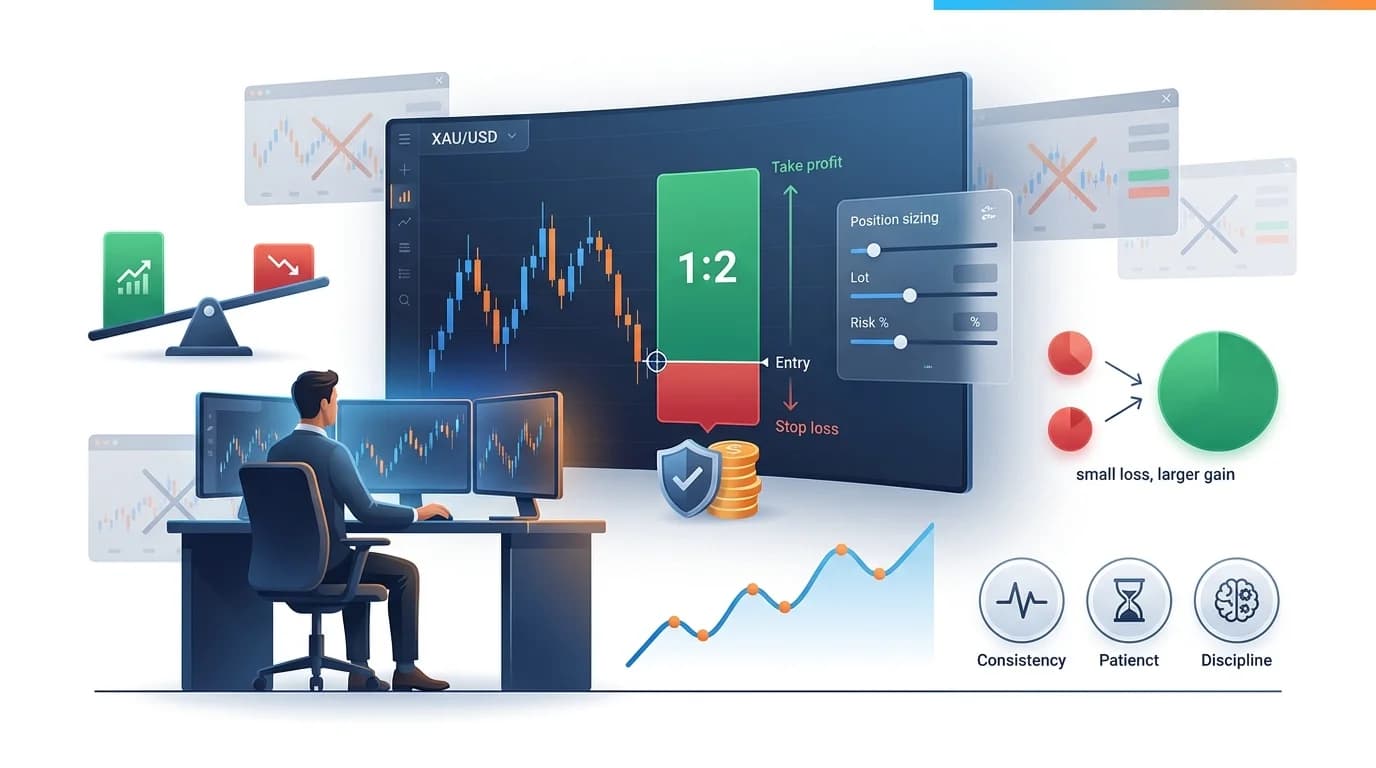
The risk-to-reward ratio (R/R) measures the relationship between how much you stand to lose on a trade and how much you stand to gain. At 1:2, your take profit is twice the size of your stop loss. Not one and a half times. Exactly twice, minimum, before a trade is worth taking.
A real example: a buy limit placed on XAU/USD at 4502.04, with a stop loss at 4496.92 and a take profit at 4512.27. The stop loss distance is 5.12 points. The take profit distance is 10.23 points. That is just over 1:2, which is the minimum threshold. That trade hit take profit within 15 minutes of the signal being sent.
Most beginners focus on win rate as the measure of whether their trading is working. Win rate matters less than most traders think. A trader winning 50% of their trades with a consistent 1:2 R/R will grow their account over time. A trader winning 70% of their trades at 1:1 R/R will struggle to stay ahead of spreads and commissions over the same period.
The math behind this is straightforward. At 1:2 R/R, you only need to be right on 4 out of 10 trades to be profitable. Each winning trade recovers two losing trades. That buffer gives your edge room to play out across a large number of trades, even during losing streaks.
In practice, applying a minimum 1:2 R/R as a fixed rule rather than a guideline changes how you evaluate setups. Before entering any trade on XAU/USD, the distance between entry point, stop loss, and take profit target is checked first. If the setup cannot deliver at least 1:2 given where the stop loss needs to sit, the trade is skipped regardless of how strong the setup looks. That rule alone filters out a large number of low-quality entries that would otherwise look valid on the chart.
The HH Scalp Setup on XAU/USD, which has been traded and refined over several years, runs at approximately 70% win rate at a fixed 1:2 R/R. A $5,000 account grew to over $70,000 over two years using this setup with that R/R discipline applied consistently on every trade. The ratio was not adjusted based on confidence in any individual setup. It stayed fixed.
If a trade does not give you at least 1:2, there is no trade. That applies regardless of how convinced you are by the analysis.
Be careful when trading on leverage
Trading with a leveraged account is one of the main reasons that beginners are attracted to the forex market, but you should note that leverage is a double-edged sword. In addition to increasing your profit, leverage can also increase your loss.
Emotional control
Fear and greed are the most destructive emotions in trading. According to experience, you will learn how to manage your emotions to not Influencing on your trading decisions. Greed in particular is much more destructive, you have to be realistic about how much you can be profitable. Don't over trade the market and don't set unrealistic profit targets that are impossible to achieve. Note that a trade with a stop loss of 10 pips and a profit target of 1000 pips is very likely to result in a loss.
Use dynamic stop loss orders to save your profit
In this method, when the trade is in profit and the price continues, the trader moves his stop-loss closer to the level of entry and even within the profit range if possible In this case if the price returns in the opposite direction of the position for any reason, some of the profit will be saved.
Understand the correlations
If you have a good understanding of the relationship between different assets, you can distribute risk of trades where a loss in one can be retrieved by a profit in another. For example, the dollar and gold often have a negative correlation means if a trader loses in buying gold, he can compensate part of his loss by buying dollars in the main currency pairs.
Important points in choosing the size of trade
In order to easily calculate the transaction volume, in this section, the relevant formula is presented and its parameters are explained. The amount of lot or size of trade that you can enter in each transaction is calculated from the following:
Lot = (E R%) / (SL PV)
Lot: size of trade
E: Equity
R%: risk percentage
SL: stop loss to pip
PV: pip value
Pip value is equal to 10 for pairs where the dollar is second currency (quote), such as EURUSD, and for pairs where the dollar is the base currency, such as USDJPY, it is equal to the spot price divided by 10.
Platforms like the cTrader provide built-in tools to simplify these calculations, helping traders quickly determine the appropriate lot size based on their risk management strategy.
For example, if your account equity is $1000 and you intend to open a long in the
Euro-Dollar currency pair and your stop loss is 20 pips, with 2% risk, the size of trade is calculated as follows:
lot = (1000 0.02) / (20 10) = 0.1
It means you are allowed to enter 0.1 lot in this transaction with a risk percentage of 2. Always remember to limit your risk to 2-3% of your capital and stick to this rule.
Note without having a stop-loss, you cannot choose the right size of trading, in other words, account management without a stop loss is meaningless.

Using stop loss in financial risk management
As mentioned before, stop loss is an essential element of a capital management strategy and an experienced trader will never trade without it. Experienced traders always stick to this concept that when they want to decide on entering a position, they first determine the level of the stop loss and then take position.
In the formula, it was observed that the stop loss is a main parameter, so the transaction volume cannot be calculated correctly without it. Many professional traders never enter the transaction without considering the depth of the stop loss and calculation the size allowed for the transaction.
How to use a demo account to practice forex account management
Many forex brokers provide demo accounts that let you trade on virtual capital without risking real money. For beginner traders, a demo account is where you test your strategy, learn the platform, and practice applying risk management rules before you are exposed to real losses.
The problem is that most traders misuse demo accounts in ways that make them less useful than they should be. They start with an unrealistically large balance, add more virtual funds whenever the account drops, use far more leverage than they would on a live account, and ignore risk management entirely because there are no real consequences. Trading this way on demo teaches habits that will damage a live account.
To get genuine value from a demo account, treat it as close to a live account as possible from the start. A practical approach that works consistently follows these steps:
- Start with the exact same balance you plan to deposit on your live account
- Never add more funds to the demo account, treat it as a fixed starting amount
- Apply the same risk management rules you intend to use on a live account, including stop loss placement and position sizing
- Trade on demo for a minimum of 1 to 2 months before moving to live
- After 2 months, assess your results: if you are within 10% drawdown, at breakeven, or in profit, you are ready for a live account
- If not, reset and repeat. Do not skip this step or shorten the timeframe
One thing to prepare for before moving to live: your results on demo will almost certainly be better than on a live account, even when you use the same strategy and the same rules. On the same setups, demo win rates run at approximately 85%, while live win rates on identical setups typically run at 70 to 75%. That 10 to 15% gap is not a strategy problem. It is entirely psychological. Real money on the line changes how you make decisions: you hold losing trades longer, you exit winning trades early, and you second-guess entries that you would have taken without hesitation on demo.
This gap shows up clearly when managing live accounts. After two consecutive stop losses on a client's account, the emotional pressure to recover led to breaking the position sizing rules. The strategy was tested on demo immediately after, using the exact same setup on the same timeframe. The demo trade was deeply in profit when reviewed. The strategy had not changed. The live execution, driven by the need to recover, had been the problem.
A demo account teaches you how the market moves. A live account teaches you how you react to it. Both are necessary, and neither replaces the other.
FAQ
What percentage of my capital should I risk per trade in forex?
Most traders start with a rule of 1 to 3% risk per trade. In practice, experienced traders often keep it even lower during unfamiliar market conditions. When managing a client account on XAU/USD, a strict 5% maximum per trade was used alongside a hard cap of 3 trades per day. That combination grew the account from $500 to $3,000 in 4 months. The number itself matters less than sticking to it. Traders who break their own risk rules during a losing streak are the ones who do the most damage to their accounts.
What is a good risk-to-reward ratio for forex trading?
A ratio of at least 1:2 is a reliable starting point. This means your target profit is twice the size of your stop loss on every trade. At this ratio, you only need to win 4 out of 10 trades to stay profitable over time. A lower ratio, such as 1:1, forces you to win more than half your trades just to break even, which puts unnecessary pressure on your win rate. Before placing any trade, check whether the distance between your entry, stop loss, and target gives you at least 1:2. If it does not, the trade is not worth taking regardless of how strong the setup looks.
How do I calculate the correct lot size for a trade?
The formula is:
Lot = (Equity × Risk%) ÷ (Stop Loss in pips × Pip Value)
For example, with $1,000 equity, 2% risk, a 20-pip stop loss on EUR/USD (pip value = $10):
Lot = (1,000 × 0.02) ÷ (20 × 10) = 0.1 lots
For gold (XAU/USD), the pip value differs from standard currency pairs, so check the pip value for the instrument you are trading before applying the formula. Platforms like cTrader include built-in lot size calculators that handle this automatically. Without a defined stop loss, you cannot apply this formula correctly, which is why stop loss placement always comes before position sizing.
Does a demo account actually prepare you for live forex trading?
Partly. A demo account is useful for testing strategies, learning the platform, and building familiarity with price action before risking real capital. The gap appears when you move to live trading. On demo, the same setups that produce around 85% accuracy can drop to 70 to 75% on a live account. The strategy does not change. The psychological pressure does. Traders tend to hold losers longer, exit winners early, and second-guess entries when real money is involved. To get the most from a demo account, start with the same capital amount you plan to use on a live account, apply identical risk management rules, and trade for at least 1 to 2 months before switching to live. Resetting the balance freely or over-leveraging on demo teaches habits that will cost you on a live account.
Why do most forex traders lose money despite having a strategy?
The most common reason is not a bad strategy. It is poor position sizing combined with emotional decision-making under pressure. Traders who risk 20 to 40% of their account on a single trade can be wiped out by 3 or 4 consecutive stop losses, which is a completely normal outcome at any win rate. A strategy that wins 60% of the time still loses 4 in a row regularly. If those 4 losses take out most of your capital, the edge never has time to play out. Keeping risk small enough to survive losing streaks is what allows any strategy to work over a large enough sample of trades.
Does leverage increase risk in forex trading?
Yes. Leverage allows you to control a larger position than your account balance would otherwise allow, which means both profits and losses are multiplied. A 50x leveraged position with no stop loss, for example, can be fully liquidated by a single unexpected news event overnight. The size of the leverage available is not the size you should use. Most beginners focus on maximum leverage as an opportunity. Experienced traders focus on the position size their risk percentage allows, and let that determine how much of the available leverage they actually apply.
Conclusion
Account management rules do not make trading easier. They make the bad weeks survivable.
The most consistent stretch of results on XAU/USD came from removing discretion, not from finding a better setup. Fixed exits, no entries around high-impact news windows, confirmation required before every trade. That produced 10 consecutive winning trades over two weeks at one trade per day. The strategy was the same one used in the weeks before. What changed was following it without exceptions.
Switching timeframes after entering a trade on the Dow Jones cost approximately 50% of the account in a single session. The entry was sound. Changing the plan while the position was open was not. That is not a strategy failure.
Most traders who blow their accounts already knew the rule they broke. They just broke it anyway, usually under pressure to recover something. The rule existed for exactly that moment.
These emotions do not go away with experience. You just get better at catching yourself before you act on them. Most of the time.